
Internet Speed Tiers Explained: Light, Standard, High, and Gigabit Plans Side by Side
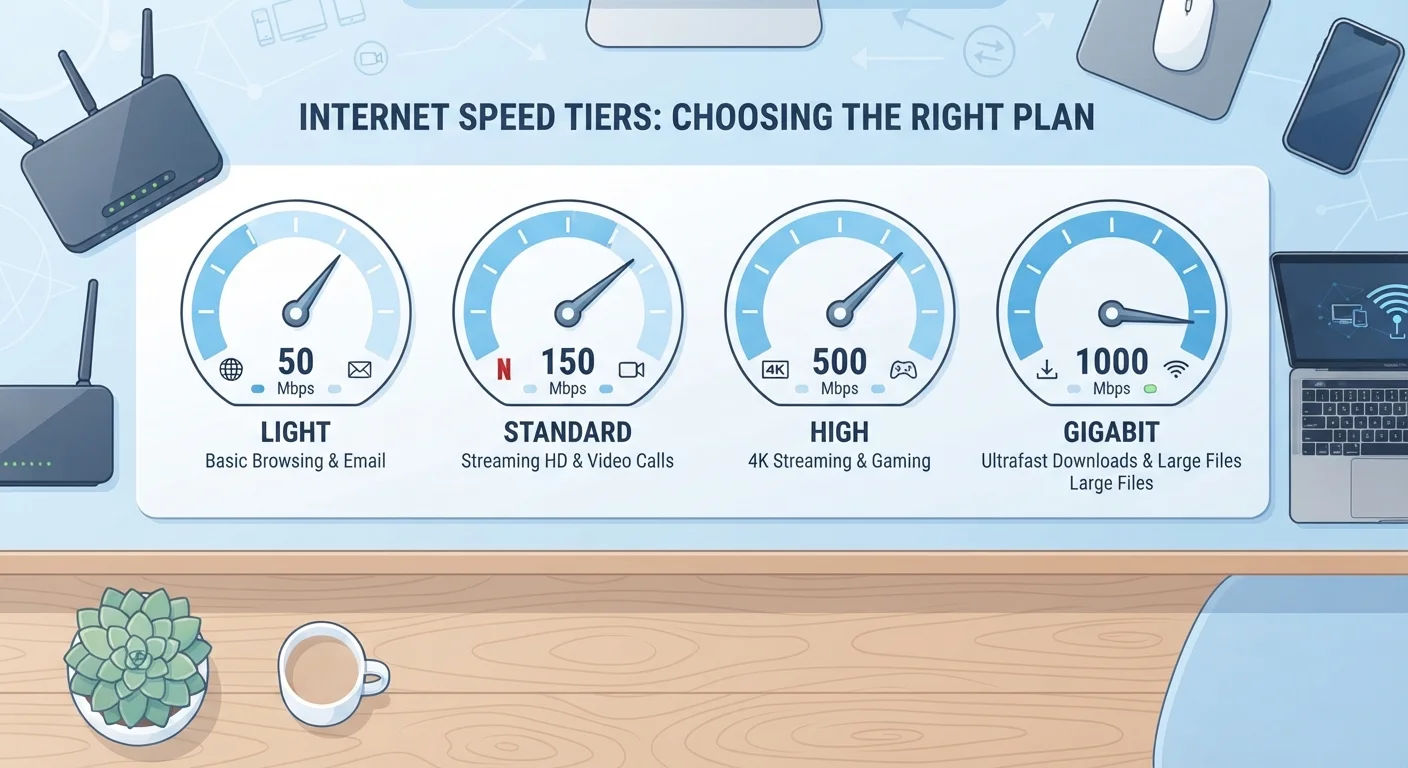
Photo credit: ArticlesHaven.net
In this article
ISPs package speeds into tiers with names like "Basic" or "Gig." Here's what those tiers actually deliver in everyday situations.
Key Takeaways
- Light plans (25-100 Mbps) suit solo users who browse and stream occasionally on one or two devices.
- Standard plans (100-300 Mbps) handle most households of two to four people without major bottlenecks.
- High-speed plans (300-900 Mbps) are worth considering when multiple people video call or stream simultaneously.
- Gigabit plans (roughly 1,000 Mbps) offer headroom but require compatible hardware to deliver real-world benefit.
- Upload speed, latency, and data caps matter just as much as the advertised download figure.
Why Speed Tiers Exist and What They're Really Selling
ISPs segment their offerings into tiers partly for legitimate technical reasons and partly for pricing strategy. Each tier corresponds to a maximum download speed - and sometimes a paired upload speed - that your connection is configured not to exceed. Understanding that ceiling is the starting point for any honest comparison.
The names vary by provider: "Basic," "Essential," "Value," "Ultra," and "Gig" are all marketing labels. What matters is the actual Mbps (megabits per second) figure attached to each plan. For a deeper primer on what those numbers mean in practice, see our explainer on Mbps and real-world speeds.
One important nuance: advertised speeds are typically "up to" figures, not guaranteed minimums. Network congestion, in-home wiring quality, and router age all affect what you actually experience. The "up to" language guide explains how this qualification is regulated and what it means for your day-to-day connection.
| Light (25-100 Mbps) | Standard (100-300 Mbps) | High (300-900 Mbps) | Gigabit (≈1,000 Mbps) | |
|---|---|---|---|---|
| Typical household size | 1-2 people | 2-4 people | 4-6 people | 5+ or power users |
| Simultaneous 4K streams | 1 (barely) | 2-3 | 4-6 | 6+ |
| Video calls (multiple at once) | 1 at a time | 2-3 without issue | 3-5 comfortably | Essentially unlimited |
| Typical upload speed | 3-10 Mbps | 10-20 Mbps | 20-50 Mbps | 500-1,000 Mbps (fiber) |
| Online gaming suitability | Adequate if uncrowded | Good for most games | Strong, low congestion | Excellent |
| Large file / cloud backup | Slow, noticeable wait | Manageable | Fast | Very fast |
| Common technology | DSL, cable entry | Cable, fiber entry | Cable, fiber mid | Fiber, some cable |
Light Plans (25-100 Mbps): Who Actually Fits Here
The FCC has historically defined broadband at 25 Mbps download / 3 Mbps upload, though that threshold has been discussed for revision. A plan in the 25-100 Mbps range is genuinely sufficient for a single user or a couple who primarily browse the web, check email, and stream video on one screen at a time.
Where light plans start to strain: a 4K Netflix stream consumes roughly 15-25 Mbps on its own. Add a video call and a smartphone updating in the background and you're near the ceiling of a 50 Mbps plan. If your household regularly has more than two devices active simultaneously, this tier will show its limits.
Count Your Simultaneous Users, Not Just Devices
The useful measure isn't how many devices you own - it's how many are active at the same time during peak hours. A household of four where everyone streams or video calls in the evening needs to plan for that concurrent load, not the midday baseline. Tally your busiest simultaneous use case before choosing a tier.
Light plans also tend to have the most asymmetric upload speeds - sometimes as low as 3-10 Mbps - which matters if anyone in the household uploads large files, video conferences frequently, or uses cloud backup services.
Standard Plans (100-300 Mbps): The Practical Middle Ground
This range covers the majority of US households without over-engineering the solution. A family of three to four people streaming different content on different devices, attending video calls, and running smart-home gadgets can generally coexist comfortably on a 200 Mbps plan.
7.2
Average connected devices per US household
According to Parks Associates research, the average US broadband household has more than seven connected devices, increasing realistic bandwidth demand.
~25 Mbps
Bandwidth for one 4K stream
Streaming services generally recommend 15-25 Mbps per 4K stream, meaning a single TV can consume half a light-tier plan's capacity.
Standard plans also tend to offer better upload allocations than light tiers - commonly 10-20 Mbps on cable, though fiber providers in this range often deliver symmetrical or near-symmetrical upload speeds, which makes a meaningful difference for remote workers. Check the FCC broadband label on any plan you're considering - it now requires ISPs to disclose both download and upload speeds, data caps, and typical latency figures in a standardized format.
High-Speed Plans (300-900 Mbps) and Gigabit: When More Actually Helps
Plans in the 300-900 Mbps range are marketed aggressively, and they do provide genuine headroom for households with five or more devices, frequent 4K streaming on multiple screens, or a home office running large uploads. The practical benefit becomes clear during peak evening hours when a standard plan might feel sluggish.
Gigabit plans - typically marketed as "Gig" or "1 Gbps" - represent the upper tier currently available to most consumers. The honest caveat: most household activities don't come close to saturating even a 300 Mbps connection. The gigabit internet deep-dive covers the hardware requirements in detail, including router capabilities and ethernet vs. Wi-Fi considerations that determine whether you'll actually use that bandwidth.
Your Router May Be the Real Bottleneck
Upgrading to a gigabit or high-speed plan doesn't automatically deliver those speeds if your router is more than four or five years old or positioned poorly in your home. Many older routers cap out at 100 Mbps on Wi-Fi or have a single-band radio that can't distribute high bandwidth effectively. Verify your hardware supports the plan tier you're paying for before assuming the ISP is underdelivering.
Speed alone doesn't tell the whole story at any tier. Latency, jitter, and packet loss can make a 500 Mbps connection feel worse than a stable 100 Mbps line for gaming and video calls. Those metrics are covered in depth in our latency and packet loss explainer. Also consider whether a bundle locks you into a speed tier that doesn't fit - see our guide to speed tiers within bundles for practical advice there.

Author
Articles Haven Editorial Contributor
Articles Haven Editorial Team is the collective byline for our editorial team and contributor network. Articles published under this byline or an editorial pen name are researched, written, and reviewed according to our editorial standards for clarity, consistency, and independence before publication.
View all articles →