
Air Fryer vs. Convection Oven: Which Cooking Method Fits Your Kitchen?
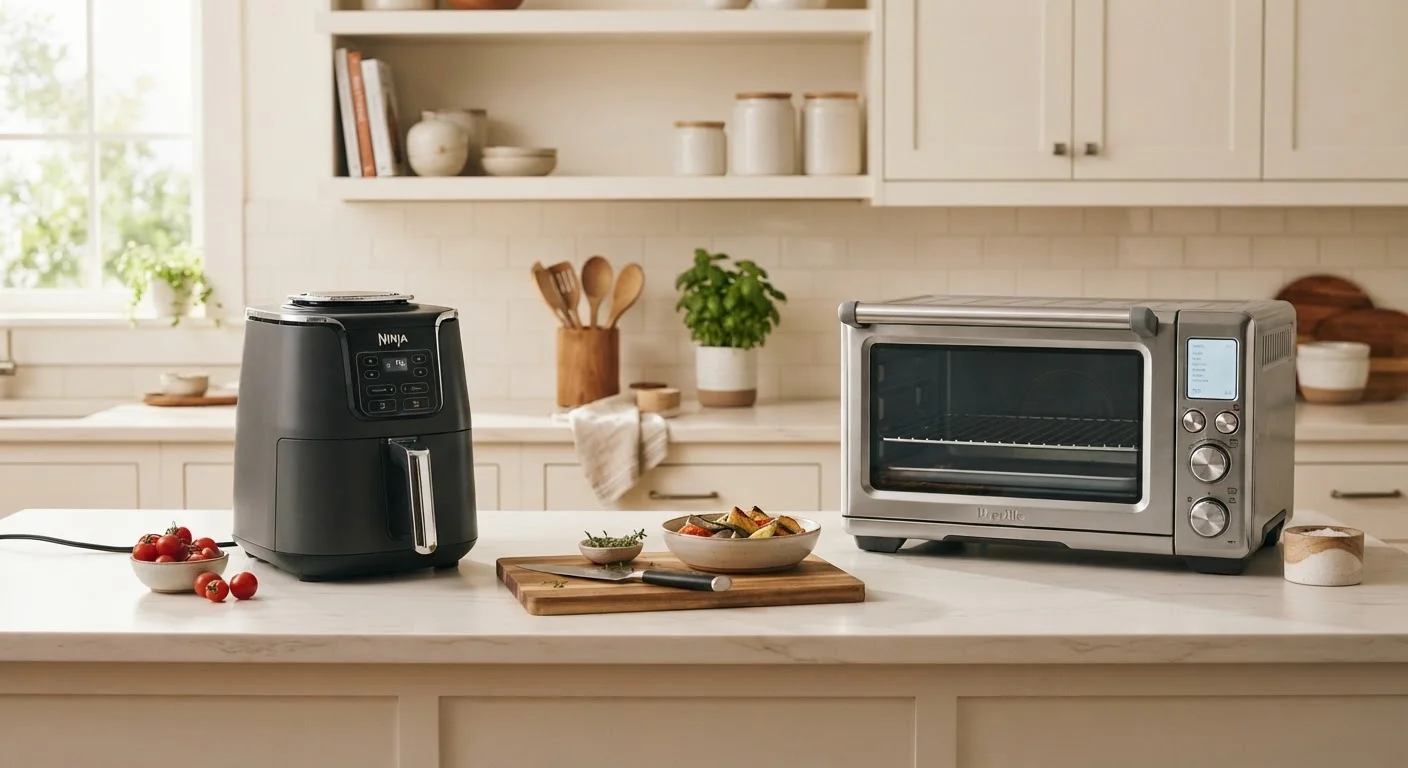
Photo credit: ArticlesHaven.net
In this article
Air fryers and convection ovens share more than you'd think—but they aren't interchangeable. Here's how they differ in practice.
Key Takeaways
- Air fryers are essentially small convection ovens - both circulate hot air to cook food faster and crispier than conventional methods.
- Air fryers heat up in minutes and excel at small-batch cooking; convection ovens handle larger volumes and multi-dish meals.
- Convection ovens generally offer more cooking modes and greater versatility for baking and roasting.
- Air fryers use less energy per cook cycle due to their smaller size and shorter cook times.
- Your kitchen space, household size, and cooking habits should drive the decision more than any single feature.
The Core Difference: Same Principle, Different Scale
At their core, air fryers and convection ovens use the same fundamental mechanism: a fan circulates hot air around food, cooking it faster and more evenly than a standard oven while promoting surface browning and crispiness. The confusion between them is understandable - because technically, an air fryer is a compact convection oven.
The meaningful differences show up in size, speed, and how each fits into a real kitchen. A standard countertop air fryer typically holds 2-6 quarts of food, while a full-size convection oven (built-in or countertop) can accommodate a full sheet pan or even multiple racks. That gap in capacity shapes almost every practical trade-off between the two.
If you're also evaluating your broader kitchen setup, the gas vs. electric range comparison is worth reading alongside this - your range type and oven configuration affect whether a standalone air fryer adds real value.
| Criterion | Air Fryer | Convection Oven |
|---|---|---|
| Cooking mechanism | Circulating hot air (small chamber) | Circulating hot air (larger chamber) |
| Typical capacity | 2-6 quarts | 1-2+ cubic feet |
| Preheat time | 2-4 minutes | 10-15 minutes |
| Best use cases | Fries, wings, reheating, small batches | Roasting, baking, broiling, large meals |
| Footprint | Small countertop appliance | Larger countertop or built-in unit |
| Energy efficiency (per meal) | More efficient for small cooks | More efficient for large-batch cooking |
| Baking suitability | Limited - small batches only | Strong - handles most baking tasks |
| Typical price range | Lower upfront cost on average | Higher average cost for quality models |
Speed, Preheat, and Energy Use
One of the most practical advantages of an air fryer is how quickly it gets to temperature. Most models reach cooking temp in two to four minutes, versus the ten to fifteen minutes a full convection oven typically requires. For weeknight meals or reheating food, that time difference matters.
Energy use follows a similar logic. Because air fryers are smaller and cook faster, they generally consume less electricity per meal than a full-size oven - even a convection one. That doesn't mean air fryers are dramatically cheaper to run, but for small-batch tasks, the efficiency edge is real.
~50%
Faster cook time vs. conventional oven
Convection cooking - whether in an air fryer or a fan-assisted oven - can reduce cook times by roughly 25-50% compared to a conventional oven, according to general appliance industry guidance.
2-4 min
Average air fryer preheat time
Most air fryer manufacturers cite preheat times of two to four minutes, compared to ten or more minutes for a standard full-size oven.
~1,500W
Typical air fryer wattage
Most household air fryers draw between 1,200 and 1,800 watts; full-size electric ovens typically draw 2,000-5,000 watts depending on mode and size.
Convection ovens close the gap when you're cooking larger quantities. If you're roasting a full chicken or baking multiple trays of cookies, running a convection oven once is more efficient than running an air fryer in two or three separate batches.
What Each Does Best - and Where Each Falls Short
Air fryers genuinely excel at a narrow but frequently used set of tasks: frozen foods, chicken pieces, vegetables, reheating fried foods, and anything where you want a dry, crispy exterior fast. The concentrated heat and tight cooking chamber make browning aggressive and consistent.
Where air fryers struggle is with larger cuts of meat, delicate baked goods, and anything requiring precise moisture control. The intense airflow that makes fries crispy can dry out more delicate items or cause uneven results if the basket is overcrowded.
Convection ovens handle a wider range of cooking tasks - roasting, baking, broiling, dehydrating - and their larger chambers give food more room to cook evenly. Bakers, in particular, tend to prefer convection ovens because fan-assisted heat helps pastries and breads brown more uniformly. For more on how cooking tools affect results, the cast iron vs. stainless steel cookware breakdown covers similar trade-offs in a different context.
Convection Mode on Your Existing Oven
Many modern electric and gas ranges already include a convection mode - a built-in fan that circulates heat more evenly. If your oven has this feature, you may already have most of what a standalone convection oven offers. Check your oven's settings before purchasing a separate countertop convection unit. See the gas vs. electric range guide for more on what current range models typically include.
Making the Decision for Your Kitchen
The right choice depends less on which appliance is objectively better and more on how you actually cook. Household size matters: air fryers are genuinely efficient for one or two people but become a bottleneck for families. Cooking habits matter too - if you bake regularly, a convection oven's capacity and control will serve you better.
Budget is a real factor. Countertop air fryers tend to cost less upfront than a quality countertop convection oven, though prices overlap at the mid-range. Neither purchase guarantees better meals - technique and ingredients still determine most of what ends up on the plate, as explored in our look at cooking at home more often.
Some cooks find the best setup is both: an air fryer for quick weeknight tasks and an existing oven for larger jobs. If counter space allows and budget permits, that combination covers most cooking scenarios without either appliance being stretched beyond its strengths.

Author
Articles Haven Editorial Contributor
Articles Haven Editorial Team is the collective byline for our editorial team and contributor network. Articles published under this byline or an editorial pen name are researched, written, and reviewed according to our editorial standards for clarity, consistency, and independence before publication.
View all articles →