
Attic Insulation: What Homeowners Should Know Before Choosing a Type
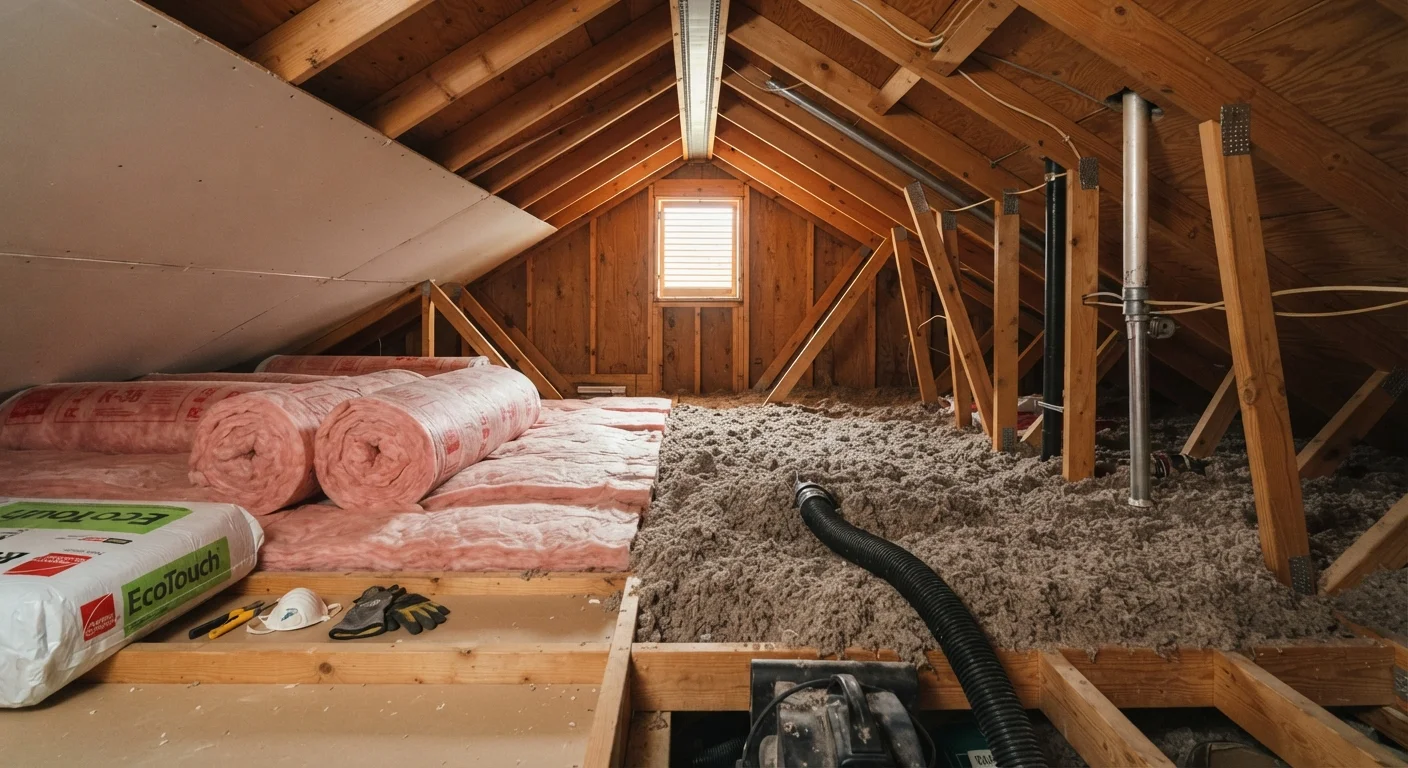
Photo credit: ArticlesHaven.net
In this article
- Why Attic Insulation Decisions Matter More Than Most Homeowners Realize
- Comparing the Three Main Attic Insulation Types
- Batt Insulation: Best for Straightforward DIY Jobs
- Blown-In Insulation: The Flexible Upgrade Option
- Spray Foam: High Performance, Professional Territory
- DIY vs. Professional Installation: Where to Draw the Line
Compare batt, blown-in, and spray foam insulation for attics—covering R-value, installation complexity, and typical use cases.
Key Takeaways
- R-value measures insulation effectiveness; most attics benefit from R-38 to R-60 depending on climate zone.
- Batt insulation is the most DIY-friendly option, while spray foam nearly always requires a professional.
- Blown-in insulation excels at covering irregular spaces and adding depth over existing insulation.
- Air sealing before insulating can be as important as the insulation type itself.
Why Attic Insulation Decisions Matter More Than Most Homeowners Realize
The attic is typically the largest source of heat loss in winter and heat gain in summer. Improving it can meaningfully reduce the workload on your heating and cooling system - though outcomes vary by home age, construction, climate, and how well the job is done. Before comparing materials, it helps to understand two fundamentals: R-value and air sealing.
R-value measures thermal resistance - the higher the number, the better the insulation resists heat flow. The U.S. Department of Energy recommends R-38 to R-60 for most attic floors, depending on your climate zone. Many older homes fall well short of that range.
Air sealing is a separate but related step. Gaps around light fixtures, plumbing penetrations, and attic hatches let conditioned air escape regardless of how much insulation sits above them. Insulation slows conductive heat transfer; it doesn't stop air movement. Addressing both is what makes an attic upgrade genuinely effective. For a broader look at how insulation fits into home energy improvements, see what energy-efficient upgrades actually do.
Comparing the Three Main Attic Insulation Types
Most residential attics use one - or a combination - of three insulation types: batt, blown-in (loose-fill), and spray foam. Each has a distinct R-value range, installation profile, and cost structure.
| Batt | Blown-In | Spray Foam (Closed-Cell) | |
|---|---|---|---|
| Typical R-value per inch | R-3.1 to R-4.3 | R-2.2 to R-3.8 | R-6 to R-7 |
| DIY friendly | Yes, for most homeowners | Yes, with rented equipment | No - professional required |
| Covers irregular spaces | Poor - gaps around obstructions | Excellent - conforms to shape | Excellent - expands into gaps |
| Air sealing ability | None on its own | Minimal | High (closed-cell) |
| Relative material cost | Low to moderate | Low to moderate | High |
| Best use case | New, open joist bays | Retrofit over existing insulation | Unvented assemblies, max performance |
Keep in mind that installed R-value can differ from rated R-value if insulation is compressed, improperly fitted, or left with gaps. Quality of installation matters as much as material choice.
Batt Insulation: Best for Straightforward DIY Jobs
Batt insulation - typically fiberglass or mineral wool - comes in pre-cut panels sized to fit standard joist spacing (usually 16 or 24 inches on center). It's the most DIY-accessible option: no special equipment required, widely available at home improvement stores, and easy to cut with a utility knife.
Where batt performs well: open, unobstructed attic floors with consistent joist spacing and no existing insulation. Where it struggles: around pipes, wiring, or irregular framing, where gaps are hard to avoid. Those gaps reduce real-world performance significantly.
Seal Before You Insulate
Air sealing should happen before adding any insulation layer. Common leak points include attic hatch perimeters, top plates of interior walls, recessed light fixtures, and plumbing and electrical penetrations. Caulk, foam sealant, and rigid foam board are common tools for this step. Skipping air sealing and relying solely on added insulation leaves a significant portion of the performance gain on the table.
Mineral wool batts cost more than fiberglass but are naturally fire-resistant and don't require a vapor retarder in many climates - worth comparing before deciding.
Blown-In Insulation: The Flexible Upgrade Option
Blown-in insulation - usually fiberglass or cellulose - is installed using a hopper machine that blows loose material into the attic space. It conforms around obstructions, fills irregular cavities, and layers easily over existing insulation, making it the practical choice for most retrofit situations.
Cellulose, made largely from recycled paper and treated with fire retardant, tends to settle over time, which is why installers typically overshoot the target depth. Fiberglass blown-in settles less. Both can be rented with a blower at many home centers for DIY projects, though professionals can work faster and more consistently.
R-38 to R-60
Recommended attic R-value range
The U.S. Department of Energy publishes climate zone-specific recommendations; many older US homes fall below R-20.
~25%
Share of home heat loss through the ceiling
The EPA estimates ceilings and attics account for roughly a quarter of typical home heating and cooling losses.
This option pairs well with attics that already have some insulation but fall short of recommended R-values. Adding four to six inches of blown-in over existing batt is a common and cost-effective approach.
Spray Foam: High Performance, Professional Territory
Spray polyurethane foam (SPF) comes in two forms: open-cell and closed-cell. Closed-cell foam has the highest R-value per inch of any common insulation (around R-6 to R-7) and also acts as an air and moisture barrier. Open-cell foam expands more, covers irregularities well, but has a lower R-value per inch and is vapor-permeable.
Spray foam is almost never a DIY project. Professional application requires protective equipment, careful temperature and humidity control, and specific training. Improper mixing can result in foam that off-gasses for extended periods - a genuine health and safety concern. The material cost is also substantially higher than batt or blown-in.
Where spray foam makes strong sense: unvented attic assemblies (where the roof deck, not the attic floor, is insulated), sealing around complex penetrations, or when air sealing and insulation need to happen in a single step. For a detailed side-by-side of spray foam against batt in different spaces, this comparison covers the trade-offs by location.
Attic Insulation Can Affect HVAC Performance
If your HVAC ducts or air handler sit in the attic, insulating only the attic floor leaves that equipment in an unconditioned space - potentially undermining efficiency gains elsewhere in the house. Discuss duct location with your contractor before finalizing which insulation approach to use. Moving ducts inside the conditioned envelope is sometimes worth considering as part of the same project.
Insulating the attic floor can affect how your HVAC ducts and equipment perform if they run through the attic space. Common HVAC misunderstandings often involve ignoring how insulation changes the thermal environment around ductwork - worth reviewing before starting.
DIY vs. Professional Installation: Where to Draw the Line
Batt installation in a clean, open attic with standard joist spacing is a reasonable DIY project for someone comfortable working in a confined, dusty environment with proper protective gear - eye protection, respirator, gloves, and long sleeves are essential with fiberglass. Blown-in is also doable as a DIY job using rental equipment, though ceiling penetrations need to be sealed first.
Spray foam, attics with complex framing, or any work involving knob-and-tube wiring should involve a professional. Electricians and code officials often require that old wiring be addressed before insulation is added on top - check local requirements before proceeding. Permits may also be needed depending on your municipality, particularly for spray foam in unvented assemblies.
Getting multiple quotes from licensed insulation contractors is advisable for anything beyond straightforward batt installation. Ask for post-job blower door test results if air sealing is part of the scope - it's the most reliable way to confirm the work reduced air leakage.

Author
Articles Haven Editorial Contributor
Articles Haven Editorial Team is the collective byline for our editorial team and contributor network. Articles published under this byline or an editorial pen name are researched, written, and reviewed according to our editorial standards for clarity, consistency, and independence before publication.
View all articles →