
Fiber, Cable, DSL, and Fixed Wireless: Matching Your Connection Type to Your Needs
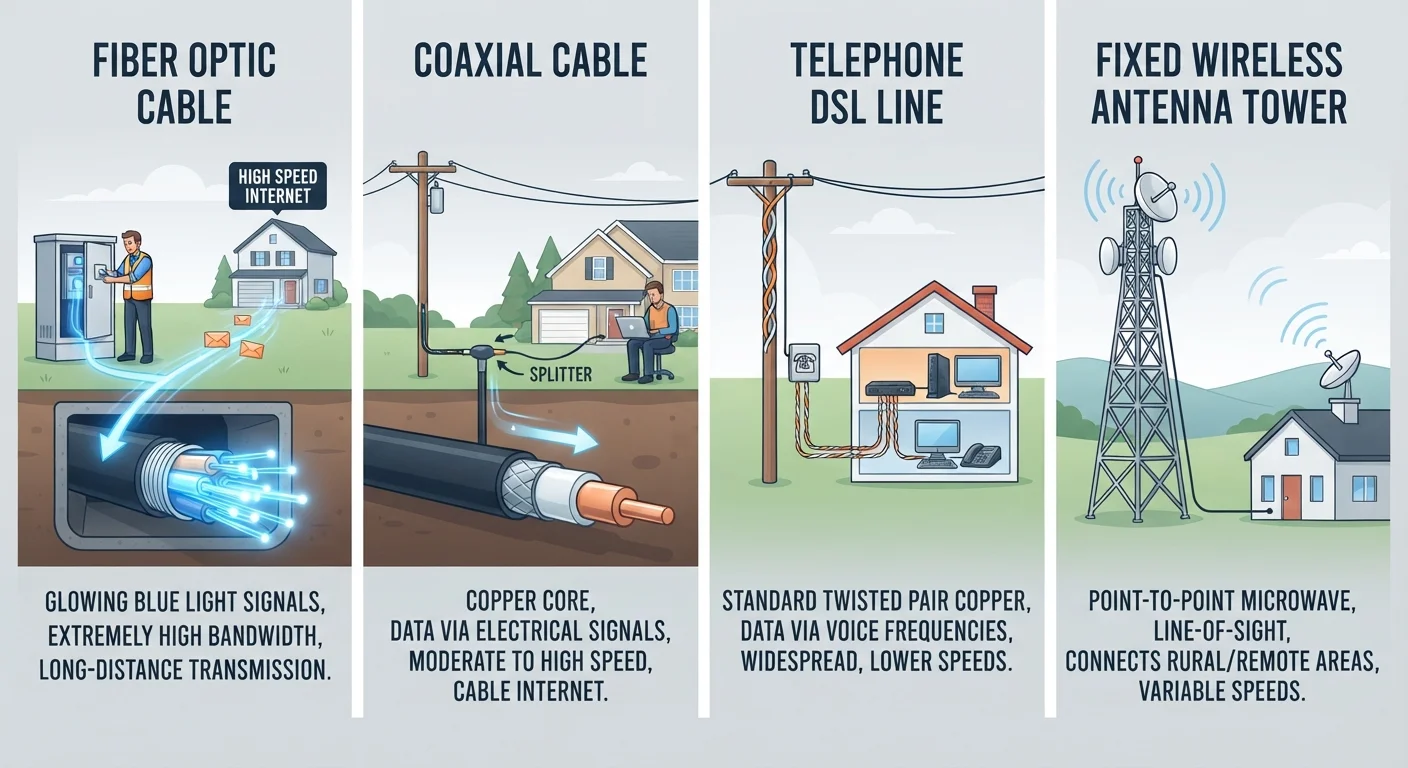
Photo credit: ArticlesHaven.net
In this article
Each home internet technology has real trade-offs in speed, reliability, and availability. Here's how to tell which fits your household.
Key Takeaways
- Fiber offers the most consistent speeds and symmetrical upload/download, but availability is still limited in many areas.
- Cable is widely available and fast for downloads, but shared infrastructure can cause slowdowns during peak hours.
- DSL uses existing phone lines and is broadly available, but speed degrades significantly with distance from the provider's hub.
- Fixed wireless delivers broadband without physical lines to the home, making it useful in rural or underserved areas.
- Your location, household size, and usage habits should drive your connection-type decision more than advertised speeds.
What Actually Separates These Four Technologies
When you shop for home internet, providers often lead with speed numbers and promotional pricing. What they don't always explain is the physical infrastructure delivering those speeds - and that infrastructure has a direct effect on consistency, upload performance, and reliability under load.
The four mainstream connection types work like this:
- Fiber transmits data as light pulses through glass or plastic strands. It's the most capable residential technology currently in widespread deployment, offering symmetrical speeds (matching upload and download rates) and very low latency.
- Cable delivers internet over the same coaxial lines originally built for TV. It's fast for downloads but typically asymmetrical - upload speeds are considerably slower than download speeds.
- DSL (Digital Subscriber Line) runs over copper telephone wiring already present in most homes. Speeds are limited compared to fiber and cable, and they drop off noticeably as distance from the provider's central office increases.
- Fixed Wireless sends a radio signal from a tower to a receiver installed at your home - no physical line required. Speed and reliability depend heavily on terrain, distance from the tower, and local interference.
For a closer look at how fiber and cable compare head-to-head, see this breakdown of fiber vs. cable differences.
| Fiber | Cable | DSL | Fixed Wireless | |
|---|---|---|---|---|
| Typical download speeds | 100 Mbps-5 Gbps | 25 Mbps-1.2 Gbps | 1-100 Mbps | 25-300 Mbps |
| Upload speeds | Symmetrical (matches download) | Much lower than download | Low, distance-dependent | Moderate, varies by tower load |
| Latency | Very low | Low to moderate | Moderate | Moderate to higher |
| Reliability | High, not shared | Good; can dip at peak hours | Consistent but speed-limited | Weather and terrain dependent |
| Availability | Urban/suburban, expanding | Broad suburban and urban | Very broad, near-universal | Rural and underserved areas |
| Best suited for | Multi-user, remote work, streaming | Most suburban households | Low-demand or rural use | Rural with no wired option |
Speed, Latency, and Upload: Where Each Type Stands
Advertised speeds reflect ideal conditions. What your household experiences depends on several factors specific to each technology.
Fiber is the only mainstream residential option that routinely delivers symmetrical speeds - meaning what you get uploading is close to what you get downloading. That matters for video calls, cloud backups, and working from home. If you're setting up a serious remote work environment, the demands of a work-from-home connection are worth reviewing before you commit to a plan.
Cable can hit download speeds competitive with fiber, but upload speeds are typically a fraction of that. Cable networks are also shared infrastructure - during peak evening hours, bandwidth gets distributed among everyone connected to the same node in your neighborhood. See what shared infrastructure means for home users for more context.
DSL speeds vary widely. A household close to a provider hub might get 25-50 Mbps down; one several miles away might see 5-10 Mbps or less. This distance-dependent degradation is the technology's core limitation.
Fixed wireless can reach speeds comparable to entry-level cable in favorable conditions, but latency is generally higher than wired connections, and heavy rain, dense foliage, or obstructions between your home and the tower can affect signal quality.
Test Before You Commit If Possible
Some fixed wireless and DSL providers offer short trial periods or month-to-month plans. Where available, these let you measure real-world speeds at your address before signing a longer contract. Running speed tests at different times of day - particularly weekday evenings - gives a more accurate picture than a single daytime test.
Availability: The Constraint That Overrides Everything
The best connection type is, practically speaking, the best one available at your specific address. Technology preference matters only when you have real options.
Fiber availability has expanded significantly in recent years, particularly in urban cores and newer suburban developments, but large portions of the country - including many rural and some suburban areas - still lack fiber infrastructure. Cable has broader residential coverage than fiber but is less common in sparsely populated areas. DSL coverage is extensive because it runs on the telephone network, which reaches nearly everywhere; its practical ceiling, however, makes it a fallback rather than a preference for most bandwidth-heavy households.
Fixed wireless has grown as a rural broadband solution where laying cable or fiber is cost-prohibitive for providers. For rural households weighing DSL against fixed wireless, see this rural-focused comparison. If your area only has satellite as an alternative, satellite vs. fixed wireless trade-offs is also worth reading.
~25%
US households without broadband access
The FCC and independent researchers have estimated that a significant share of US households lack access to fixed broadband at threshold speeds, with rural areas disproportionately affected.
42%
Rural homes lacking fiber or cable access
According to FCC coverage data analysis, a substantial portion of rural locations remain outside fiber and cable service footprints, leaving DSL and wireless as primary options.
Matching Connection Type to Household Needs
Once you've identified what's available at your address, the right plan comes down to how your household actually uses the internet.
Heavy multi-user households - families streaming in multiple rooms, with remote workers or gamers - benefit most from fiber's combination of high speeds and consistent upload performance. If gigabit plans are available in your area, who genuinely needs gigabit internet is worth reading before paying for more bandwidth than your equipment can use.
Solo renters and light users streaming video and browsing on one or two devices generally don't need fiber's top-end performance. A mid-tier cable plan or even a strong DSL connection may be entirely sufficient. The household-type internet plan comparison can help frame what speed tier actually makes sense.
Budget-constrained households should look at what lower-cost tiers are available across connection types - and whether any assistance programs apply. Federal programs have historically helped qualifying households reduce costs; low-income internet assistance options outlines what's generally available.
Finally, once you've chosen a plan, running a proper speed test will tell you whether you're actually getting what you're paying for.
Advertised Speeds Are Not Guaranteed
Providers advertise maximum or "up to" speeds, not average or minimum speeds. Cable plans in particular can deliver noticeably lower speeds during peak-use hours due to shared network infrastructure. Before signing a contract, ask the provider what speeds are typical during evening hours in your area, and check whether there are data caps that could throttle your connection after a certain usage threshold.

Author
Articles Haven Editorial Contributor
Articles Haven Editorial Team is the collective byline for our editorial team and contributor network. Articles published under this byline or an editorial pen name are researched, written, and reviewed according to our editorial standards for clarity, consistency, and independence before publication.
View all articles →