
Fiber vs. Cable Internet: Speed, Reliability, and Availability Differences Explained
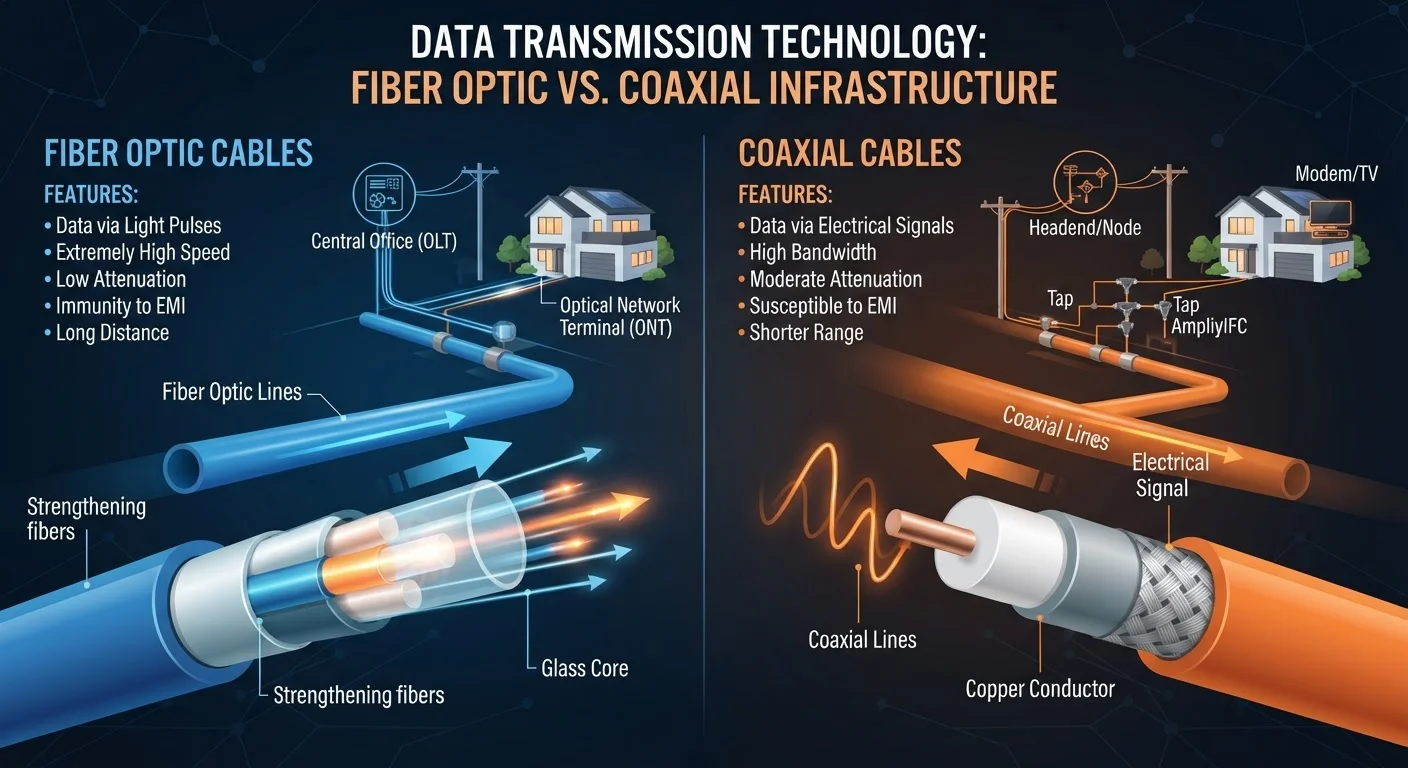
Photo credit: ArticlesHaven.net
In this article
Fiber and cable dominate most metro markets. Understand what separates them before you commit to a multi-year service contract.
Key Takeaways
- Fiber uses light signals through glass strands; cable transmits data over coaxial copper lines originally built for TV.
- Fiber typically delivers symmetrical upload and download speeds; cable upload speeds are usually much lower than download speeds.
- Cable infrastructure is available to roughly 90% of US households; fiber reaches closer to 40-45%.
- Both technologies can deliver 1 Gbps or more download speeds, but fiber maintains consistency more reliably at peak hours.
- Cable is a shared-network technology, meaning congestion during peak hours can noticeably reduce real-world speeds.
- Availability in your specific address - not general coverage maps - is the most important first filter when choosing.
How the Two Technologies Actually Work
The core difference between fiber and cable comes down to what physically carries your data. Fiber-optic internet transmits information as pulses of light through thin strands of glass or plastic. Cable internet uses coaxial copper lines - the same infrastructure originally built to deliver cable television signals.
That physical distinction has real consequences. Light signals in fiber experience very little degradation over distance and are largely immune to electrical interference. Coaxial copper lines, while effective, are more susceptible to signal noise, distance loss, and the effects of shared network congestion.
Cable networks use a technology called DOCSIS, which has evolved significantly over the years. The current standard, DOCSIS 3.1, allows cable providers to offer multi-gigabit download speeds, narrowing the raw speed gap with fiber considerably. However, the underlying shared-infrastructure model remains. For a deeper look at what shared infrastructure means in practice, see how shared vs. dedicated connections work.
| Criterion | Fiber Internet | Cable Internet |
|---|---|---|
| Transmission medium | Glass/plastic fiber optic strands | Coaxial copper cable |
| Download speeds | Up to 1-5 Gbps (varies by plan) | Up to 1-2 Gbps (varies by plan) |
| Upload speeds | Symmetrical (matches download) | Typically 20-50 Mbps on standard plans |
| Peak-hour consistency | Generally very consistent | Can slow during peak hours |
| US household availability | ~40-45% of US homes | ~88-90% of US homes |
| Infrastructure model | Point-to-point (dedicated path) | Shared neighborhood nodes |
| Interference susceptibility | Very low | Moderate (electrical, physical) |
Speed, Symmetry, and Peak-Hour Performance
Advertised speeds from both fiber and cable providers can look similar on paper - plans offering 500 Mbps or 1 Gbps are common in both categories. The meaningful difference shows up in two places: upload speed and consistency.
Most cable plans are heavily asymmetrical. A plan advertised as "500 Mbps" often delivers download speeds near that figure but upload speeds of only 20-50 Mbps. Fiber plans are typically symmetrical, meaning a 500 Mbps plan provides 500 Mbps in both directions. For households doing video conferencing, cloud backup, or content creation, that upload gap matters considerably.
Consistency is the other factor. Because cable is a shared medium, speeds can dip noticeably during evenings and weekends when neighborhood usage peaks. Fiber connections, being point-to-point rather than shared at the neighborhood level, tend to hold closer to their advertised speeds throughout the day.
~90%
US homes with cable broadband access
FCC broadband deployment data consistently shows cable as the most widely available fixed broadband technology in the United States.
~43%
US homes with fiber broadband access
Fiber availability has grown substantially in recent years, driven by provider expansion and federal infrastructure investment programs.
10-20x
Typical fiber-to-cable upload speed advantage
On comparable-tier plans, fiber's symmetrical architecture often delivers upload speeds many times higher than equivalent cable plans.
Availability: The Factor That May Decide for You
All the performance advantages of fiber become irrelevant if it isn't available at your address. Cable infrastructure covers roughly 88-90% of US households, according to FCC broadband data. Fiber availability varies considerably by region but has been estimated at around 40-45% of US homes - a figure that has been growing as providers expand networks, partly driven by federal infrastructure funding.
Urban and dense suburban areas are most likely to have both options. Rural and exurban households often have neither, relying instead on DSL, fixed wireless, or satellite. If you're in that situation, comparing satellite and fixed wireless is a more relevant starting point.
Coverage maps published by providers and the FCC are useful starting points, but they're not always precise at the address level. The only reliable way to confirm availability is to check directly with providers serving your specific address before making any decisions. If you're also weighing rural alternatives like DSL, DSL vs. fixed wireless for rural households covers that comparison in detail.
Coverage Maps Aren't Always Accurate
Both provider websites and the FCC's broadband maps have known gaps in accuracy, particularly at the individual address level. A neighborhood shown as "served" by fiber may have streets where installation isn't yet complete. Always verify availability directly with the provider for your specific address - not just your ZIP code or general area.
What Else to Evaluate Before You Sign Up
Speed and technology type are only part of what separates internet plans in practice. Equipment fees, installation costs, contract length, early termination penalties, and data caps all affect the real-world value of a plan. These are easy to overlook when a headline speed figure dominates the comparison. Common overlooked factors when comparing internet plans covers these in depth and is worth reading before you commit.
If you want a broader view of how fiber and cable fit alongside DSL and fixed wireless, matching your connection type to your needs provides a useful framework for evaluating all four technologies together. And if you're considering bundling your internet service with TV or phone, understanding bundle trade-offs is a practical next step.
The bottom line: fiber offers a technically superior experience where available, particularly for upload-heavy households. Cable remains a solid, widely accessible alternative - and for many households, it's still the only realistic broadband option. Let availability narrow your choices first, then evaluate plans on the specifics, not just the headline speed.

Author
Articles Haven Editorial Contributor
Articles Haven Editorial Team is the collective byline for our editorial team and contributor network. Articles published under this byline or an editorial pen name are researched, written, and reviewed according to our editorial standards for clarity, consistency, and independence before publication.
View all articles →