
State Minimum vs. Full Coverage Auto Insurance: What You're Actually Giving Up
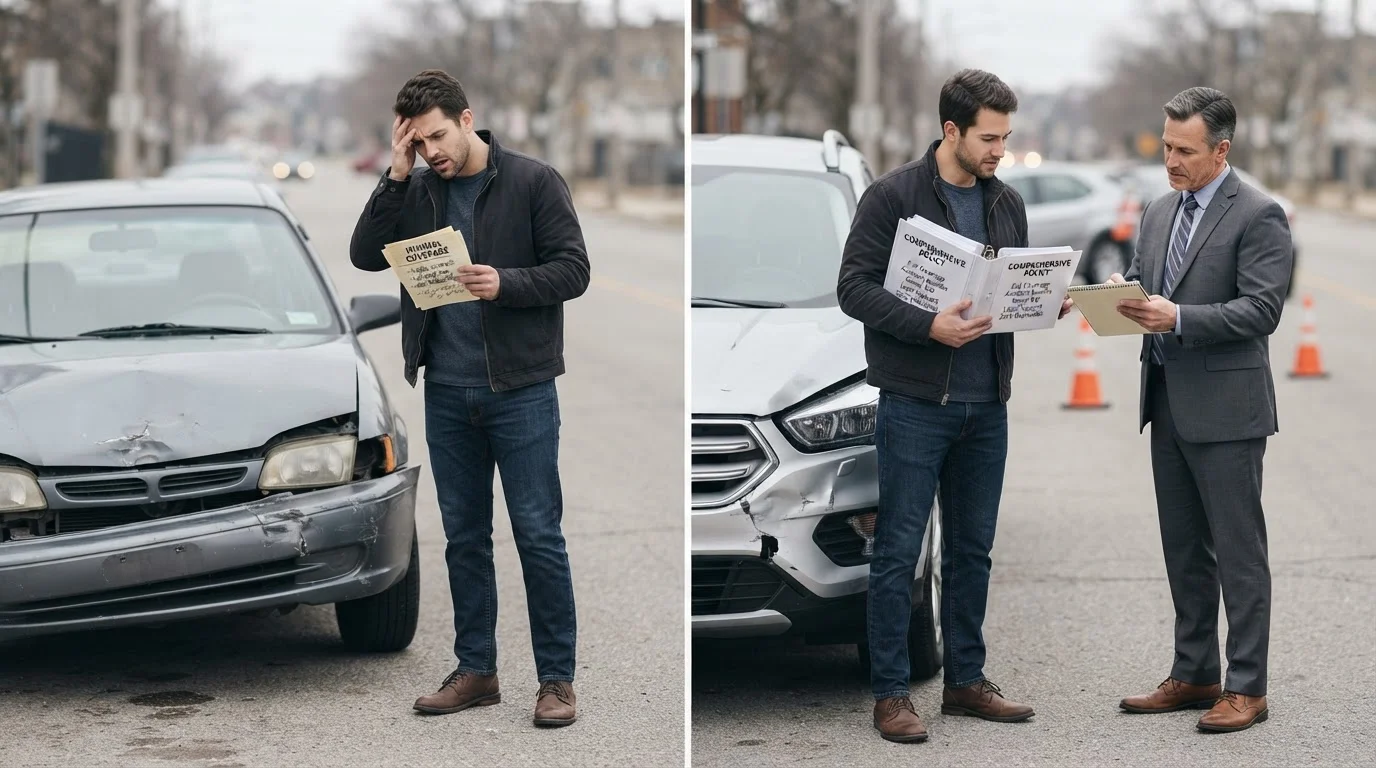
Photo credit: ArticlesHaven.net
In this article
State minimums keep you legal—but they may leave you financially exposed. Here's what you gain and lose by choosing minimum over fuller coverage.
Key Takeaways
- State minimum coverage keeps you legal but rarely covers your full financial exposure in a serious accident.
- Full coverage typically adds collision and comprehensive protection - meaning your own vehicle repairs are included.
- Minimum liability limits vary by state and are often far below the actual costs of a moderate accident.
- Whether full coverage makes sense depends on your vehicle's value, your savings, and your risk tolerance.
- Being insured and being adequately insured are not the same thing.
What State Minimum Coverage Actually Includes
Every state requires drivers to carry some form of auto insurance, but what "minimum" means varies widely. In most states, the legal floor is liability-only coverage - which pays for injuries and property damage you cause to others in an accident where you're at fault. It does not pay for your own vehicle or your own medical expenses.
Liability coverage is typically expressed as three numbers, such as 25/50/25. That means $25,000 per injured person, $50,000 per accident, and $25,000 in property damage. Some states set their minimums as low as $10,000 per person - a figure that can be exhausted quickly in a hospital emergency room. A handful of states also require personal injury protection (PIP) or uninsured motorist coverage as part of their minimum, but most do not. See our guide to no-fault vs. at-fault states for how your state's rules shape claim handling.
| State Minimum Coverage | Full Coverage | |
|---|---|---|
| Pays for others' injuries (at-fault) | Yes, up to state limits | Yes, typically with higher limits |
| Pays for others' property damage | Yes, up to state limits | Yes, typically with higher limits |
| Pays to repair your own vehicle | No | Yes (collision coverage) |
| Covers theft, weather, fire damage | No | Yes (comprehensive coverage) |
| Required by lenders/lessors | No | Yes, typically required |
| Monthly premium cost | Lower | Higher |
| Out-of-pocket risk after at-fault crash | High | Lower, subject to deductible |
| UM/UIM protection | Rarely included | Often available as add-on |
What Full Coverage Adds to the Picture
"Full coverage" isn't a single policy type - it's shorthand for combining liability insurance with collision coverage (repairs to your car after an at-fault crash) and comprehensive coverage (damage from theft, weather, fire, or animal strikes). Lenders typically require both collision and comprehensive if you're financing or leasing a vehicle.
Beyond those core additions, many drivers also layer in higher liability limits, uninsured/underinsured motorist (UM/UIM) coverage, and roadside assistance. The value of UM/UIM coverage is easy to overlook until you're hit by a driver who carries the state minimum - or nothing at all.
Revisit Your Coverage When Your Car's Value Changes
As a vehicle ages and depreciates, the math on collision and comprehensive coverage shifts. If your car's market value drops significantly below your annual premium for those coverages plus your deductible, dropping to liability-only may be worth considering. Run the numbers annually or after major life changes - and check your vehicle's current value through sources like Kelley Blue Book or NADA Guides before making changes.
The Real-World Cost Gap Between the Two
The financial difference between minimum and full coverage shows up most clearly after a serious accident. Consider a scenario where you rear-end another vehicle at highway speed: the other driver's injuries total $60,000 in medical bills, and your car sustains $12,000 in damage. If you carry only a 25/50/25 minimum policy, your insurer pays up to $25,000 toward the other driver's bills - leaving you personally responsible for the remaining $35,000. Your own car repairs? Entirely out of pocket.
That exposure is the core trade-off. Minimum coverage keeps premium costs lower month to month, but it transfers significant financial risk back to you. As noted in our analysis of what state minimums don't cover, the gap between legal and adequate coverage can be substantial. The difference between being insured and adequately insured is a distinction worth understanding before an accident forces the question.
~13%
Estimated uninsured drivers on US roads
According to the Insurance Research Council, roughly 1 in 8 drivers nationally lacks any auto insurance coverage.
$24,000+
Average cost of injury claims per accident
Industry data consistently shows that bodily injury liability claims frequently exceed typical state minimum coverage limits.
~30%
Premium difference, minimum vs. full coverage
The premium gap varies widely by driver profile, vehicle, and location - individual quotes can differ significantly from averages.
How to Decide Which Coverage Tier Makes Sense
The right coverage level depends on a few practical factors:
- Your vehicle's value: If your car is worth less than $4,000-$5,000, paying for collision and comprehensive may not pencil out - the premium cost could approach the maximum claim payout after your deductible.
- Your savings cushion: Minimum coverage is a calculated risk. If you couldn't absorb a $10,000-$15,000 out-of-pocket expense without financial hardship, that risk may not be worth taking.
- Your liability exposure: If you have significant assets, low liability limits leave those assets exposed to a lawsuit following a serious at-fault accident. Higher limits cost less than most people expect.
- Your state's minimum: Some states have low enough minimums that even a minor accident can exhaust your coverage.
For a side-by-side look at how these two coverage tiers compare on other dimensions, our liability-only vs. full coverage breakdown covers the decision in more detail. And if you're worried about misjudging your needs, common ways drivers underestimate coverage needs is worth a read before you finalize your policy.
Minimum Coverage Can Expose Your Personal Assets
If you cause an accident where costs exceed your policy limits, the injured party can potentially pursue you personally for the remainder. This means wages, savings, or other assets could be at risk depending on your state's laws. Drivers with significant personal assets should consider this when evaluating whether state minimum limits are sufficient.
This article is for general informational purposes only and does not constitute insurance or financial advice. Coverage terms, limits, and requirements vary by state and provider. Consult a licensed insurance agent or adviser to evaluate your specific situation.

Author
Articles Haven Editorial Contributor
Articles Haven Editorial Team is the collective byline for our editorial team and contributor network. Articles published under this byline or an editorial pen name are researched, written, and reviewed according to our editorial standards for clarity, consistency, and independence before publication.
View all articles →