
No-Fault vs. At-Fault Auto Insurance States: What the Rules Mean for You
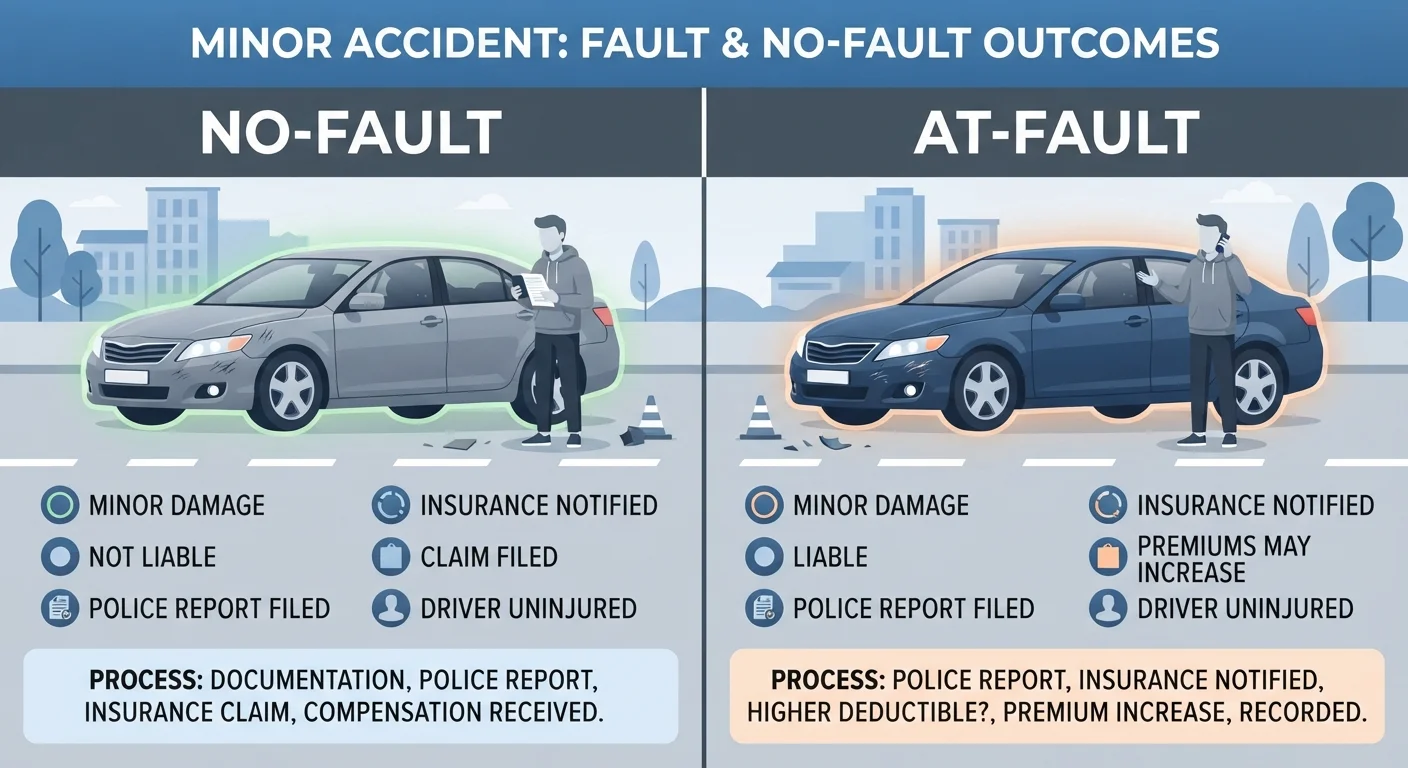
Photo credit: ArticlesHaven.net
In this article
Where you live determines how auto accident claims are handled. Learn the difference between no-fault and at-fault insurance systems.
Key Takeaways
- Your state's fault system determines who pays for injuries after a crash - your insurer or the at-fault driver's.
- No-fault states require Personal Injury Protection (PIP) coverage; most at-fault states do not mandate it.
- In no-fault states, your ability to sue the other driver for damages is typically restricted unless injuries meet a certain threshold.
- At-fault states allow injured parties to pursue the at-fault driver's liability insurance directly.
- A handful of states offer a choice between the two systems - these are called choice no-fault states.
- Understanding your state's system helps you decide whether you need more coverage than the legal minimum.
The Core Difference: Who Pays for Your Injuries
After a car accident, two questions arise almost immediately: who pays, and how fast? The answer depends on whether you're in an at-fault (also called tort) state or a no-fault state.
In the majority of U.S. states - at-fault states - the driver who caused the accident bears financial responsibility. The injured party files a claim against the at-fault driver's liability insurance. If that coverage is inadequate, the injured party may have the legal right to sue the at-fault driver directly.
In no-fault states, the system works differently. Each driver turns to their own insurance policy - specifically their Personal Injury Protection (PIP) coverage - to pay for medical bills and, in some cases, lost wages. It doesn't matter who caused the crash. The trade-off is that your right to sue the other driver is typically restricted unless your injuries are serious enough to meet your state's defined threshold.
For a fuller picture of what PIP and other coverage types actually do, see a breakdown of auto insurance coverage types.
Property Damage Is Usually Treated Differently
No-fault rules primarily govern bodily injury claims - who pays for your medical treatment. Property damage to your vehicle is typically still handled on an at-fault basis even in no-fault states. If another driver damaged your car, you'd generally pursue their liability coverage or use your own collision coverage. See how collision coverage works for more on that distinction.
How At-Fault States Work in Practice
In an at-fault state, establishing who caused the accident matters enormously. Insurance adjusters, police reports, and sometimes courts determine the percentage of fault - a concept known as comparative negligence in most states (or contributory negligence in a few).
If you are found partially at fault, your compensation may be reduced proportionally. For instance, if you're deemed 20% responsible for a crash and your damages total $10,000, you may only recover $8,000 from the other driver's insurer in a comparative negligence state.
The practical upside of at-fault systems for injured parties: if the other driver was clearly responsible, you can pursue their liability insurance directly for both medical expenses and property damage. The downside: claims can take longer to resolve while fault is being investigated, and you may need to front your own medical costs in the meantime.
Check Your State's Fault Rules Before Buying Coverage
Your state's department of insurance website is the most reliable place to confirm whether you live in a no-fault or at-fault state and what coverage is legally required. Coverage minimums, PIP thresholds, and lawsuit restrictions all vary - what's sufficient in one state may leave you exposed in another. When in doubt, a licensed insurance agent can walk you through your state-specific options.
How No-Fault States Work in Practice
No-fault systems are designed to speed up medical claim payments. Because you're filing with your own insurer, there's less dispute over who caused the crash before your bills get paid. This can be especially helpful when injuries require immediate treatment.
However, no-fault insurance comes with important limitations. Most no-fault states cap PIP benefits - meaning there's a ceiling on how much your policy will pay for medical costs and lost wages. If your actual costs exceed that limit, you may be left covering the gap unless you have additional health insurance or umbrella coverage.
Your right to sue the other driver is also restricted in no-fault states. Only injuries that cross a statutory "serious injury threshold" - such as permanent disability, significant disfigurement, or fractures - typically unlock the right to pursue a lawsuit against the at-fault driver.
~12
U.S. states with no-fault auto insurance systems
The Insurance Information Institute identifies roughly a dozen states that use no-fault or choice no-fault frameworks, with the remainder operating under traditional at-fault rules.
1 in 7
Drivers estimated to be uninsured on U.S. roads
According to Insurance Research Council estimates, approximately one in seven drivers lacks auto insurance - underscoring why UM/UIM coverage matters in at-fault states.
Up to $250,000
Michigan's unlimited PIP benefit cap (pre-2020 reform default)
Before Michigan's 2020 no-fault reform, unlimited lifetime medical benefits were standard; the reform introduced tiered PIP limits that drivers now choose among.
Michigan has historically operated the most expansive no-fault system in the country, though the state has undergone significant legislative reform in recent years that altered PIP benefit levels. This is a useful reminder that no-fault rules are not static - they can and do change at the state level.
Coverage Decisions That Depend on Your State's System
Understanding fault systems should directly inform your coverage choices. In a no-fault state, PIP isn't optional - it's legally required - and the amount of PIP you carry matters. Opting for the state minimum PIP limit may leave you underinsured if you're seriously hurt in a crash.
In at-fault states, uninsured/underinsured motorist coverage (UM/UIM) becomes especially important. If the driver who hits you carries only the minimum liability coverage - or none at all - your ability to recover damages depends on your own policy's UM/UIM limits.
For context on what state minimums typically require and where they fall short, see what you're actually giving up with state minimum coverage. And if you're weighing broader coverage tiers, liability-only vs. full coverage is worth reviewing alongside this topic.
This article is for general informational purposes only and does not constitute insurance, legal, or financial advice. Coverage rules, requirements, and thresholds vary by state and insurer. Consult a licensed insurance agent or your state's department of insurance for guidance specific to your situation.
Frequently Asked Questions

Author
Articles Haven Editorial Contributor
Articles Haven Editorial Team is the collective byline for our editorial team and contributor network. Articles published under this byline or an editorial pen name are researched, written, and reviewed according to our editorial standards for clarity, consistency, and independence before publication.
View all articles →