
Compost, Mulch, and Fertilizer: Knowing When to Use Each
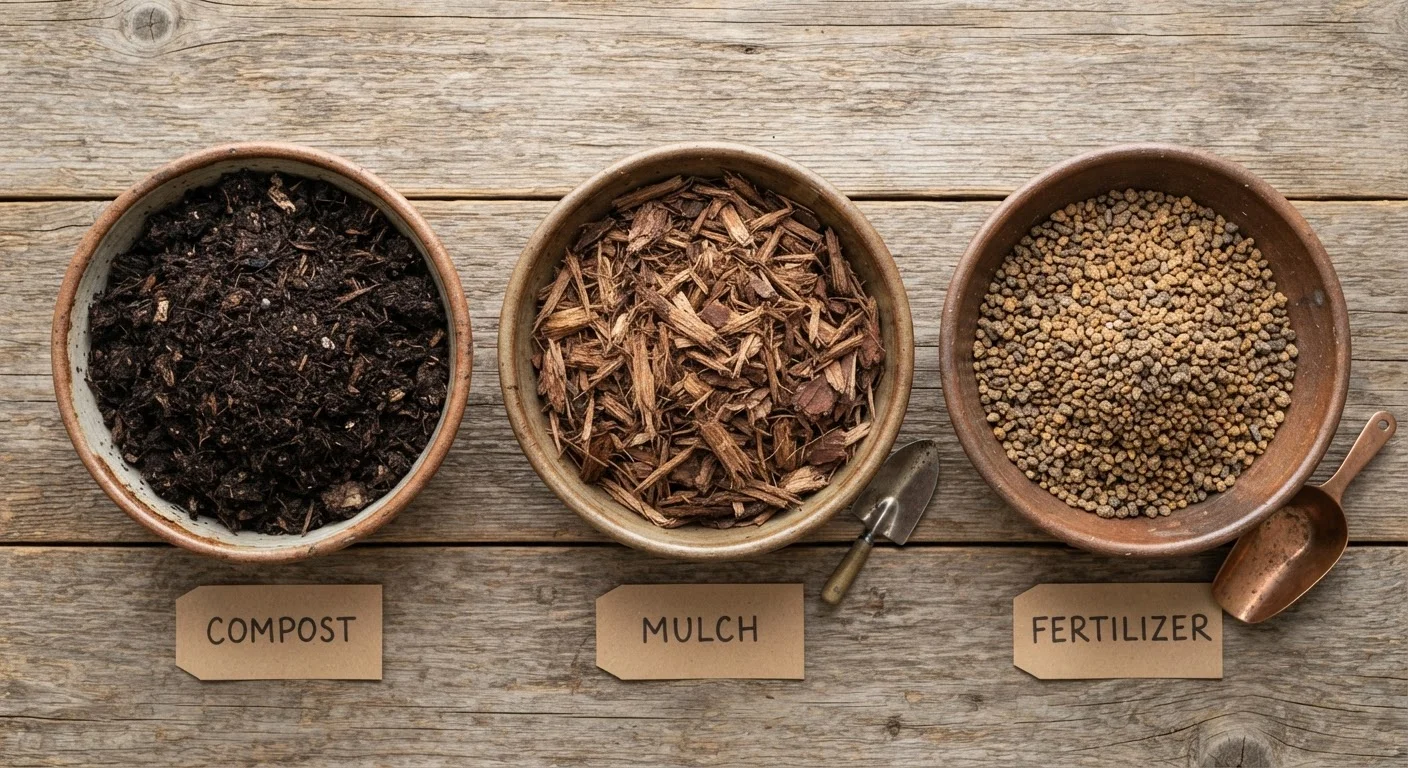
Photo credit: ArticlesHaven.net
In this article
Compost, mulch, and fertilizer all feed or protect your garden—but they work differently. Learn which one your soil actually needs.
Key Takeaways
- Compost improves soil structure and adds a broad range of nutrients slowly over time.
- Mulch sits on top of soil to retain moisture, regulate temperature, and suppress weeds.
- Fertilizer delivers specific nutrients quickly but doesn't improve soil health on its own.
- Using the wrong amendment at the wrong time can waste money or even harm plants.
- Many gardeners benefit most from combining all three strategically, not choosing just one.
Why These Three Get Confused
Walk into any garden center and you'll find compost, mulch, and fertilizer stacked alongside each other, often in similar-looking bags. It's easy to assume they do roughly the same job. They don't.
Each one addresses a different layer of your garden's needs. Compost works inside the soil, improving its structure and biology. Mulch works on top of the soil, protecting and stabilizing it. Fertilizer works chemically, delivering specific nutrients plants can absorb directly. Mixing up their roles leads to real problems - applying fertilizer when the soil is depleted won't fix the underlying issue, and piling compost on top like mulch wastes most of its benefit.
If you're planning a garden that performs season after season, understanding these distinctions is as fundamental as knowing your plants. See how annuals and perennials fit into long-term planning for broader context on garden design decisions.
What Each Amendment Actually Does
Compost is decomposed organic matter - kitchen scraps, yard waste, leaves - broken down by microorganisms into a dark, crumbly material. When worked into soil, it improves drainage in clay soils, boosts water retention in sandy soils, and feeds a diverse microbial ecosystem. It adds nutrients, but slowly and in modest amounts. Think of compost as a long-term investment in soil health rather than a quick fix.
Mulch is a surface layer - typically 2 to 4 inches of wood chips, straw, shredded leaves, or other materials - spread over bare soil. It slows evaporation, moderates soil temperature, blocks weed germination, and (with organic types) breaks down gradually to add minor organic matter. Mulch doesn't feed plants directly; it protects the environment plants grow in. For a deeper dive into material types and application depth, understanding mulch types and when it helps vs. hurts covers the specifics.
Fertilizer delivers concentrated nutrients - most commonly nitrogen (N), phosphorus (P), and potassium (K) - in forms plants can absorb relatively quickly. It's designed to correct deficiencies or support high-demand growth phases, not to build soil. Applying fertilizer to structurally poor soil is like giving vitamins to someone who isn't absorbing food properly - the soil has to be able to hold and transfer those nutrients for the plants to benefit. For a comparison of organic versus synthetic options, see organic vs. synthetic fertilizers explained.
| Compost | Mulch | Fertilizer | |
|---|---|---|---|
| Primary function | Improve soil structure and biology | Protect soil surface | Deliver targeted nutrients |
| Where it's applied | Worked into soil | Laid on top of soil | Applied to soil or foliage |
| Speed of effect | Slow, builds over seasons | Immediate physical protection | Relatively fast nutrient uptake |
| Improves soil long-term | Yes - core benefit | Gradually, as it breaks down | No - doesn't build soil |
| Risk of overuse | Low at typical rates | Low (watch depth) | High - can burn or pollute |
| Best timing | Spring/fall soil prep | After planting, seasonally | During active growth or deficiency |
When to Reach for Each One
Use compost when you're starting a new bed, when soil is compacted or drains poorly, or as a general amendment each spring and fall. Work it into the top several inches of soil rather than leaving it on the surface. Compost is also worth adding any time you notice that soil doesn't hold moisture well - a sign of low organic matter.
Use mulch after planting, once soil has warmed in spring. Apply it around (not directly against) plant stems and tree trunks to avoid rot. Refresh mulch layers as they break down, typically once or twice a year. In summer, mulch is your best defense against moisture loss during dry spells. In winter, it insulates roots from freeze-thaw cycles.
Use fertilizer when you have visible signs of nutrient deficiency - yellowing leaves, stunted growth, poor flowering - or when growing heavy-feeding crops like corn or tomatoes. A soil test is the most reliable way to know what's actually missing rather than guessing. Soil pH also affects whether nutrients are available to plants at all; soil pH explained is a useful companion read before you fertilize.
Get a Soil Test Before Fertilizing
A basic soil test - available through most state university extension programs for a modest fee - tells you exactly which nutrients are deficient and what your soil's pH is. This removes the guesswork from fertilizer selection and prevents you from adding nutrients you don't actually need. Testing once every two to three years is a practical habit for any active gardener.
Common Mistakes to Avoid
Several patterns trip up even experienced home gardeners:
- Over-fertilizing: More nutrients don't mean faster growth - excess nitrogen can burn roots, promote weak leafy growth at the expense of fruit, and leach into groundwater.
- Compost too thick on the surface: Applied like mulch without being incorporated, compost can dry out into a crust that repels water rather than absorbing it.
- Mulch volcanoes around trees: Piling mulch up against tree trunks invites rot and pest damage. Keep a gap of a few inches around the base.
- Skipping compost in favor of fertilizer alone: Fertilizer can't replace what compost does for soil biology and structure. Healthy soil holds and cycles nutrients far more efficiently than depleted soil ever will.
For other soil-health fundamentals that interact with amendments, lawn aeration explained covers how compaction affects nutrient uptake - relevant beyond just lawns.
Don't Rely on Fertilizer to Fix Poor Soil
Fertilizer is not a substitute for healthy soil structure. If your soil is compacted, drains poorly, or lacks organic matter, nutrients from fertilizer can wash away before plants can use them. Address the soil foundation with compost first, then use fertilizer to fine-tune nutrient levels as needed.

Author
Articles Haven Editorial Contributor
Articles Haven Editorial Team is the collective byline for our editorial team and contributor network. Articles published under this byline or an editorial pen name are researched, written, and reviewed according to our editorial standards for clarity, consistency, and independence before publication.
View all articles →