
Greenhouse vs. Grow Tent for the Home Gardener
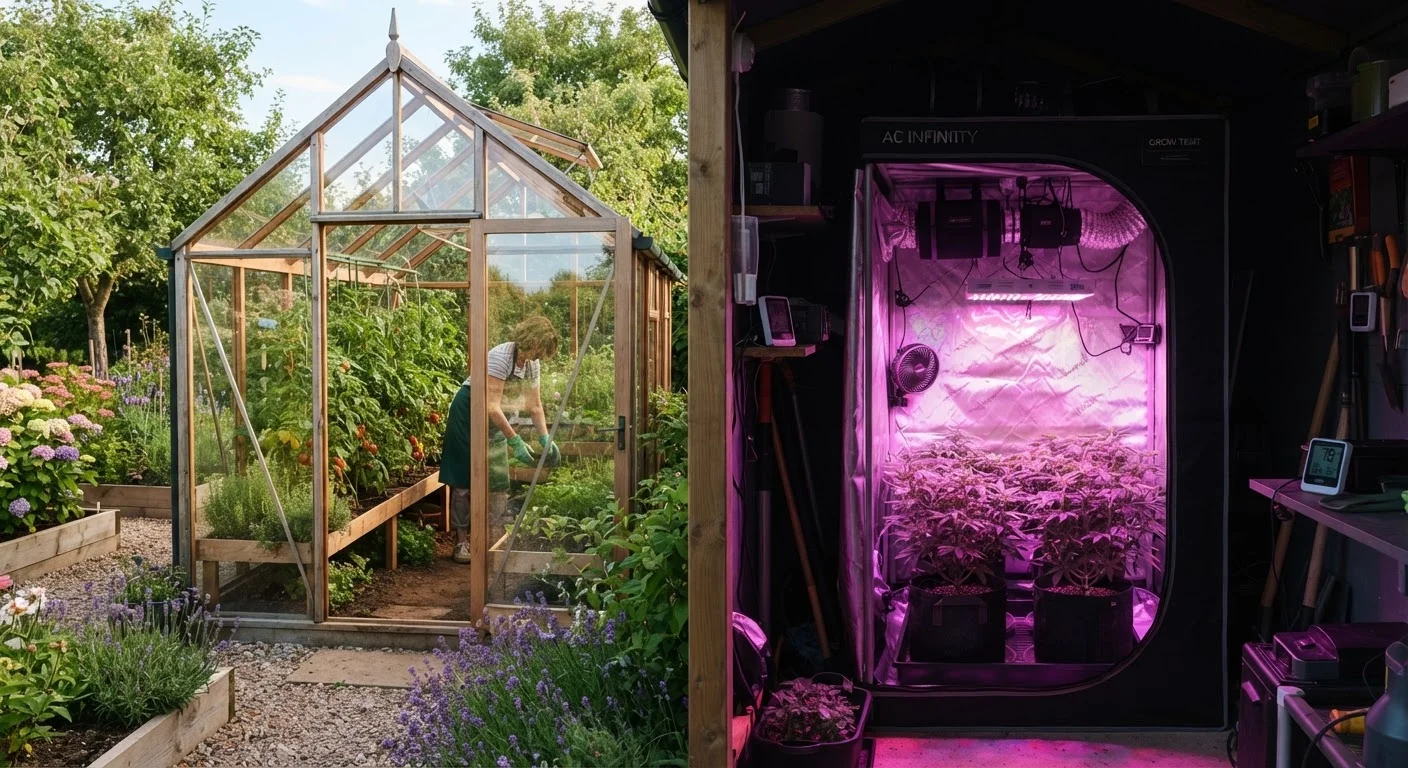
Photo credit: ArticlesHaven.net
In this article
Greenhouses and grow tents both extend what you can grow—but they differ sharply in cost, space needs, and flexibility. Compare the two honestly.
Key Takeaways
- Greenhouses rely on natural light and suit gardeners with dedicated outdoor space and a higher upfront budget.
- Grow tents work indoors with artificial lighting, making them accessible regardless of climate or yard size.
- Operating costs differ significantly: greenhouses cost more to build, while grow tents cost more to run due to electricity.
- Greenhouses scale better for vegetables and large plants; grow tents excel with herbs, seedlings, and specialty crops.
- Neither option guarantees specific yields - success depends on plant selection, management, and local conditions.
What Each Structure Actually Does
Both a greenhouse and a grow tent are designed to let you grow plants outside of their natural season or climate - but the mechanics are completely different.
A greenhouse is a permanent or semi-permanent outdoor structure with transparent walls and a roof (glass, polycarbonate, or heavy-duty polyethylene film). It captures solar radiation to warm the interior, extending the growing season passively. Most home greenhouses range from small lean-to models attached to a house to freestanding structures of 6×8 feet or larger.
A grow tent is an indoor enclosure - typically a fabric frame lined with reflective Mylar - that houses artificial grow lights, ventilation fans, and sometimes a carbon filter. Everything the plant needs (light spectrum, humidity, airflow) is managed by equipment inside the tent. Sizes range from tiny 2×2-foot units to larger 4×8-foot setups used by serious hobbyists.
If you're already thinking about outdoor setups, our comparison of raised beds vs. in-ground planting covers another foundational decision worth pairing with a greenhouse plan.
Cost, Setup, and Space Requirements
Cost is where these two options diverge most sharply.
Entry-level hobby greenhouses typically start in the few-hundred-dollar range for basic polycarbonate kits, but well-built, insulated models cost significantly more - and that's before factoring in foundation work, heating, or permitting, which some municipalities require for permanent structures. Always check local building codes before installing a greenhouse.
Grow tents have a lower upfront cost for the tent itself, but the necessary equipment - LED grow lights, inline fans, ducting, timers, and possibly a carbon filter - adds up. Electricity costs are ongoing and real; running grow lights for 16-18 hours a day will show up on your utility bill.
| Criterion | Greenhouse | Grow Tent |
|---|---|---|
| Upfront cost | Moderate to high | Low to moderate (plus equipment) |
| Ongoing electricity cost | Low (passive solar) | Moderate to high (grow lights, fans) |
| Space required | Outdoor yard space | Indoor floor space |
| Light source | Natural sunlight | Artificial LED or HID lights |
| Climate control | Partial (heating, ventilation needed) | High (fully controllable) |
| Portability | Not portable | Portable and disassembleable |
| Permit requirements | Often required (varies locally) | Generally none |
| Best crop types | Vegetables, tropicals, large plants | Herbs, seedlings, specialty crops |
Space requirements also shape the decision. A greenhouse needs a flat, sun-exposed outdoor area. A grow tent fits in a spare room, basement, or garage - but it occupies that floor space permanently while in use. Neither is truly low-footprint at full capacity.
Growing Conditions and Plant Suitability
Greenhouses rely on the sun, which means light availability varies by season and latitude. In northern states during winter, short days limit what's practical to grow without supplemental lighting. Passive solar greenhouses do well for cold-tolerant crops like greens, brassicas, and herbs in shoulder seasons, but summer heat buildup can be a real challenge - ventilation is essential.
Grow tents give you precise control over the light schedule and spectrum, which is advantageous for plants with specific photoperiod requirements. Humidity and temperature can also be dialed in more tightly, making tents well-suited to herbs, microgreens, seedling propagation, and specialty crops. The trade-off is that space-hungry plants like tomatoes or squash quickly outgrow a standard tent.
~50%
Energy used by lighting in indoor grows
Lighting typically accounts for roughly half of total energy consumption in small-scale indoor growing setups, according to general horticultural energy studies.
6-8 hrs
Minimum daily direct sun for greenhouse productivity
Most vegetable crops require at least 6 to 8 hours of direct sunlight daily, which shapes site selection for any greenhouse installation.
2×2 ft
Smallest practical grow tent footprint
Entry-level grow tents start at around 2×2 feet, accommodating a small number of herb or seedling trays with a single compact LED panel.
For gardeners interested in water-efficient methods inside either structure, understanding the difference between drip irrigation and sprinkler systems is worth the time - drip setups work especially well in enclosed growing spaces.
Flexibility, Longevity, and Practical Trade-offs
A greenhouse is a long-term investment. When built and maintained well, a quality structure lasts decades. It adds visual character to a property and, in some cases, modest resale value - though that varies widely. The downside is commitment: relocating or dismantling a greenhouse is a significant undertaking.
Grow tents are portable by comparison. Most can be broken down and moved, which matters for renters or anyone whose living situation may change. They're also easier to sanitize between grows, reducing pest and disease carryover. However, mechanical components like fans and lights have a finite lifespan and need periodic replacement.
Permits and Local Regulations Matter
Permanent greenhouses may require a building permit depending on size, placement, and local zoning rules. Some neighborhoods with HOA restrictions also have guidelines on outbuildings. Before purchasing a greenhouse kit, check with your local building department or HOA. Grow tents installed indoors generally don't face the same regulatory hurdles, but high electrical loads may warrant consulting a licensed electrician.
Neither option is a substitute for good plant knowledge. The structure won't compensate for poor soil mix choices, overwatering, or wrong light timing. If space is genuinely limited, container gardening may offer a more accessible starting point before committing to either setup.
If you're weighing cost-effective season extension and neither a greenhouse nor a tent fits your situation, cold frames and row covers are a lower-cost alternative worth exploring.

Author
Articles Haven Editorial Contributor
Articles Haven Editorial Team is the collective byline for our editorial team and contributor network. Articles published under this byline or an editorial pen name are researched, written, and reviewed according to our editorial standards for clarity, consistency, and independence before publication.
View all articles →