
Economy, Premium Economy, Business, and First Class: What the Cabin Differences Really Are
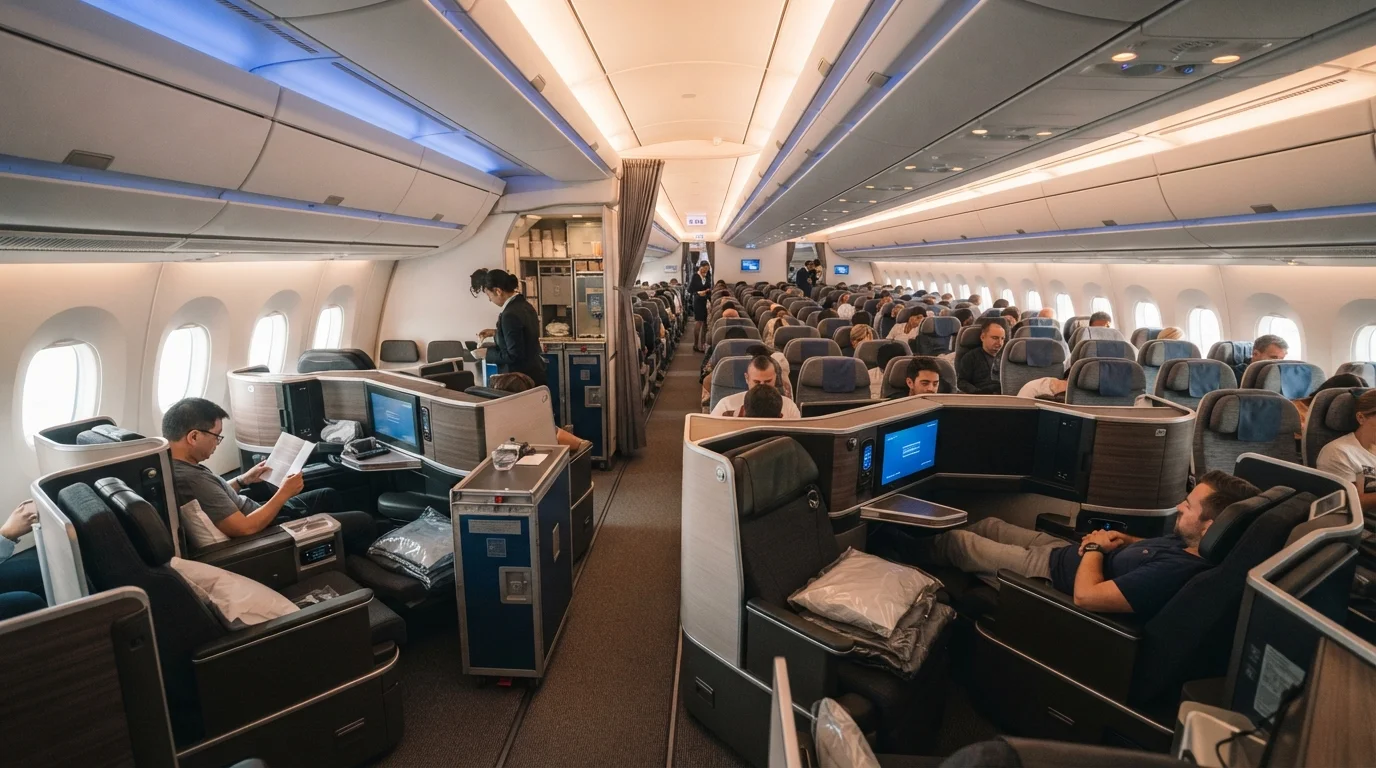
Photo credit: ArticlesHaven.net
In this article
A clear breakdown of what changes between fare cabins—from seat pitch and meals to check-in access and baggage.
The Four Cabins at a Glance
Most long-haul flights offer at least two cabins; some wide-body aircraft stack up to four. The labels - Economy, Premium Economy, Business, and First Class - are broadly standardized, but what sits behind those labels varies considerably by airline, route length, and aircraft type. Here's what each tier generally delivers.
| Economy seat pitch (typical) | 28-34 inches (Varies by carrier and aircraft type) |
| Premium Economy seat pitch (typical) | 35-38 inches (Varies by carrier and aircraft type) |
| Business Class lie-flat bed length (typical) | 76-80 inches (Long-haul routes on major international carriers) |
| Lounge access included | Business and First Class (most carriers) |
| Priority boarding | Premium Economy, Business, and First Class (Economy may have paid priority options) |
| Checked bags included (domestic US economy) | Usually 0 on legacy carriers (Fee structures vary; always verify at booking) |
One important nuance: the same airline may operate completely different cabin products on different aircraft. A domestic "First Class" recliner is not the same product as an international First Class suite. Always check the specific aircraft and seat map before booking.
Economy Class: The Baseline
Economy is the default cabin on virtually every commercial flight. Seats are arranged in a high-density configuration, and seat pitch - the distance from one seat back to the next - typically ranges from around 28 to 32 inches on domestic US routes and 31 to 34 inches on most international carriers. That pitch directly affects legroom.
Standard inclusions in economy usually cover:
- A carry-on bag and one personal item (on full-service carriers - budget carriers often charge separately)
- Basic meal service on flights exceeding roughly three hours (varies by carrier)
- In-seat or overhead entertainment on most wide-body aircraft
What economy generally does not include: priority boarding, lounge access, or complimentary checked bags on US domestic carriers. Ancillary fees for seat selection, bags, and meals have become common, so the ticket price rarely reflects the true cost. For a full picture of what you're actually paying, see how airline pricing really works.
Seat pitch
The distance measured from one point on a seat to the same point on the seat in front. It's the most common proxy for legroom, though seat thickness also affects the space available to your knees.
Lie-flat seat
A seat that reclines to a fully horizontal position, allowing passengers to sleep flat. Standard on most Business Class products on long-haul international routes.
Fare class / booking class
A letter code used internally by airlines to categorize seats within the same physical cabin by price, flexibility, and earning potential. Two economy tickets on the same flight can be in different fare classes with different rules.
Ancillary fees
Charges added on top of the base ticket price for services like checked bags, seat selection, or in-flight meals. Common across economy cabins, especially on budget carriers.
Priority boarding
The ability to board an aircraft before general economy passengers, typically included with premium cabins or available as a paid add-on.
Premium Economy: The Middle Ground
Premium Economy occupies a distinct cabin on most international wide-body aircraft - it's not just a better economy seat, it's a physically separate section with its own service standards. Seat pitch typically falls in the 35-38 inch range, seats are wider (often 18-19 inches vs. 17-18 in economy), and recline is noticeably deeper.
The perks that tend to come with premium economy tickets:
- One or two checked bags included
- Enhanced meal service (usually a separate menu from economy)
- Priority boarding and sometimes dedicated check-in lines
- Larger personal screen and amenity kit
Premium Economy fares are often two to three times the price of economy on the same route. Whether that premium is worth it depends heavily on flight duration - the benefit is most tangible on flights exceeding eight hours. For trips under five hours, the upgrade math rarely favors it.
35-38"
Typical Premium Economy seat pitch
Compared to 28-34 inches in standard economy - a meaningful difference on flights over eight hours.
2-3x
Premium Economy price premium over economy
On most international routes, premium economy fares are roughly two to three times the base economy fare for the same route.
~80%
Major carriers offering lie-flat in Business
The majority of legacy carriers operating long-haul wide-body aircraft now include lie-flat seats in their Business Class product.
Business Class: The Productivity Cabin
Business Class is the inflection point where the experience changes fundamentally. On long-haul routes, most major carriers now offer lie-flat seats - pods that convert to a flat bed, typically 76 to 80 inches long. Aisle access is often direct from every seat (in 1-2-1 or 1-1-1 configurations), meaning you don't climb over anyone.
Standard business class inclusions typically cover:
- Two or more checked bags
- Lounge access at departure airports
- Multi-course meals with broader menu options and often alcohol service
- Priority check-in, security (where available), and boarding
- Larger screens, noise-canceling headphones, and premium amenity kits
Booking through airline alliances can significantly affect what lounge access you receive and who actually operates your flight - factors worth understanding before you commit. See how alliances and codeshares affect your booking for context.
Business Class Varies More Than You'd Expect
Business Class is not a uniform standard. A carrier's long-haul transoceanic product - lie-flat pods with direct aisle access - can differ dramatically from the same carrier's regional or domestic business product, which may simply be a wider recliner seat. When comparing fares, look up the specific aircraft type and seat map for your route, not just the cabin label. Sites that publish seat maps and passenger reviews can help you evaluate whether a particular configuration fits your needs.
First Class: What's Actually Different From Business
On airlines that still operate a true First Class cabin - and fewer do every year - the differences from Business Class are primarily about space, privacy, and service personalization. First Class suites on carriers like those flying transpacific or transatlantic routes may include closing doors, a separate ottoman or companion seat, and individual mini-bars.
Meal service in First Class is typically à la carte and served on fine china, sometimes with pre-departure dining options. Dedicated ground service (private check-in areas, dedicated lounges distinct from business class) is standard on carriers that offer it.
Practically speaking: First Class is largely gone on domestic US routes. What domestic carriers call "First Class" is closer to what international airlines call Business or even Premium Economy. On transcontinental US routes, some carriers offer a business-class-equivalent product under a "First Class" branding. Read seat maps carefully.
Baggage allowances in both Business and First are generally generous - often three checked bags or higher weight limits - but the specifics vary. For a carrier-by-carrier breakdown of bag rules, compare airline baggage policies before you pack.
Seat Map Research Tools
Third-party seat map databases let you look up specific aircraft configurations by airline and flight number, showing exact seat dimensions and layout before you book.
Airline Baggage Policy Guide
A breakdown of how US carrier baggage allowances and fees are structured by cabin - useful for calculating the true cost of each fare tier. View the full baggage policy comparison
Carry-On vs. Checked Bag Strategy
Helps you decide whether to check luggage or go carry-on only based on cabin, trip length, and airline - a practical complement to understanding fare differences. Compare strategies here

Author
Articles Haven Editorial Contributor
Articles Haven Editorial Team is the collective byline for our editorial team and contributor network. Articles published under this byline or an editorial pen name are researched, written, and reviewed according to our editorial standards for clarity, consistency, and independence before publication.
View all articles →