
Window AC Units vs. Portable Air Conditioners: Cooling Power and Installation Trade-Offs
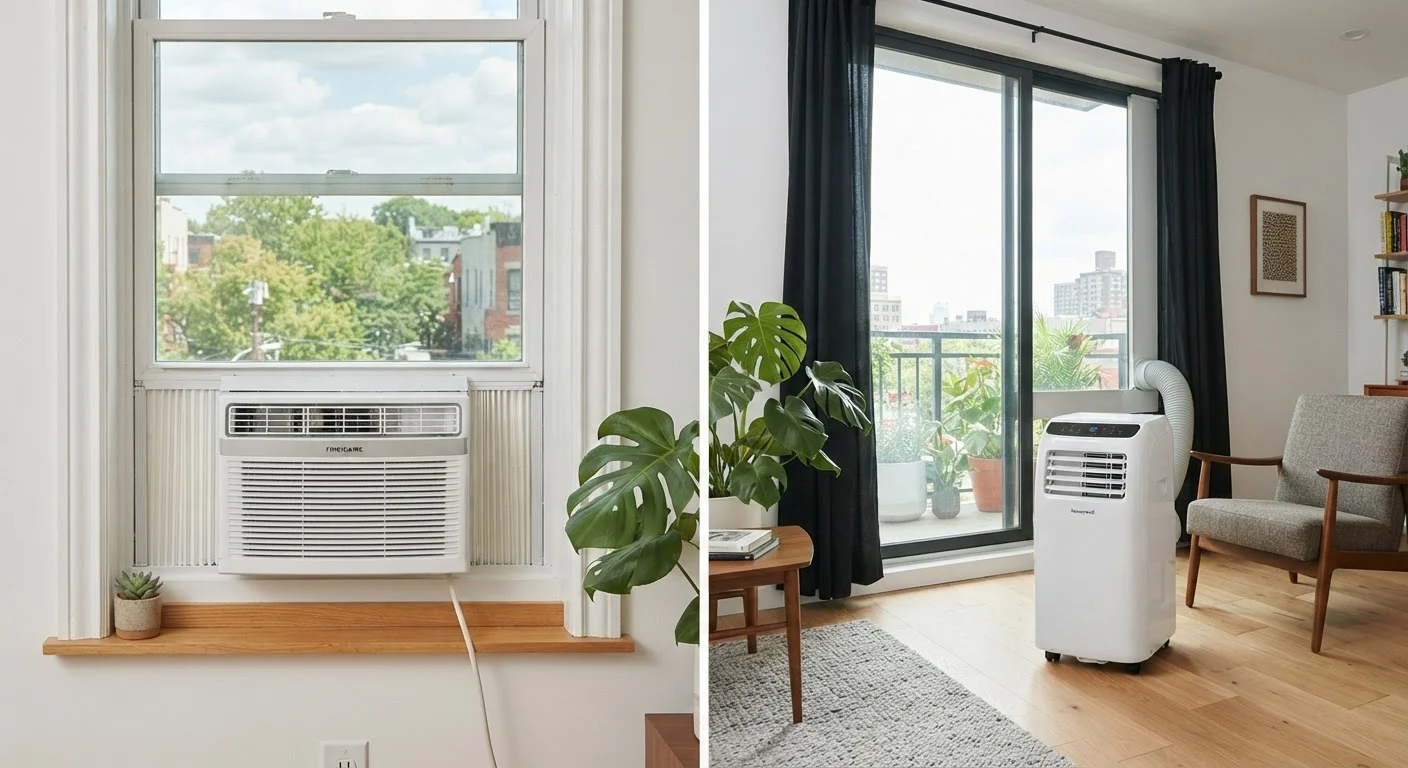
Photo credit: ArticlesHaven.net
In this article
Neither window units nor portable ACs are perfect. Compare both on cooling efficiency, noise, cost, and rental-friendly installation.
Key Takeaways
- Window AC units generally deliver stronger cooling per dollar than portable air conditioners of comparable BTU ratings.
- Portable ACs require no permanent installation but exhaust hot air through a hose, reducing their real-world efficiency.
- Window units restrict window access and may violate lease terms; portables are usually renter-friendly.
- Noise levels differ by design - window units keep compressors outside the room; portables keep them inside.
- Neither option suits spaces without a window or exterior vent access.
How Each Type Actually Works
Both window units and portable ACs use the same refrigeration cycle - a compressor circulates refrigerant to absorb heat from indoor air and dump it outside. The critical difference is where the components sit.
A window AC unit mounts in the window frame with its condenser coils and compressor hanging outside. That means heat is expelled directly outdoors, and the bulkiest, noisiest components stay out of your living space. A portable air conditioner keeps all its components inside the room and routes hot exhaust air through a flexible hose vented through a window or sliding door kit.
That distinction matters more than it might seem. Every time a portable AC's exhaust hose transfers heat, some warm air inevitably seeps back into the room - either through hose leakage or because the unit draws in conditioned air and expels it. This is why portable ACs often underperform their advertised BTU ratings under real-world conditions. Common HVAC misconceptions like over-relying on rated BTUs rather than real-world output affect both types, but the gap is wider with portables.
Cooling Performance and Efficiency
BTU (British Thermal Unit) ratings indicate how much heat a unit can remove per hour. However, the Association of Home Appliance Manufacturers (AHAM) revised its testing standards for portable ACs to reflect a more realistic "Combined Energy Efficiency Ratio" (CEER), which accounts for the self-heating effect of their indoor components. Under these standards, a portable AC with a 14,000 BTU gross rating may deliver an effective cooling output closer to 8,000-10,000 BTU.
Window units don't suffer the same penalty. Their CEER ratings more closely reflect actual performance because heat rejection happens outside the conditioned space. For equivalent room coverage, you'll typically need a higher-rated portable unit than a window unit - and it will still likely use more electricity to achieve the same result.
~25-30%
Efficiency loss in portable ACs
AHAM revised testing standards reveal portable units can lose roughly 25-30% of gross BTU output to self-heating effects under real operating conditions.
$100-$200
Typical upfront cost advantage of window units
Window AC units commonly cost less than portable units at equivalent rated cooling capacities, based on general market pricing observations.
Operating cost over a summer adds up. If a window unit and a portable unit are both running several hours a day for months, the efficiency gap translates into a measurable difference on your electricity bill, though exact figures depend on local utility rates and usage patterns.
Installation: What Each Type Actually Requires
Window units require a compatible window - typically double-hung or single-hung styles. Installation involves securing the unit, extending accordion side panels, and sealing gaps with foam or weatherstripping. It's a one-person job for smaller units but can require help for heavier models. Once in, access to that window is lost.
Portable ACs simply roll into position and vent through a hose. Most kits include a sliding panel adapter that fits standard windows or sliding doors. Setup takes minutes, and the unit can be relocated to another room. For renters worried about lease terms, that flexibility is significant. Just be aware: the venting kit still occupies part of a window opening, and without a proper seal, warm outdoor air can infiltrate around the hose.
Seal the Hose Connection Properly
A loose or unsealed exhaust hose connection is one of the biggest real-world efficiency killers for portable ACs. Use foam weatherstripping or a purpose-made hose seal kit around the window adapter panel. Even a small gap allows warm outdoor air to flow back into the room, undermining any cooling the unit achieves.
If your building has casement windows that crank outward, portable ACs are effectively the only self-contained option - window units aren't designed for that frame type, and central-system modifications are a different category entirely. This mirrors the kind of constraint-based trade-off seen in other appliance decisions, such as weighing upfront installation cost against long-term efficiency.
Noise, Size, and Practical Considerations
Noise is a meaningful differentiator. Window units place the loud compressor and condenser fan outside the room, so interior noise is mainly the quieter evaporator fan. Portable ACs run the entire system indoors, which makes them noticeably louder in the space you're trying to cool or sleep in.
Footprint is another factor. Window units occupy a window but take up zero floor space. Portable units sit on the floor - typically 14-18 inches square - and need clearance for airflow. In a small studio or bedroom, that floor space matters.
| Window AC Unit | Portable Air Conditioner | |
|---|---|---|
| Cooling Efficiency | Higher real-world output per BTU | Lower due to self-heating effect |
| Installation Complexity | Moderate - requires window mounting | Minimal - hose kit, rolls into place |
| Renter Friendliness | May violate lease; check first | Generally lease-friendly |
| Noise Level (Indoor) | Quieter - compressor stays outside | Louder - all components inside |
| Floor Space Used | None - mounts in window | Requires 2-4 sq ft of floor space |
| Window Compatibility | Best for double-hung windows | Works with most window/door types |
| Upfront Cost (typical range) | Generally lower per BTU | Generally higher per BTU |
| Portability Between Rooms | Fixed installation | Easily moved |
Both types also involve upfront cost differences. Window units for a given BTU output tend to cost less than comparable portables, and portables also require occasional manual draining of condensate (or a continuous drain setup) in humid climates, unless they have an auto-evaporation feature. For renters comparing appliance decisions, the portability trade-off has parallels in other categories - like how cordless tools trade raw power for flexibility.
Don't Rely Solely on Rated BTUs
Both window and portable AC units are marketed by BTU output, but portable units in particular often underdeliver compared to their labels under real operating conditions. Before purchasing, look for the CEER (Combined Energy Efficiency Ratio) rating on portable units, which provides a more realistic picture of what you'll actually experience. Sizing a unit too small for the room is a common and costly mistake.

Author
Articles Haven Editorial Contributor
Articles Haven Editorial Team is the collective byline for our editorial team and contributor network. Articles published under this byline or an editorial pen name are researched, written, and reviewed according to our editorial standards for clarity, consistency, and independence before publication.
View all articles →