
Tankless vs. Traditional Water Heaters: Upfront Cost vs. Long-Term Efficiency
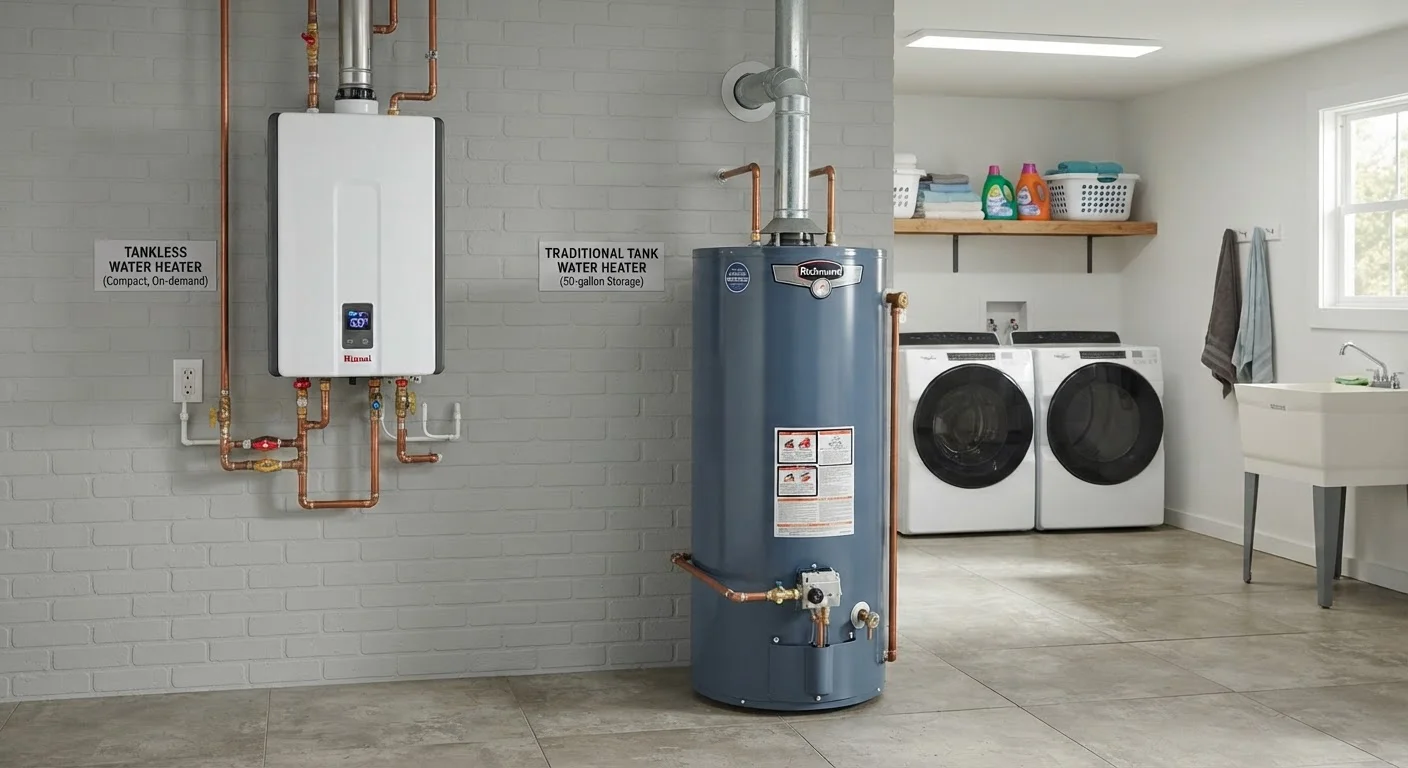
Photo credit: ArticlesHaven.net
In this article
Tankless water heaters heat on demand, but they come with trade-offs. Compare both systems on efficiency, cost, and installation needs.
Key Takeaways
- Tankless heaters cost significantly more upfront but can reduce water heating energy use by 24-34% for average households.
- Traditional tank heaters are cheaper to buy and install, but continuously expend energy keeping stored water hot.
- A tankless unit typically lasts 20+ years; a standard tank averages 8-12 years before replacement.
- Whole-home tankless installation may require upgraded gas lines or electrical panels, adding hidden costs.
- The right choice depends on your household's hot water demand, budget, and how long you plan to stay in the home.
How Each System Works
A traditional water heater stores 30-80 gallons of water in an insulated tank and keeps it heated continuously - ready whenever you turn on a tap. The trade-off is standby heat loss: energy is consumed around the clock simply to maintain temperature, even when no hot water is being used.
A tankless (or on-demand) water heater has no storage tank. Cold water passes through a heat exchanger - powered by gas or electricity - and is heated only when a tap is opened. Once the tap closes, the heater shuts off. This eliminates standby loss entirely but introduces a practical ceiling: the unit can only heat so many gallons per minute (GPM), which matters when multiple fixtures run simultaneously.
Both systems are available in gas and electric configurations, and both are mature, widely available technologies. The core question isn't which is newer - it's which fits your household's actual usage patterns and financial situation.
| Criterion | Tankless Water Heater | Traditional Tank Heater |
|---|---|---|
| Typical unit cost | $500-$1,500+ | $300-$700 |
| Installation cost | $1,000-$3,000 (may need upgrades) | $150-$450 |
| Energy efficiency | 24-34% more efficient (DOE) | Baseline; standby loss daily |
| Average lifespan | 20+ years | 8-12 years |
| Hot water supply | Continuous but flow-rate limited | Tank capacity dependent |
| Standby heat loss | None | Constant, year-round |
| Space required | Wall-mounted, compact | Requires floor space for tank |
| Maintenance complexity | Moderate (descaling, filters) | Low (annual flush, anode rod) |
Upfront Costs and Installation Realities
The price gap between these two systems is real and significant. A standard tank water heater typically runs $300-$700 for the unit, with installation adding $150-$450 depending on your local market and whether venting changes are needed. Most plumbers can swap a like-for-like replacement in a few hours.
Tankless units cost considerably more - commonly $500-$1,500+ for a whole-home gas model, and installation can reach $1,000-$3,000 when you factor in potential upgrades to gas line sizing, dedicated electrical circuits, or new venting requirements. Electric tankless heaters designed for whole-home use often demand a significant electrical panel upgrade, which is an expense many buyers don't anticipate.
Installation Costs Vary Widely by Home
Older homes may lack the gas line capacity or electrical infrastructure that a whole-home tankless unit requires. Before getting a firm quote, ask a licensed plumber or HVAC technician to assess your current setup. Permit requirements also vary by municipality - confirm local rules before any work begins.
Point-of-use tankless heaters - small units installed under a sink - are much cheaper and simpler to install, but they only serve a single fixture. They're worth considering as a supplement, not a whole-home replacement.
This upfront gap is the central trade-off the rest of this comparison revolves around. As explored in our look at long-term cost of ownership, the cheaper option isn't always the less expensive one over time.
Efficiency, Energy Use, and Operating Costs
According to the U.S. Department of Energy, tankless water heaters can be 24-34% more energy efficient than conventional storage models for homes that use 41 gallons or fewer of hot water per day. For higher-use households, the efficiency advantage narrows but doesn't disappear.
24-34%
Energy savings for average households
According to the U.S. Department of Energy, tankless heaters are this much more efficient for homes using 41 gallons or fewer per day.
20 years
Typical tankless heater lifespan
Industry estimates consistently place well-maintained tankless units at 20 or more years of service life.
8-12 years
Average tank heater lifespan
Most traditional storage tank heaters require replacement within this window, especially in hard-water regions.
The savings come entirely from eliminating standby heat loss. A tank heater cycles on and off repeatedly throughout the day to keep stored water at temperature - even at 2 a.m. when everyone is asleep. That ongoing energy draw adds up. A tankless heater draws no energy between uses.
In practical dollar terms, the monthly savings vary widely based on energy rates, household size, and usage habits. Estimates commonly range from $5-$15 per month in gas savings, though electric systems and local rate differences can shift that figure substantially. Tracking your utility bills before and after a switch - as described in this guide to utility bill monitoring - is one of the better ways to verify real-world impact.
Lifespan, Maintenance, and Long-Term Value
Lifespan is where tankless heaters make a compelling case. A well-maintained tankless unit routinely lasts 20 years or more. Traditional tank heaters average 8-12 years before corrosion or sediment buildup forces a replacement. Over a 20-year homeownership period, you may replace a tank unit twice - or more - while a tankless unit is still running.
Maintenance requirements differ too. Tank heaters benefit from annual sediment flushing and anode rod inspection - tasks a handy homeowner can often manage. Tankless units generally need annual descaling (especially in hard-water areas) and occasionally require filter cleaning. Neither system is maintenance-free, but tankless units have more components - flow sensors, heat exchangers, control boards - meaning repairs when they do occur can be more involved and costly.
If you're also evaluating other home efficiency upgrades, the same upfront-versus-long-term logic applies to systems like HVAC controls. See smart vs. programmable thermostat comparisons for a parallel example of how to weigh initial cost against efficiency payback.

Author
Articles Haven Editorial Contributor
Articles Haven Editorial Team is the collective byline for our editorial team and contributor network. Articles published under this byline or an editorial pen name are researched, written, and reviewed according to our editorial standards for clarity, consistency, and independence before publication.
View all articles →