
Portable Chargers vs. Charging Cases: Which Battery Backup Fits Your Lifestyle?
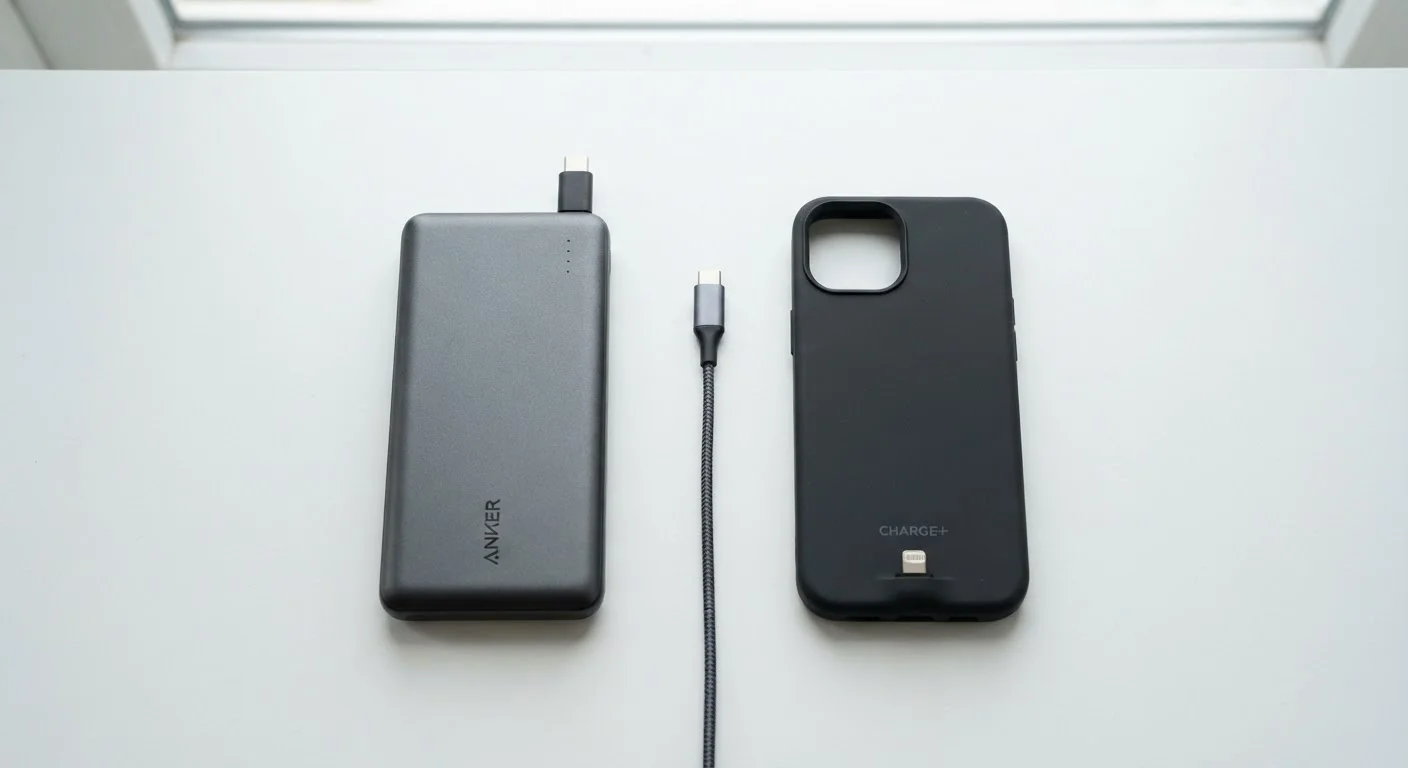
Photo credit: ArticlesHaven.net
In this article
Power banks and charging cases both extend your battery life—but they serve different needs. Here's how to tell which suits you.
Key Takeaways
- Portable chargers (power banks) offer higher capacity and can charge multiple devices simultaneously.
- Charging cases integrate battery backup directly into phone protection, eliminating a separate device to carry.
- Charging cases are phone-model-specific; power banks work with virtually any device.
- Heavy travelers and multi-device users generally get more utility from a power bank.
- Charging cases suit minimalists who dislike managing cables and extra gear.
Understanding What Each Option Actually Does
A portable charger - commonly called a power bank - is a standalone battery that stores charge and delivers it to devices via a cable or, in some models, wirelessly. Capacity is measured in milliamp hours (mAh); a 10,000 mAh bank can typically refill a modern smartphone two to three times over.
A charging case is a protective phone case with a built-in battery. It connects directly to your phone's charging port and tops up the battery passively as you use the device. Most charging cases add 1,500-4,000 mAh - enough for roughly one extra full charge - and they're built specifically for one phone model.
Both solve the same core problem: your phone dies before your day ends. But the way they solve it, and the trade-offs involved, are quite different. For a broader look at how battery technology shapes everyday tech decisions, see our guide to portability trade-offs in battery-powered devices.
Key Differences: Capacity, Compatibility, and Convenience
| Portable Charger (Power Bank) | Charging Case | |
|---|---|---|
| Typical capacity range | 5,000-26,800 mAh | 1,500-4,000 mAh |
| Device compatibility | Any device with compatible port | Single phone model only |
| Cables required | Yes, to connect to phone | No, integrates directly |
| Carry method | Separate item in bag or pocket | Worn on the phone itself |
| Longevity across upgrades | Works with future devices | May not fit new phone models |
| General price range | Lower for equivalent capacity | Higher for equivalent capacity |
| Fast charging support | Common in mid-to-upper range | Less common, varies by model |
Capacity is the starkest difference. Power banks range from pocket-sized 5,000 mAh models up to 26,800 mAh travel units - enough to charge a laptop. Charging cases are constrained by the size of the phone they wrap around, so their capacity ceiling is much lower.
Compatibility is equally important. A single power bank can charge your phone, wireless earbuds, a tablet, or even a small laptop - anything with a compatible port. Connector standards matter here; understanding how USB-C, Lightning, and Micro-USB cables differ helps you choose a power bank with the right output ports. Charging cases, by contrast, are engineered for a specific phone model and become obsolete when you upgrade devices.
Convenience cuts both ways. A charging case means no extra cables to carry, no forgetting a second device - your phone is always drawing power from its own case. A power bank requires you to plug in, but it gives you far more control over when and how much you charge.
Match Capacity to Your Actual Day
Before buying either option, track how much battery you typically use in a full day. If you drain roughly 60-70% by evening, even a modest charging case may be enough. If you regularly hit zero before noon, a higher-capacity power bank is the more practical investment. Buying more capacity than you need just adds weight and cost without benefit.
Weight, Bulk, and Everyday Carry
This is where personal preference drives the decision most clearly. Charging cases add bulk directly to the phone - a device that already lives in your hand or pocket. Some users find this acceptable; others find it uncomfortable for extended phone use. The added weight is usually 50-100 grams depending on battery size.
Power banks are separate objects to track, charge, and remember to bring. A compact 5,000 mAh bank can fit in a jacket pocket, but it's still one more item in your bag. Larger, higher-capacity banks are closer in size to a small paperback book.
If you're a light traveler who carries just a phone and a wallet, a charging case fits that lifestyle naturally. If you already carry a bag - whether for work, the gym, or travel - a power bank adds minimal friction and pays off with significantly more capability. When traveling internationally, reliable battery backup becomes even more critical; our overview of staying connected abroad covers how power needs intersect with international data strategies.
Cost Considerations and Long-Term Value
~50%
Smartphone users report daily battery anxiety
A Pew Research Center survey found roughly half of smartphone owners say they often worry about running out of battery before the day ends.
2-3x
Typical recharges from a 10,000 mAh power bank
Most modern smartphones have batteries in the 3,000-5,000 mAh range, meaning a 10,000 mAh bank offers multiple full refills per outing.
Charging cases tend to cost more than comparable-capacity power banks, partly because of the engineering required to fit a battery within a phone-specific form factor. They also depreciate faster - when you switch phones, the case may not be compatible with your new model.
Power banks, in contrast, work across phone generations and with other devices. A quality power bank bought today should still be useful three or four phone upgrades from now, provided you maintain the battery (most lithium-ion power banks hold their capacity well if not stored fully charged or completely depleted for extended periods).
For shoppers thinking carefully about long-term value, the Shopping Smarter hub has practical frameworks for evaluating cost-per-use on accessories like these.
Watch for Uncertified Batteries
Cheap, uncertified power banks and charging cases sold through some online marketplaces have been linked to overheating and, in rare cases, fire hazards. Look for products that carry recognized safety certifications (such as UL listing) and avoid units with no documented manufacturer information. This applies to both product categories equally.
Which One Should You Choose?
Choose a charging case if: you use a single phone model for years at a time, you dislike carrying extra accessories, and one additional charge per day is enough for your needs. It works best as a quiet, always-there safety net.
Choose a portable charger if: you need more than one full charge per day, you own multiple devices, you travel frequently, or you want flexibility to use the same backup battery for years regardless of which phone you own. Power banks also tend to support faster charging speeds, especially models with Power Delivery (PD) support - a worthwhile feature to look for.
There's no wrong answer here - only a mismatch between the product and your actual routine. Matching the tool to your lifestyle is the only metric that matters.

Author
Articles Haven Editorial Contributor
Articles Haven Editorial Team is the collective byline for our editorial team and contributor network. Articles published under this byline or an editorial pen name are researched, written, and reviewed according to our editorial standards for clarity, consistency, and independence before publication.
View all articles →