
Countertop Dishwashers vs. Built-In Models: Space, Cost, and Capacity Compared
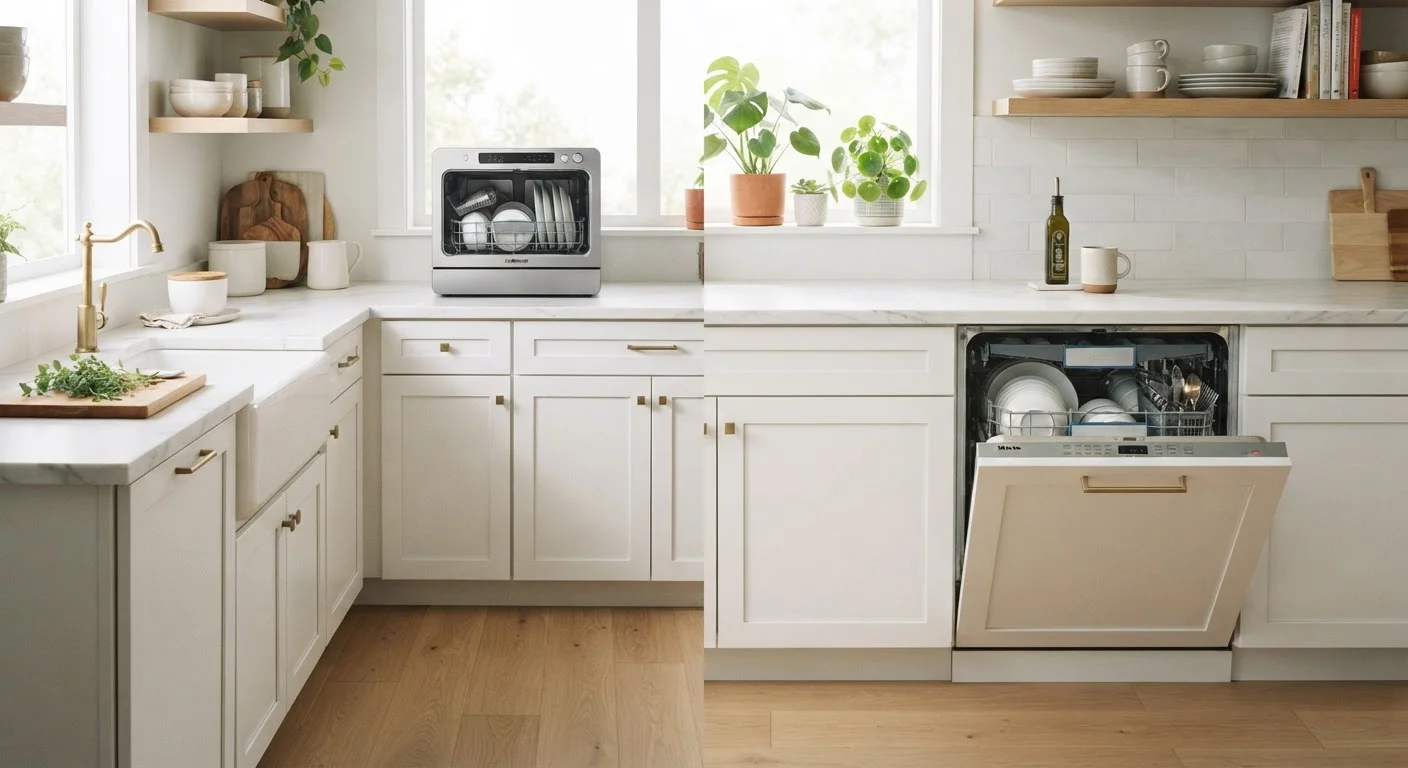
Photo credit: ArticlesHaven.net
In this article
Renting a small space or remodeling a kitchen? Compare countertop and full-size dishwashers on installation, capacity, and cost.
Key Takeaways
- Countertop dishwashers cost less upfront and require no installation, making them ideal for renters.
- Built-in models handle significantly larger loads - typically 12-16 place settings versus 4-6 for countertop units.
- Built-ins use dedicated plumbing and may require professional installation, adding to total cost.
- Countertop dishwashers connect to a standard faucet and sit on the counter, consuming valuable workspace.
- Long-term water and energy efficiency can favor built-in models at higher usage volumes.
The Core Difference: Form Factor and Where They Live
Countertop dishwashers are compact, freestanding units that sit on your kitchen counter. They hook up to your faucet via an adapter, drain into the sink, and plug into a standard outlet. No cabinetry work, no plumber required. Built-in dishwashers, by contrast, are installed under the counter between cabinets, connected to your home's water supply and drain lines - usually a job for a licensed plumber or appliance installer.
That installation difference has real downstream effects. Countertop units are portable - useful in rentals where you can't alter the kitchen. Built-ins disappear into the kitchen layout, freeing up counter space permanently. If you're weighing other appliance trade-offs the same way, the logic used in comparing pod vs. drip coffee makers - convenience versus capacity - applies directly here too.
Check Your Faucet Before Buying a Countertop Unit
Countertop dishwashers connect via a threaded adapter that fits most standard faucet aerators. However, some pull-out spray faucets or non-standard faucet heads don't accept universal adapters. Check your faucet thread size before purchasing, or look for models that include multiple adapter types in the box.
Capacity: How Many Dishes Can Each Handle?
Capacity is where the gap between the two types becomes most pronounced. Most countertop models accommodate roughly 4 to 6 place settings per cycle. That's adequate for one or two people, but starts to strain if you're cooking for a family or entertaining regularly.
Standard built-in dishwashers are rated for 12 to 16 place settings, with some larger models going higher. They also fit pots, pans, sheet trays, and larger serving dishes that won't physically fit in a countertop unit's compact interior. If your household generates significant dish volume daily, running multiple countertop cycles to match one built-in load adds time, water, and energy use.
~4-6
Place settings per countertop cycle
Most countertop dishwasher manufacturers rate their units at 4-6 standard place settings per wash cycle.
~3 gallons
Water use per countertop cycle
Many countertop models use roughly 2.5-3.5 gallons per cycle; efficiency varies by unit and wash setting.
$150+
Typical professional installation cost
Plumber or appliance installer fees for built-in dishwasher hookups commonly range from $100 to over $200 depending on location and complexity.
Cost: Upfront Price vs. Total Investment
Countertop dishwashers generally carry a lower sticker price, often ranging from around $200 to $400 for mainstream models. There's no installation cost beyond the faucet adapter that typically comes included. Built-in dishwashers span a wider range - entry-level units start around $400-$500, mid-range models run $600-$900, and premium options climb well above $1,000. Add professional installation, which commonly runs $100-$200 or more depending on your location and existing plumbing.
However, the per-load cost calculation can shift over time. Built-in models often use less water per load relative to the number of dishes cleaned, since they handle larger volumes in one cycle. Frequent countertop users running multiple daily cycles may find their water and energy costs approach or exceed what a built-in would use. For a parallel look at how upfront versus long-term costs play out in home appliances, see how tankless and traditional water heaters compare on efficiency over time.
| Countertop Dishwasher | Built-In Dishwasher | |
|---|---|---|
| Typical price range | $200-$400 | $400-$1,000+ |
| Installation cost | None (faucet adapter included) | $100-$200+ professional install |
| Capacity | 4-6 place settings | 12-16 place settings |
| Counter space used | Occupies counter surface | Hidden under counter |
| Portability | Fully portable | Permanent fixture |
| Best for | 1-2 person households, renters | Families, high dish volume |
Installation, Maintenance, and Practical Considerations
Countertop models require almost no setup - unbox, attach the faucet adapter, and run a cycle. Maintenance is similarly straightforward: clean the filter, wipe the interior, and descale occasionally depending on your water hardness. The tradeoff is that they occupy 18-24 inches of counter space that could otherwise hold prep space or other appliances.
Built-in dishwashers demand more at the start - proper leveling, securing to adjacent cabinetry, and ensuring drain and water connections meet local codes. Repairs can be more involved since accessing internal components means pulling the unit partially out. That said, the appliance repair industry is well-versed in standard built-in configurations, and parts tend to be widely available for common models.
For households managing broader home upkeep decisions, it may also be worth consulting resources on when to hire out versus DIY household tasks - the same cost-versus-effort framework applies to appliance installation decisions.
Built-In Installation May Require a Permit
In many jurisdictions, connecting an appliance to your home's water supply and drain lines is considered plumbing work that requires a permit and licensed contractor. Skipping this step can create liability issues - especially if a leak causes damage. Before starting a built-in installation, check your local building codes and consult a licensed plumber to confirm what's required in your area.

Author
Articles Haven Editorial Contributor
Articles Haven Editorial Team is the collective byline for our editorial team and contributor network. Articles published under this byline or an editorial pen name are researched, written, and reviewed according to our editorial standards for clarity, consistency, and independence before publication.
View all articles →