
The Real Cost of a Bundle: Beyond the Advertised Monthly Rate
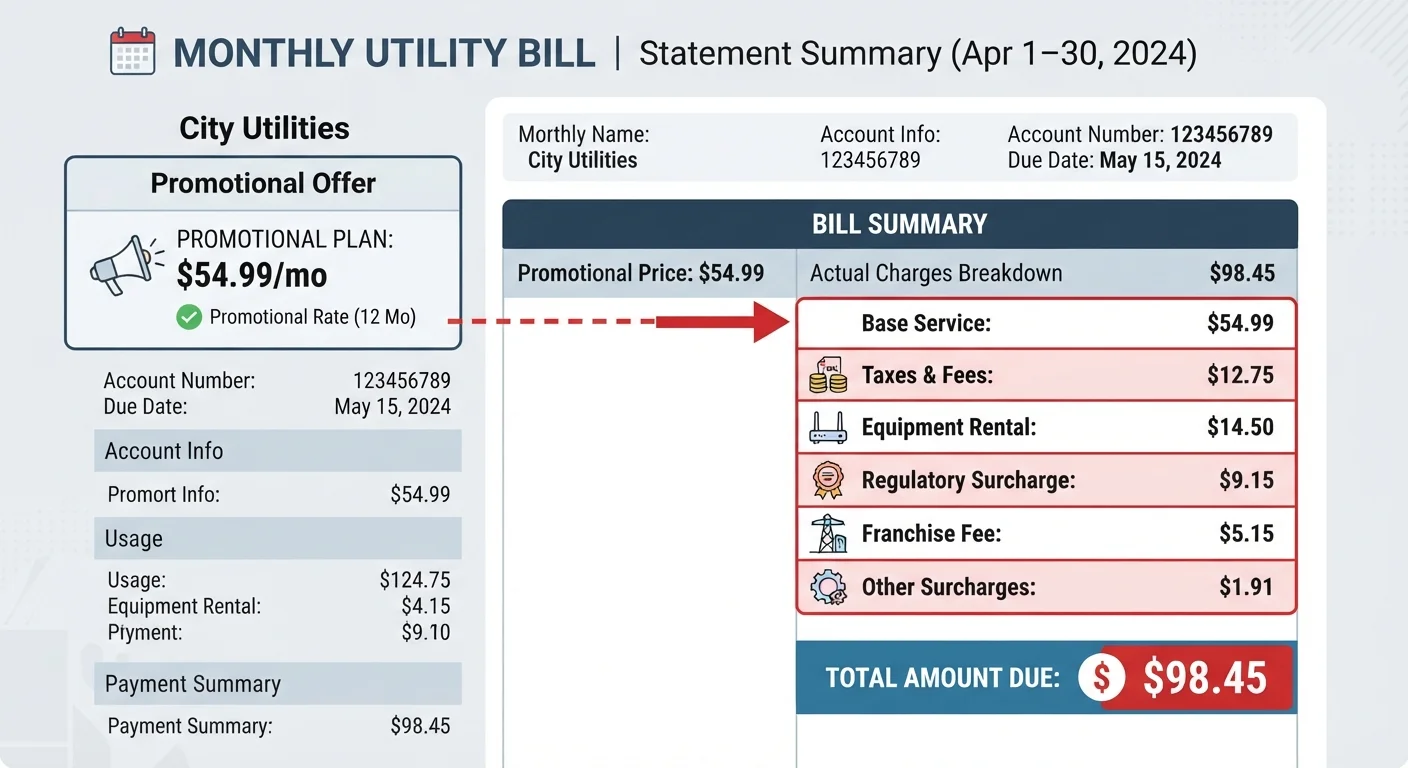
Photo credit: ArticlesHaven.net
In this article
Installation fees, equipment rental, taxes, and surcharges often push your true monthly bill well past the headline price. Here's what to account for.
Key Takeaways
- The advertised bundle rate rarely reflects what you'll actually pay each month.
- Equipment rental fees, installation charges, and taxes can add $20-$50 or more to your monthly bill.
- Promotional pricing typically expires after 12 to 24 months, often triggering a significant rate increase.
- Reading your first bill carefully is the best way to catch unexpected charges early.
- Buying your own compatible equipment can reduce ongoing rental costs over time.
What the Advertised Rate Actually Covers
Telecom providers promote bundle prices in large, friendly numbers. What those numbers typically represent is the base service rate - the cost of the internet, TV, or phone service itself, stripped of everything else. It's not a complete picture of your monthly obligation.
When you receive your first bill, you're likely to find a longer list of line items than you expected. The gap between the promotional price and your actual total is almost never a billing error - it's the structure of how telecom pricing works. Understanding each component gives you the information you need to compare bundles accurately before you commit.
For a broader look at how this plays out on a standard internet bill, see what each line item on a typical internet bill represents.
~25-40%
Typical gap between advertised and actual bundle cost
Consumer advocacy analyses consistently find that taxes, fees, and equipment rental push effective monthly costs well above the promotional rate.
$10-$15/mo
Average modem/router rental fee
Most major cable and internet providers charge a monthly equipment rental fee that accumulates to $120-$180 per year per device.
12-24 months
Typical promotional pricing window
After this period, standard rates apply - often $20-$60 higher per month than the introductory offer.
The Fees That Quietly Inflate Your Total
Several categories of charges are routinely excluded from advertised bundle rates but show up on every monthly bill:
- Equipment rental: If you use the provider's modem, router, or cable boxes, you'll pay a monthly rental fee for each device. This alone can add $15-$30 per month depending on how many TV boxes you have in your home.
- Broadcast TV and regional sports fees: These are pass-through costs providers say they collect to cover programming costs. They appear as separate line items and have increased steadily in recent years.
- Taxes and regulatory fees: Federal, state, and local taxes apply to telecom services. These vary by jurisdiction but commonly add 10-20% on top of the base rate.
- Installation or activation fees: One-time charges for setting up service can range from $50 to over $100, though they're sometimes waived during promotional periods.
- Early termination fees: If your bundle includes a contract, leaving before the term ends may trigger a fee that erodes any savings you'd calculated.
These categories are not unique to bundles - hidden fees can quietly undo a good deal across many consumer categories. But in telecom, they're especially consistent and significant.
Ask for the All-In Estimate Before You Sign
Before agreeing to any bundle, ask the provider for a written estimate that includes equipment rental, taxes, surcharges, and any one-time fees. Compare that number - not the advertised rate - against competing offers. Providers are required to disclose these costs, though you may need to ask directly.
How Promotional Pricing Creates a Moving Target
Most bundle offers lead with a promotional rate valid for a fixed term - often 12 or 24 months. Once that period expires, the price typically resets to the standard rate, which can be $20-$60 higher per month than what you originally signed up for. Providers are required to disclose this, but the information is often buried in fine print or footnotes.
This is worth calculating before you sign up. If a bundle is advertised at $89/month for the first year but reverts to $140/month after that, the two-year average is closer to $115/month - before adding taxes and fees. That's a meaningfully different number than the headline.
What happens to your bundle price when the promotional period ends covers this dynamic in detail and is worth reviewing before agreeing to a multi-year term.
Promotional Disclosures Are Required, But Easy to Miss
FCC rules require providers to disclose promotional pricing terms, including the rate after the promo period ends. This information is included in your service agreement, but it's often presented in small print or a separate addendum. Before signing, ask a representative to state the post-promotional rate explicitly and confirm it in writing.
Calculating What You'll Actually Pay
Before signing up for any bundle, it's worth doing a realistic cost estimate rather than relying on the advertised figure. A straightforward approach:
- Start with the base monthly rate during the promotional period.
- Add estimated equipment rental for all devices you'll use.
- Add an estimated 15% for taxes and regulatory fees (adjust based on your state's tax rate).
- Add any recurring surcharges listed in the service agreement, such as broadcast TV fees.
- Divide any one-time installation fees by the length of your contract and add that monthly average.
- Recalculate steps 1-5 using the post-promotional rate to understand your second-year cost.
This exercise often reveals that the true monthly cost is 25-40% above the advertised rate. The same methodology applies when calculating your actual monthly cost across different phone plans.
If you want to track how these costs tend to grow over time, the true cost of home internet over a 12- to 24-month period walks through the math in detail.
What You Can - and Can't - Negotiate
Not every charge on your bundle bill is fixed. Some are worth pushing back on, especially at sign-up or renewal:
- Equipment fees: Purchasing a compatible modem or router - rather than renting - eliminates that recurring charge. Confirm device compatibility with your provider before buying.
- Installation fees: These are frequently waived for new customers, particularly if you're switching from a competitor. It's reasonable to ask.
- Promotional rate extension: When a promo period ends, some providers will extend a similar rate if you call and express intent to cancel. This works more reliably for long-term customers.
What's generally not negotiable: government-mandated taxes, franchise fees, and federal regulatory charges. Those are set externally and passed through regardless of your plan.
Once you're locked into a bundle, bills can still creep upward. Why your bundle bill keeps climbing even without a plan change explains the mechanisms behind gradual increases that happen even when you haven't changed your plan.
Frequently Asked Questions

Author
Articles Haven Editorial Contributor
Articles Haven Editorial Team is the collective byline for our editorial team and contributor network. Articles published under this byline or an editorial pen name are researched, written, and reviewed according to our editorial standards for clarity, consistency, and independence before publication.
View all articles →