
Actual Cash Value vs. Replacement Cost: Which Coverage Pays More After a Loss
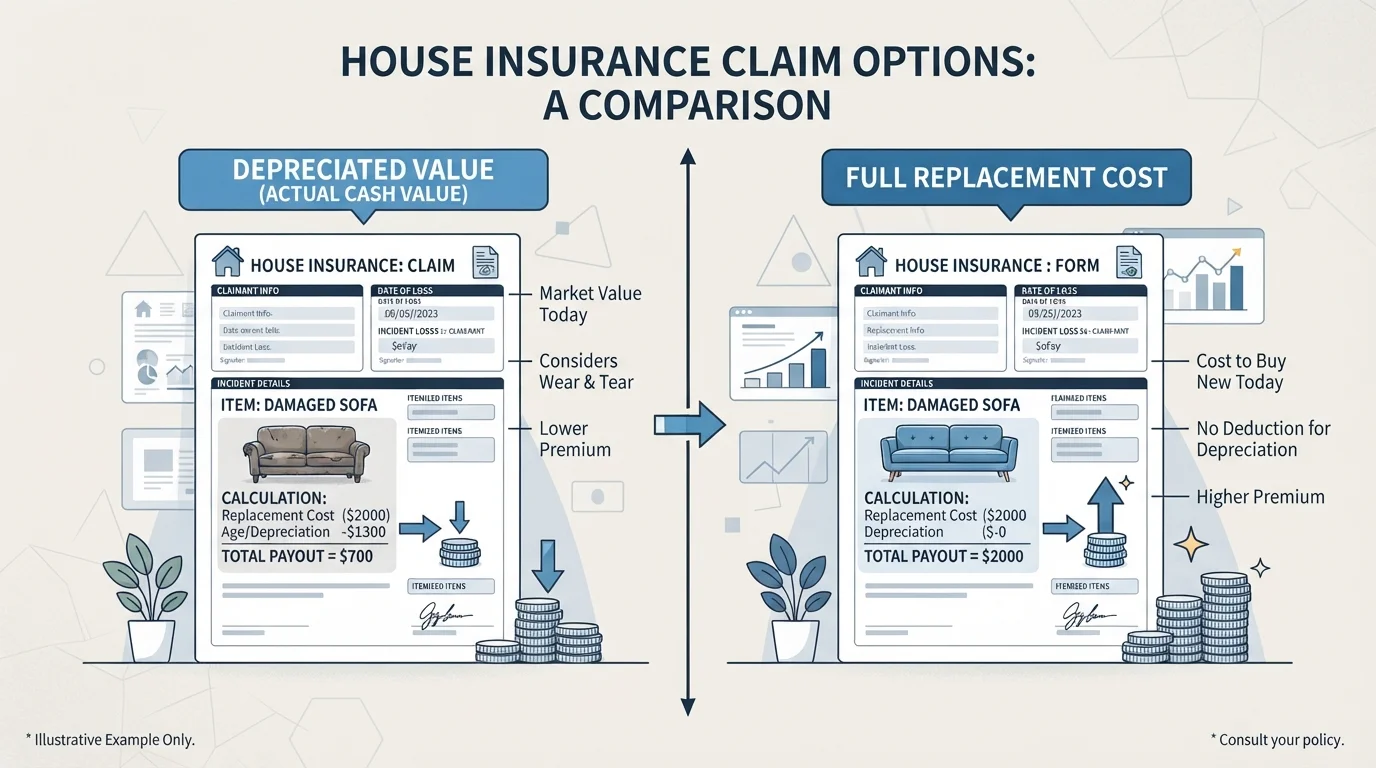
Photo credit: ArticlesHaven.net
In this article
ACV and replacement cost policies both cover losses—but one pays significantly less. Here's the difference and why it matters at claim time.
Key Takeaways
- ACV pays what your damaged property was worth at the time of loss, after depreciation is subtracted.
- Replacement cost pays what it actually costs to repair or replace the item today, with no depreciation deduction.
- The gap between ACV and RCV payouts can be thousands of dollars on older roofs, appliances, or electronics.
- RCV policies carry higher premiums, but they reduce your out-of-pocket exposure significantly at claim time.
- Always read your declarations page to confirm which valuation method your policy uses for each category of property.
- Some policies offer ACV as the default but allow an RCV endorsement for an additional premium.
What Each Valuation Method Actually Means
When you file a property insurance claim, your insurer does not simply write a check for whatever repairs or replacements cost. Instead, it applies a valuation method defined in your policy to calculate the payout. The two most common methods - Actual Cash Value (ACV) and Replacement Cost Value (RCV) - can produce dramatically different numbers for the exact same loss.
Actual Cash Value is calculated by taking the replacement cost of the item and subtracting depreciation. Depreciation accounts for age, wear, and reduced useful life. A roof that cost $15,000 when installed twelve years ago and has an expected lifespan of twenty-five years might be considered roughly 48% depreciated. Your ACV payout on a total roof loss could be in the range of $7,800 - leaving a substantial gap you'd need to cover yourself. For more context on how roofing costs are built up, see The Real Costs Behind a Roof Replacement.
Replacement Cost Value pays what it actually costs to repair or replace the damaged property with materials of like kind and quality at current market prices - no depreciation deducted. On that same roof, you could receive close to the full current cost of replacement.
| Criterion | Actual Cash Value (ACV) | Replacement Cost Value (RCV) |
|---|---|---|
| Payout basis | Depreciated value at time of loss | Current cost to repair or replace |
| Depreciation deducted | Yes | No |
| Typical premium cost | Lower | Higher |
| Out-of-pocket gap risk | Higher - especially for older property | Lower - insurer covers full replacement |
| Best suited for | Budget-focused, older or lower-value property | Newer property, high-value contents, low risk tolerance |
| Payout on older roof example | Fraction of replacement cost | Full current replacement cost |
| Policy complexity | Simpler calculation | May involve two-step claims process |
How Depreciation Changes the Claim Math
Depreciation is the core variable separating these two coverage types, and it compounds quickly. Insurers typically use schedules that assign depreciation rates by property category and age. Personal electronics might depreciate at 20-30% annually. Roofing materials depreciate more gradually but still meaningfully over a decade.
~48%
Typical depreciation on a 12-year-old roof
Based on a 25-year expected lifespan; illustrates how significantly ACV payouts can differ from replacement cost on aging structures.
20-30%
Annual depreciation rate for personal electronics
Common insurer depreciation schedules for consumer electronics, meaning a five-year-old laptop may be valued at a fraction of its purchase price.
1 in 15
US homeowners filing a claim annually
According to the Insurance Information Institute, roughly one in fifteen insured homes has a claim each year, making valuation method a real-world issue.
Consider a homeowner whose kitchen appliances are damaged in a fire. The appliances cost $8,000 new but are seven years old. Under ACV, the insurer deducts depreciation - perhaps arriving at a $3,200 payout. Under RCV, the insurer would pay toward replacing those appliances at today's prices, which may have actually increased since the original purchase. The practical difference between these two outcomes is significant and is often only understood at claim time, not at policy purchase.
This is why policy language matters so much. The Choosing a Policy process should include a direct review of the valuation method your policy applies - not just the coverage limits. For a deeper look at how these two methods compare alongside a third option, see Agreed Value vs. ACV vs. Replacement Cost.
The Two-Step RCV Claims Process
Some replacement cost policies pay out in two stages. First, the insurer pays the ACV amount immediately after the loss. Once repairs or replacement are completed and documented, the insurer releases the remaining "recoverable depreciation" to bring the total up to RCV. This means you may need to fund repairs upfront before receiving the full RCV settlement. Confirm your insurer's process before work begins to avoid cash-flow surprises.
Premium Differences and When Each Makes Sense
RCV policies generally cost more than ACV policies - estimates vary by insurer, property type, and location, but the premium difference for home contents or dwelling coverage can be meaningful. Whether that cost is justified depends on your financial situation and the age and condition of what you're insuring.
If your home is older and your contents are well-used, the depreciation hit under ACV may be steep, meaning an RCV policy's higher premium is buying you real protection against a large out-of-pocket gap. Conversely, if your budget is tight and you have savings to absorb a partial shortfall, an ACV policy may be a reasonable trade-off - provided you understand what you are accepting.
Some insurers allow policyholders to start with an ACV policy and add an RCV endorsement for specific categories like the roof or personal electronics. This hybrid approach can offer a middle ground. Always ask your agent or review your declarations page to confirm what valuation method applies to each component of your coverage - dwelling, other structures, and personal property are sometimes treated differently within the same policy. Why ACV and Replacement Cost Are Not the Same explains more about how depreciation is actually applied by insurers.
This article provides general insurance education and is not personalized insurance or financial advice. Coverage terms, eligibility, and payout amounts vary by insurer, policy, and region. Always read your policy documents carefully and consult a licensed insurance agent or adviser for guidance specific to your situation.

Author
Articles Haven Editorial Contributor
Articles Haven Editorial Team is the collective byline for our editorial team and contributor network. Articles published under this byline or an editorial pen name are researched, written, and reviewed according to our editorial standards for clarity, consistency, and independence before publication.
View all articles →