
Spray Foam vs. Batt Insulation: Choosing the Right Fit for Each Space
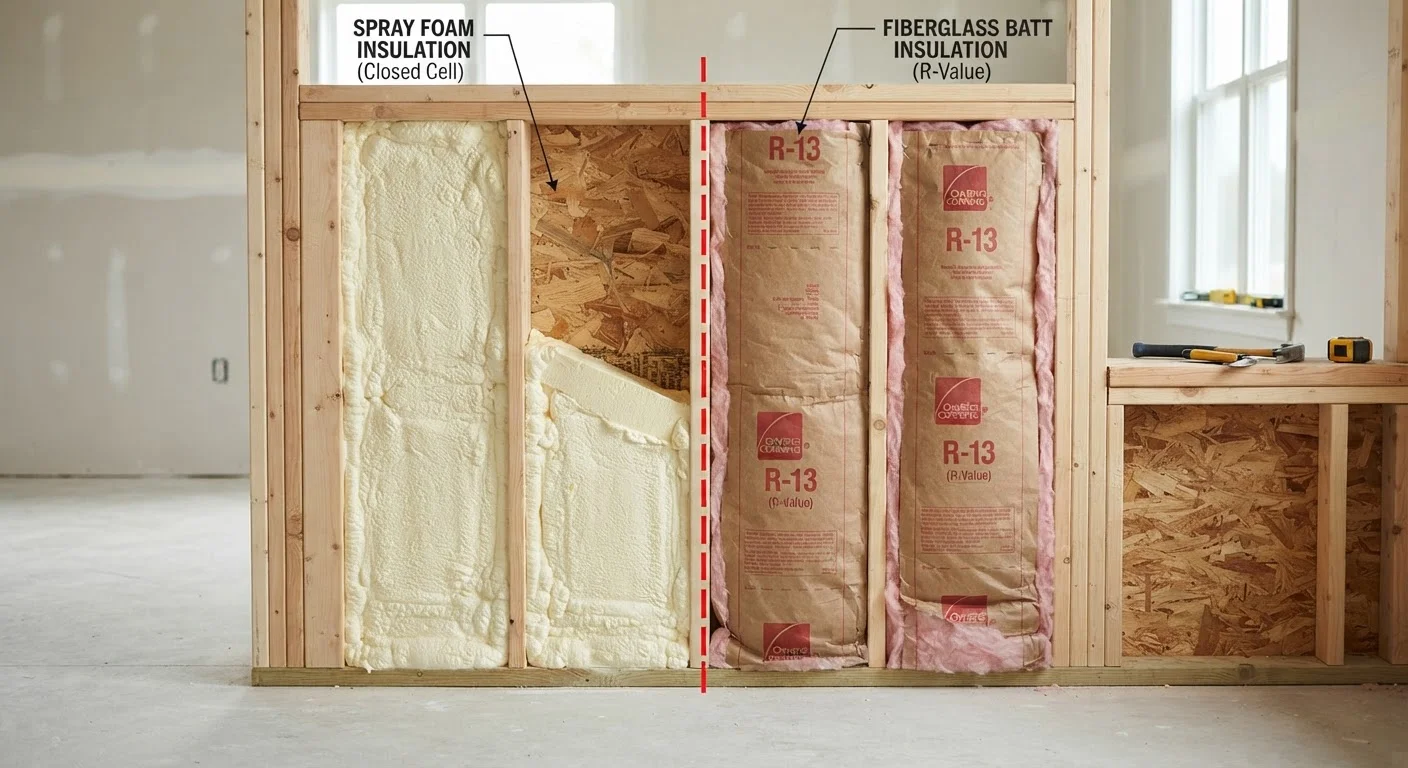
Photo credit: ArticlesHaven.net
In this article
Spray foam and batt insulation perform differently by location, budget, and installation complexity. Here's how to think through the choice.
Key Takeaways
- Spray foam provides both insulation and air sealing in one step, making it more effective in complex or irregular spaces.
- Batt insulation costs significantly less per square foot and is well-suited for straightforward DIY installation in standard cavities.
- Closed-cell spray foam offers the highest R-value per inch of any common insulation type.
- Improper batt installation-gaps, compression, or missing air sealing-dramatically reduces real-world performance.
- Spray foam generally requires professional installation and carries higher upfront costs but may lower energy bills more over time.
- The right choice often depends on the specific location in the home, not a single blanket preference.
What Each Insulation Type Actually Does
Both spray foam and batt insulation slow the transfer of heat through walls, ceilings, and floors - but they work through fundamentally different mechanisms, and that difference shapes where each belongs in a home.
Batt insulation - typically fiberglass or mineral wool - works by trapping air within a fibrous matrix. It comes in pre-cut panels sized to fit standard 16- or 24-inch stud spacing. Installation is straightforward: fit the batt snugly between framing members, and the material does its job. The caveat is that batts only insulate; they don't stop air movement. Any gaps, compression, or missing caulk around penetrations creates a bypass that substantially reduces real-world performance.
Spray foam insulation comes in two forms: open-cell and closed-cell. Open-cell foam is softer and more vapor-permeable, offering around R-3.5 per inch. Closed-cell foam is denser, rigid, and highly moisture-resistant, reaching roughly R-6 to R-7 per inch - the highest of any common insulation type. Both forms expand to fill irregular shapes and, critically, create an air barrier as they cure. This dual function - insulating and sealing - is spray foam's defining advantage.
For a deeper look at how insulation types compare specifically in attic applications, see the attic insulation overview covering R-value and installation complexity by type.
| Criterion | Spray Foam | Batt Insulation |
|---|---|---|
| R-value per inch | R-3.5 to R-7 (open/closed cell) | R-3.1 to R-4.3 (fiberglass/mineral wool) |
| Air sealing | Yes - built-in air barrier | No - requires separate sealing |
| Material cost | $1.00-$6.00+ per sq ft | $0.30-$1.50 per sq ft |
| DIY-friendly | Limited (small jobs only) | Yes - standard DIY task |
| Best cavity type | Irregular, tight, or complex | Standard, uniform framing |
| Moisture resistance | High (closed-cell) | Moderate; vulnerable if wet |
| Installation speed | Fast once staged; cure time needed | Fast; no cure time |
Where Each Type Performs Best
Location within the home is the single most useful variable when choosing between these two options.
Where Batt Wins
- Standard stud walls (new construction): Uniform cavities with clean framing are exactly what batts are designed for. There's minimal waste and installation is fast.
- Attic floors: When running between joists with no air-sealing needs, batts are cost-effective and easy to access.
- Basement ceilings: Unfaced or kraft-faced batts between floor joists work well when the basement remains unconditioned.
Where Spray Foam Wins
- Rim joists: The irregular gaps around the perimeter where the floor meets the foundation wall are notoriously hard to seal. Spray foam fills and seals in one pass.
- Crawl spaces and vented roof assemblies: Moisture exposure and odd shapes make spray foam far more reliable here.
- Existing walls (retrofit): When walls are closed and only small access holes are available, injection foam or spray foam is the practical option.
- Tight or irregular cavities: Anywhere framing isn't perfectly uniform, batts leave voids that foam fills naturally.
~40%
Share of home energy loss from air infiltration
The U.S. Department of Energy estimates that air leakage accounts for roughly 25-40% of heating and cooling energy loss in typical homes.
R-6 to R-7
Closed-cell spray foam R-value per inch
Closed-cell spray foam achieves the highest R-value per inch of any widely used insulation, per general industry data and DOE resources.
2-3x
Spray foam cost premium over batts
Professional spray foam installation typically costs two to three times more per square foot than comparable batt insulation, based on general contractor pricing ranges.
Cost, Installation, and Practical Realities
Cost is often the deciding factor, and the gap between these two options is real.
Batt insulation typically runs between $0.30 and $1.50 per square foot for materials, depending on R-value and type. A motivated homeowner with basic tools can complete most batt installations without professional help. The trade-off: the performance you get depends heavily on the care taken during installation. Compressed batts lose R-value. Gaps around outlets or pipes create cold spots and moisture risks.
Spray foam - applied professionally - typically costs between $1.00 and $4.50 per square foot for open-cell, and $1.50 to $6.00 or more for closed-cell, depending on thickness and region. DIY spray foam kits exist for small jobs like rim joists, but full-wall applications are generally not practical without professional equipment and training. Installers also wear respiratory protection and follow ventilation protocols during application; the foam must fully cure before the space is occupied.
Check Local Code Requirements First
Building codes in many states specify minimum R-values by climate zone, and some assemblies - such as unvented attics or conditioned crawl spaces - may require specific insulation types or vapor control layers. Requirements vary considerably by region and are updated periodically. Always verify current local code with your building department or a licensed contractor before starting any insulation project, as unpermitted work can complicate home sales and insurance claims.
When comparing costs, it helps to think in terms of the total project - not just materials. A batt job done incorrectly may need to be re-done or supplemented with air sealing later, narrowing the apparent savings.
Making the Decision for Your Home
Rather than choosing one type for the whole house, many homeowners find the most sensible approach is to use each where it fits: spray foam for the crawl space and rim joists where air sealing is critical, batts for the straightforward wall and attic-floor runs where the cost savings are large and installation is predictable.
Before committing to either, a few practical questions help clarify the decision:
- Is the cavity regular or irregular? Irregular almost always favors foam.
- Does the area need air sealing as well as insulation? If yes, foam handles both; batts require a separate air-sealing step.
- Is this a DIY project or a professional job? Batts are the realistic DIY option for most spaces; foam typically requires a contractor for anything beyond small spot applications.
- What's the required R-value? Building codes specify minimum R-values by climate zone. If you're working in a tight space - like a 2x4 wall - closed-cell foam may be the only way to reach the target.
For homeowners weighing other improvement decisions with a spray vs. traditional application dynamic, the comparison between spray and brush-on paint methods offers a useful parallel framing around technique trade-offs.
When in doubt about requirements for your climate zone or whether your planned installation requires permits or inspection, consult a licensed insulation contractor or your local building department before proceeding. Insulation work that involves conditioned crawl spaces or unvented roof assemblies in particular can have moisture and code implications that vary by region.

Author
Articles Haven Editorial Contributor
Articles Haven Editorial Team is the collective byline for our editorial team and contributor network. Articles published under this byline or an editorial pen name are researched, written, and reviewed according to our editorial standards for clarity, consistency, and independence before publication.
View all articles →