
Wired vs. Wireless Earbuds: Sound Quality, Latency, and Daily Trade-Offs
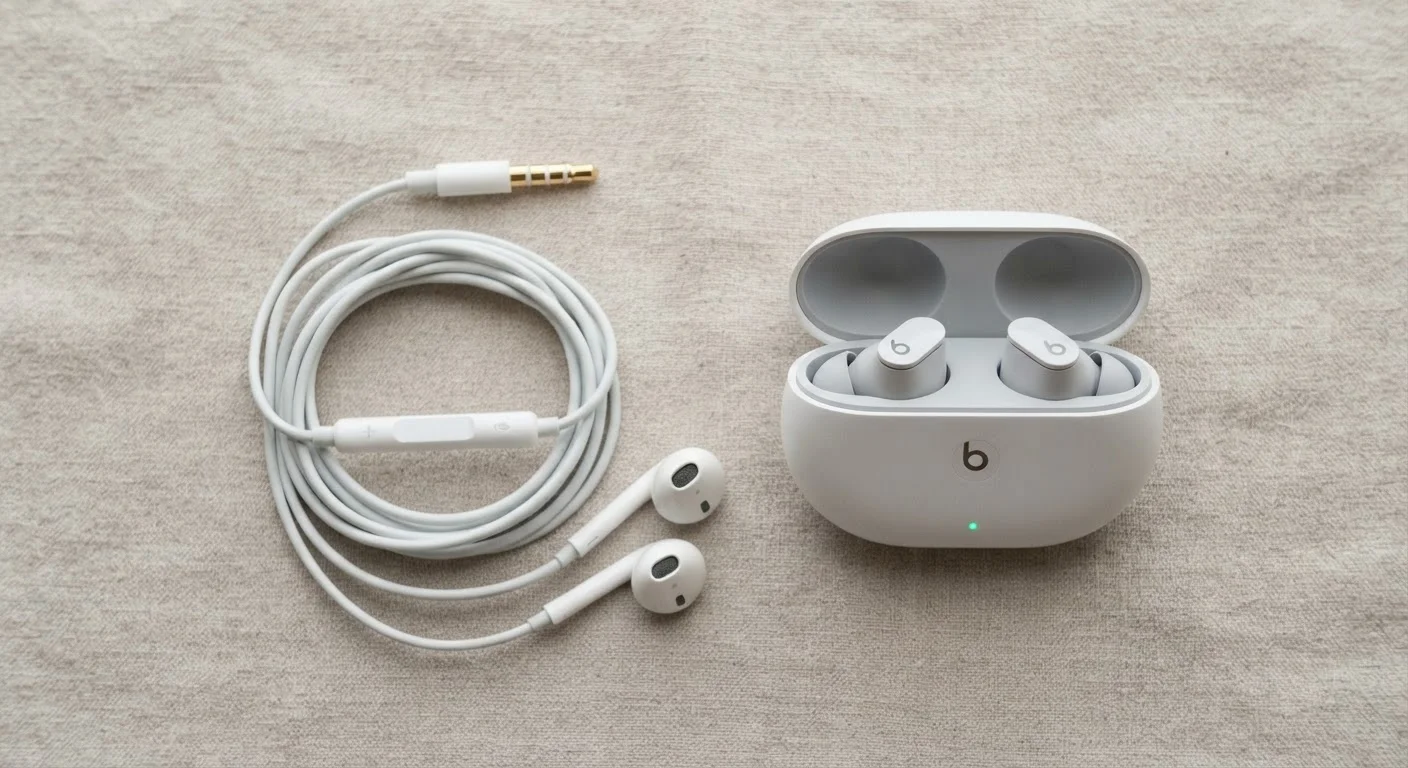
Photo credit: ArticlesHaven.net
In this article
Wireless earbuds are convenient, but wired still has its place. See how both stack up across audio quality, battery, and price.
Key Takeaways
- Wired earbuds deliver more consistent audio quality with no latency or battery concerns.
- Wireless earbuds offer unmatched convenience but depend on Bluetooth and battery life.
- Latency in wireless earbuds has improved but can still matter for gaming and video editing.
- Wired options are generally more affordable at comparable audio quality tiers.
- Wireless earbuds add features like active noise cancellation and touch controls.
- Your daily routine - not specs alone - should drive the final decision.
Sound Quality: Does the Wire Still Make a Difference?
In audio circles, this debate has sharpened considerably as wireless technology has matured. Wired earbuds transmit an analog signal directly from the source, bypassing the compression that Bluetooth codecs apply. For most mainstream listeners, that distinction is subtle - but it becomes more noticeable with high-resolution audio files or in quiet listening environments.
Bluetooth audio quality depends heavily on the codec in use. SBC (the universal fallback) compresses audio more aggressively. Newer codecs like aptX HD and AAC preserve more detail, but they require support on both the earbud and the source device. If either side doesn't support the higher codec, the connection defaults to the lower one automatically - something many shoppers don't realize until after purchase.
That said, many wireless earbuds at mid-to-higher price points sound excellent for everyday listening. If your library is primarily compressed streaming audio, the gap between wired and wireless is less meaningful than it would be for lossless formats.
| Criterion | Wired Earbuds | Wireless Earbuds |
|---|---|---|
| Audio Signal | Uncompressed analog | Bluetooth codec (compressed) |
| Latency | Near zero | 40-200ms depending on codec |
| Battery Required | No | Yes (5-8 hrs per charge) |
| Typical Price Range | Lower for equivalent quality | Higher due to added components |
| Active Noise Cancellation | Rarely included | Common in mid/upper tier |
| Device Compatibility | Requires 3.5mm or USB-C jack | Works with any Bluetooth device |
| Cable Tangle / Snagging | Yes | No |
| Long-Term Durability | Cable wear is main failure point | Battery degrades over 2-3 years |
Latency, Battery, and the Hidden Daily Costs
Latency - the delay between audio being produced and you hearing it - is one area where wired earbuds still hold a structural advantage. Wired connections are effectively instantaneous. Wireless earbuds, even with low-latency codecs, introduce delays typically ranging from 40ms to 200ms depending on the codec and connection quality. For music and podcasts, this is imperceptible. For gaming, video calls, or syncing audio to video playback, it can be noticeable.
~40ms
Minimum wireless audio latency (aptX LL codec)
aptX Low Latency is among the most responsive Bluetooth codecs available, though both devices must support it for this figure to apply.
5-8 hrs
Typical wireless earbud battery life per charge
Most mainstream true wireless earbuds offer this range; charging cases typically provide 2-4 additional full charges.
20-30 hrs
Total playtime with charging case included
Combined earbud and case capacity figures commonly cited by manufacturers across mid-range wireless earbud categories.
Battery life is the practical trade-off most users feel daily. Wired earbuds never run out of power. Wireless earbuds typically offer 5-8 hours of playback per charge, with charging cases extending that to 20-30 hours total. That's enough for most people - until it isn't. Forgetting to charge, or traveling without the case, can leave you without audio entirely.
There's also a long-term durability consideration. Wired earbuds can fail if the cable is damaged, though this is usually a mechanical stress issue at the connector point. Wireless earbuds carry lithium-ion batteries that degrade over charge cycles, meaning their capacity diminishes over 2-3 years of regular use. Replaceable batteries are rare in this category, which means the device has a built-in lifespan.
Feature Sets, Compatibility, and Practical Considerations
Wireless earbuds have pulled ahead in the features race. Active noise cancellation (ANC), ambient sound passthrough, touch controls, automatic ear detection, and companion apps are common in this category. These features can genuinely improve daily usability - though they also increase the price and add more components that can fail. If you're interested in how ANC compares to ambient mode more broadly, see our guide to noise-canceling vs. ambient sound headphones.
Wired earbuds, by contrast, are plug-and-play across virtually any device with a 3.5mm jack or USB-C port. No pairing, no firmware updates, no codec negotiation. That simplicity has real value - particularly for people who use multiple devices or travel frequently with older audio equipment.
Compatibility is worth checking before buying either type. Many laptops retain the headphone jack, but flagship smartphones increasingly do not. If your primary device lacks a 3.5mm port, using wired earbuds requires a dongle adapter, which adds cost and another thing to carry or lose.
Dongle Adapters: Small Cost, Real Friction
If your phone or laptop lacks a 3.5mm headphone jack, wired earbuds require a USB-C or Lightning to 3.5mm adapter. These adapters are inexpensive and widely available, but they add a step to every listening session and are easy to misplace. Some adapters also affect audio quality depending on the built-in DAC (digital-to-analog converter) they use. It's a workable solution - but worth factoring into your decision before buying wired earbuds for a port-free device.
For broader perspective on how wireless audio technology shapes different listening products, the comparison of smart speakers vs. Bluetooth speakers covers how these same trade-offs play out at a larger scale.

Author
Articles Haven Editorial Contributor
Articles Haven Editorial Team is the collective byline for our editorial team and contributor network. Articles published under this byline or an editorial pen name are researched, written, and reviewed according to our editorial standards for clarity, consistency, and independence before publication.
View all articles →