
Percentage Off vs. Dollar Off: Which Framing Actually Saves You More
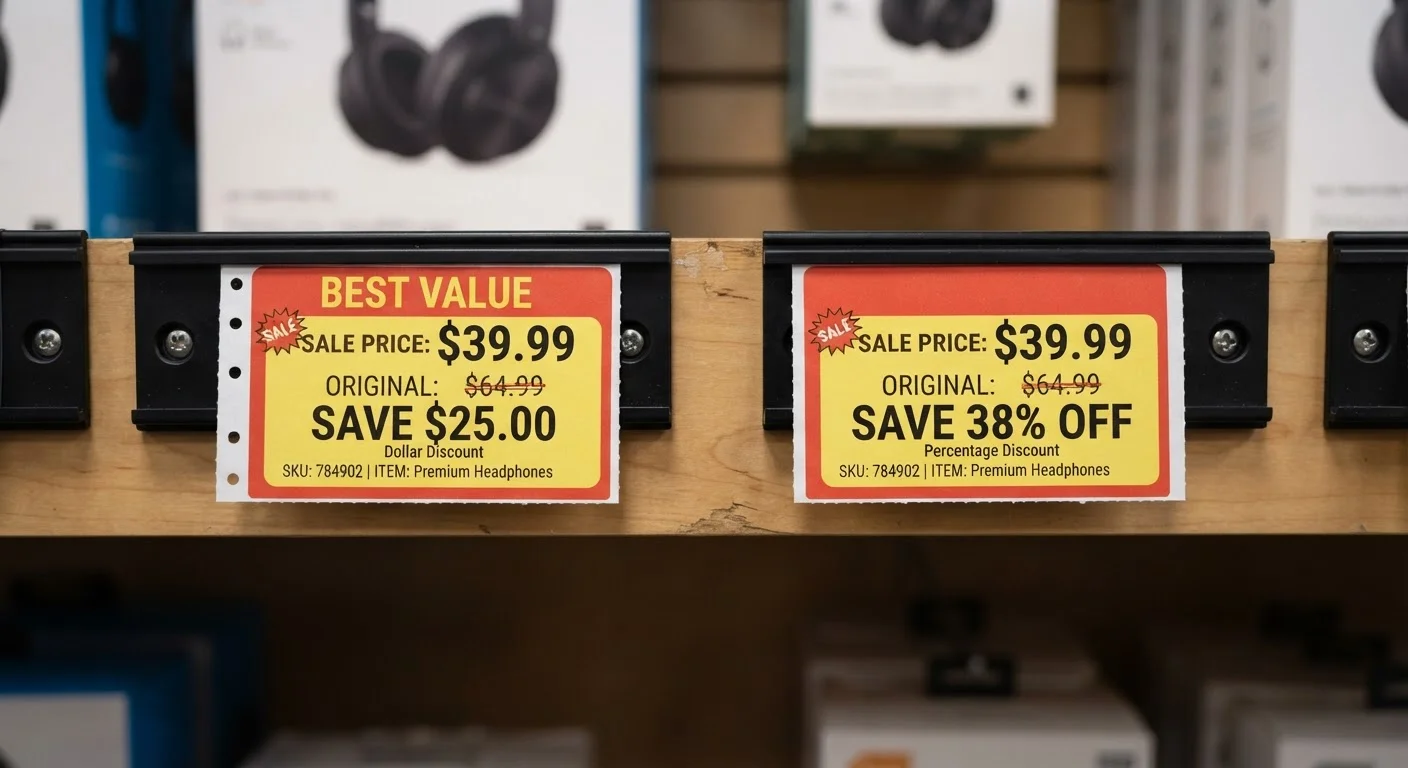
Photo credit: ArticlesHaven.net
In this article
Retailers choose discount framing strategically. Knowing when each format gives you the better deal helps you cut through the noise.
Key Takeaways
- The better framing depends entirely on the item's original price - run the actual math first.
- Retailers choose percentage or dollar framing strategically to make the discount look larger.
- On cheap items, a high percentage off often translates to only a few cents in real savings.
- On expensive items, a fixed dollar amount can seem generous while the percentage is actually modest.
- Comparing the raw dollar saving against the original price is the most reliable reality check.
Why Framing Matters More Than It Should
Retailers and marketers have long understood that the way a discount is presented changes how shoppers perceive it - even when the underlying saving is identical. A jacket marked "$50 off" and one marked "25% off" could be the exact same deal on a $200 jacket. But they feel different, and that's the point.
Consumer behavior research consistently shows that people are poor at converting between percentage and absolute formats without doing the explicit math. Retailers exploit this gap - not maliciously, but rationally. They present whichever format makes the discount appear largest or most compelling. Understanding this pattern is the first step toward evaluating deals on your own terms. See what actually makes a discount worth it for a broader framework.
| Criterion | Percentage Off | Dollar Off |
|---|---|---|
| Best used on | High-priced items ($100+) | Low-to-mid priced items (under $100) |
| Clarity for shoppers | Requires mental math | Immediately concrete |
| Risk of misleading | High on cheap items (big % = tiny saving) | High on expensive items ($X looks large, % is small) |
| Retailer preference | Electronics, furniture, appliances | Groceries, apparel, everyday goods |
| Comparison across items | Easier to compare proportionally | Easier to compare in absolute terms |
| Consumer reality check | Convert to dollars to verify | Convert to % of price to verify |
The Math Behind Each Format
The core rule is simple: multiply the percentage by the original price to find the dollar saving, or divide the dollar saving by the original price to find the percentage. From there, you can compare apples to apples.
Where the two formats diverge in real-world usefulness is at price extremes:
- Low-priced items: A 50% discount on a $6 item saves you $3. The percentage sounds dramatic; the dollar amount tells the real story.
- High-priced items: A "$30 off" promotion on a $1,000 appliance is only 3% - modest by any standard, even if $30 feels like meaningful money in isolation.
This is why the same dollar-off amount can be either a strong deal or a cosmetic one depending entirely on context. The percentage format grounds the saving relative to what you're actually spending. The dollar format grounds it in concrete purchasing power.
~3x
Perceived value gap between identical discounts
Research in behavioral economics suggests consumers rate the same saving significantly higher when framed as a percentage versus a dollar amount on higher-priced goods.
20%+
Threshold where percentage discounts tend to feel meaningful
Consumer psychology studies generally find that discounts below 20% often fail to significantly shift purchase intent on discretionary items.
When Retailers Use Each Format - and Why
Stores aren't choosing discount formats randomly. There are predictable patterns worth knowing:
- Percentage framing appears more often on expensive items - furniture, electronics, appliances. "Up to 40% off" sounds significant and scales impressively with the price.
- Dollar framing is common on mid-range everyday goods - groceries, personal care, clothing basics. "$5 off" is tangible and requires no calculation.
- Threshold offers use dollar framing - "$20 off orders over $100" - because the qualifier is easy to understand in absolute terms.
Knowing these defaults helps you spot when a format is being used to flatter a mediocre deal. A "15% off" badge on a $30 item is $4.50 - worth noticing, not worth celebrating. For a deeper look at how deal overload distorts your judgment, see how deal fatigue affects decision-making.
"Up to" Discounts Deserve Extra Scrutiny
Promotions framed as "up to X% off" apply that maximum only to a subset of items - often the ones least likely to be what you came for. The average saving across the promotion is typically much lower. When you see "up to" language, treat the advertised figure as a ceiling, not an expectation, and check the actual discount on the specific item you want.
A Practical Decision Rule for Shoppers
Rather than defaulting to whichever number looks bigger, use this two-step check before deciding a deal is worth acting on:
- Convert to dollars. Whatever format is shown, calculate what you're actually saving in cash. This removes the psychological effect of percentages.
- Evaluate the dollar saving against your baseline. Is $8 off meaningful on this purchase? That depends on whether the item costs $16 or $160.
A useful rough benchmark: discounts that move the needle tend to be at least 20% on items over $50, or at least $10 in absolute terms on everyday purchases. Below those thresholds, the framing is often doing more work than the discount itself.
For context on how timing interacts with discount depth, shopping off-season can produce genuine savings that dwarf any in-store promotion. And if you want to sharpen your overall deal evaluation skills, the Shopping Smarter hub covers the broader decision frameworks worth keeping in your toolkit.

Author
Articles Haven Editorial Contributor
Articles Haven Editorial Team is the collective byline for our editorial team and contributor network. Articles published under this byline or an editorial pen name are researched, written, and reviewed according to our editorial standards for clarity, consistency, and independence before publication.
View all articles →