
What Happens to Your Phone Plan During a Natural Disaster or Emergency?
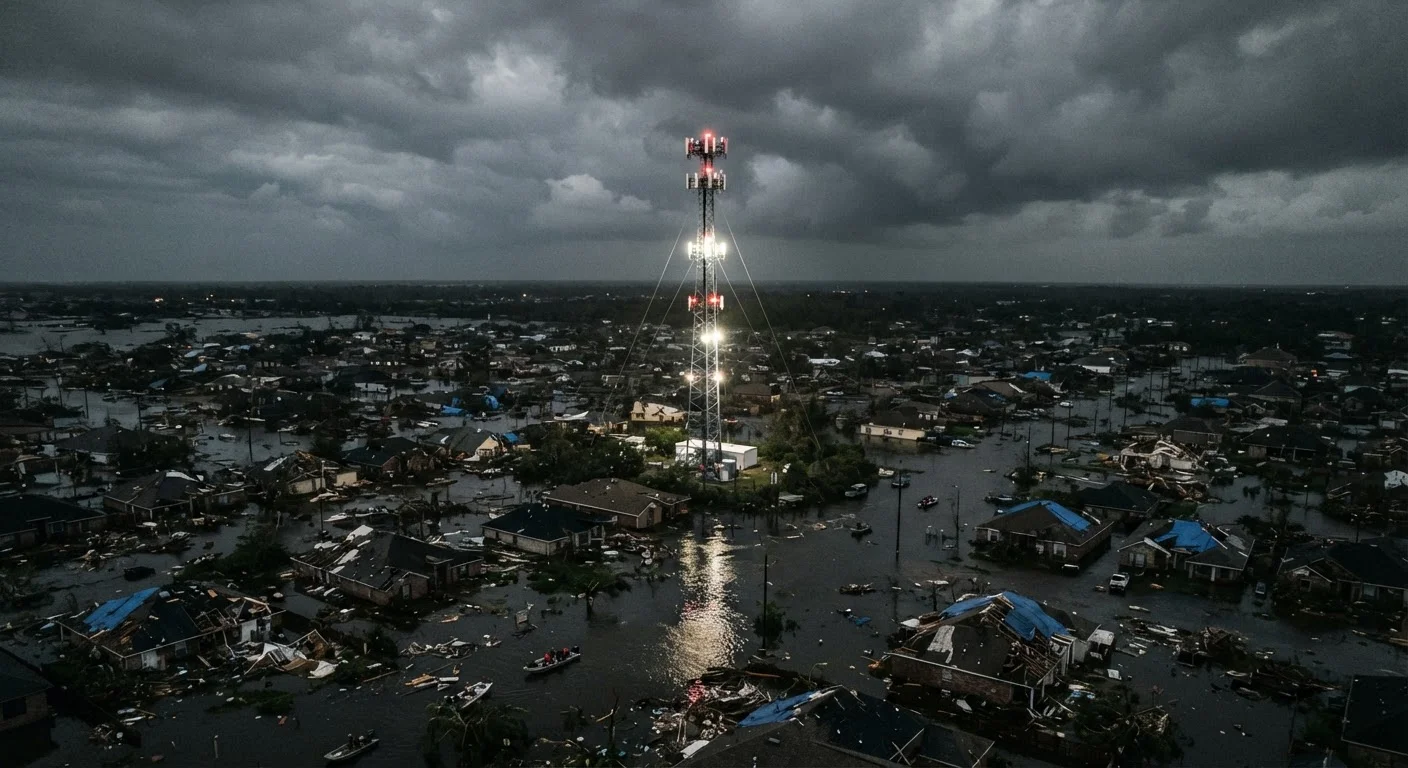
Photo credit: ArticlesHaven.net
In this article
Wireless networks can get congested or damaged in emergencies. Learn how carriers typically respond and how to stay connected when networks are strained.
Key Takeaways
- Cell towers can be physically damaged or lose power during disasters, reducing coverage in affected areas.
- Heavy call volume causes network congestion that slows or blocks calls even when towers are functional.
- Text messages use far less bandwidth than calls and are more likely to get through during congestion.
- Carriers may deploy mobile cell units (COWs) to restore temporary coverage after disasters.
- Your plan's deprioritization rules can become more impactful when network capacity is strained.
- Wireless Emergency Alerts (WEA) operate on a separate broadcast channel and are designed to reach phones under congestion.
What Actually Happens to Cell Networks When Disaster Strikes
Wireless networks face two distinct threats during a natural disaster: physical damage and demand overload. These problems often hit simultaneously, which is why service degrades so dramatically and so fast.
Physical damage includes downed towers from high winds, flooding of equipment shelters, severed fiber backhaul lines that connect towers to the broader internet, and power outages that take towers offline even when hardware is intact. Most towers have backup batteries or generators, but those resources are finite - backup power typically lasts between four and eight hours depending on the site.
Congestion is the second and often more immediate problem. When thousands of people in the same area try to call family members or emergency services at the same moment, the network's voice circuits get saturated. You may have a strong signal bar display but still be unable to complete a call - the tower is reachable, but it has no available capacity to route your call.
~25%
Cell sites knocked out during major US hurricanes
FCC post-storm infrastructure reports have historically documented roughly one in four cell sites going out of service in directly impacted counties during major hurricane landfalls.
4-8 hrs
Typical backup battery life for cell towers
Industry estimates place the backup power window for tower battery systems at four to eight hours without grid power, after which generators are needed - or the site goes dark.
1,000x
Increase in call attempts after major disasters
Network engineers have described call-attempt volumes spiking by factors of hundreds to over a thousand times normal levels in the immediate aftermath of large-scale emergencies.
Text messages (SMS) and data transmissions are broken into small packets that can queue and retry. This makes them more resilient during congestion than traditional voice calls. During emergencies, many carriers and emergency management agencies actively advise using texts over calls for exactly this reason.
How Carriers Typically Respond
Major wireless carriers have disaster-response playbooks that involve both technical and policy measures. The specifics vary by carrier and by the scale of the event, but several responses are common across the industry.
- Deploying COWs and COLTs: Cells on Wheels (COWs) and Cells on Light Trucks (COLTs) are portable base stations rushed to affected areas to restore coverage where towers are down or damaged.
- Prioritizing emergency communications: Carriers may apply network-level prioritization to 911 calls and first-responder communications, which can further reduce available capacity for general consumer use.
- Extending roaming agreements: In some disaster declarations, carriers have temporarily allowed customers to roam on competing networks if their home carrier's towers are out. This is not guaranteed and depends on inter-carrier coordination. See how network sharing agreements between US carriers normally function for context.
- Fee waivers: Some carriers have historically suspended overage, roaming, or reconnection fees in federally declared disaster areas. These are discretionary responses and not a guaranteed consumer protection under standard plans.
Roaming in Disaster Zones Is Not Automatic
While some carriers coordinate roaming access during declared disasters, this is typically done voluntarily and varies by agreement. Your standard plan's roaming terms still apply unless your carrier explicitly announces an emergency exception. Always verify with your carrier directly rather than assuming expanded coverage.
It's worth reviewing your plan's fine print before a disaster occurs. Your plan's data deprioritization terms - which explain how the carrier manages your traffic during congestion - become very relevant in these conditions. Deprioritization and throttling work differently, and both can significantly affect emergency-period performance.
Wireless Emergency Alerts and How They're Different
One bright spot in emergency communications is the Wireless Emergency Alert (WEA) system. Unlike standard calls or texts, WEA messages are broadcast simultaneously over a dedicated channel to all compatible devices within range of a cell tower - regardless of carrier, plan, or whether data service is active.
This means a phone that can't make a call or load a webpage may still receive a tornado warning, flash flood alert, or AMBER Alert. The system was designed specifically to function under congested conditions. Most modern smartphones are WEA-compatible by default, though users can check notification settings to confirm alerts are enabled.
“The cell broadcast technology behind Wireless Emergency Alerts is intentionally designed to sidestep the congestion problems that overwhelm regular voice and data channels during disasters - it reaches many devices at once without requiring individual connections.”
— Harold Feld, Senior Vice President, Public Knowledge (telecommunications policy advocacy)
WEA operates independently of normal network traffic, which is a meaningful design advantage during exactly the conditions when conventional network capacity collapses.
Practical Steps to Improve Your Chances of Staying Connected
No consumer action guarantees connectivity during a major disaster, but several habits and plan features can meaningfully improve your odds.
Review Your Plan's Priority Tier Before Emergencies Hit
Deprioritization terms in your plan's fine print determine how your data is handled when a tower is congested. During a disaster, every tower in the affected area is congested. If you're on a lower-priority tier, consider whether upgrading your plan - or choosing a carrier with stronger network depth in your area - makes sense for your risk profile.
Know your plan's data priority tier before an emergency occurs. If your current plan places you in a lower priority tier, that matters more during disasters than on an ordinary busy afternoon. When comparing wireless options, the checklist for evaluating a new phone plan includes coverage depth and deprioritization terms worth reviewing.
- Text instead of calling during high-congestion periods - SMS packets are smaller and retry automatically.
- Save calls for urgent needs and use data-based messaging apps (when data is available) as a complement.
- Conserve battery by reducing screen brightness, disabling non-essential apps, and keeping the phone in a low-signal area as little as possible, since searching for weak signals drains battery faster.
- Know your phone's satellite capabilities. Some newer devices support basic SOS texting via satellite - check your model's specifications and your carrier's terms to understand what's available to you.
- Have a backup communication plan that doesn't rely solely on cellular - a battery-powered weather radio, a pre-arranged check-in location, or a landline (where available) can serve as fallbacks.
If you're evaluating carriers specifically with reliability in mind, understanding common mistakes people make when switching carriers - including misreading coverage maps - can help you avoid overestimating how far a network actually extends in rural or disaster-prone areas.
Frequently Asked Questions

Author
Articles Haven Editorial Contributor
Articles Haven Editorial Team is the collective byline for our editorial team and contributor network. Articles published under this byline or an editorial pen name are researched, written, and reviewed according to our editorial standards for clarity, consistency, and independence before publication.
View all articles →