
Rural Coverage and Mobile Service: Why Your ZIP Code Shapes Your Options
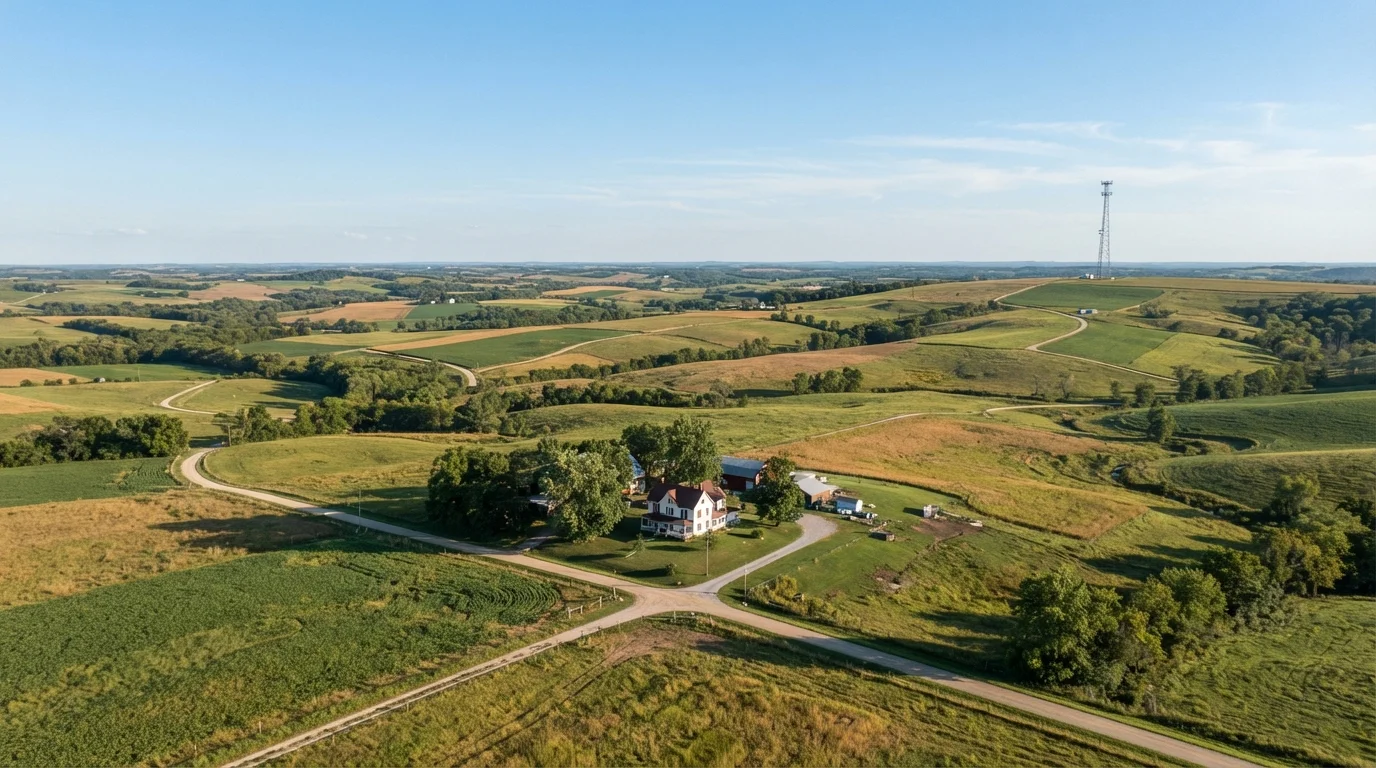
Photo credit: ArticlesHaven.net
In this article
Rural areas often have limited carrier options and patchier coverage. Understand how to evaluate rural wireless service before committing to a plan.
Key Takeaways
- Rural areas have fewer cell towers, so carrier choice is often more limited than in cities.
- Low-band spectrum travels farther and is the primary technology enabling rural coverage.
- Coverage maps are a starting point, but real-world signal can differ significantly from what they show.
- Roaming agreements between carriers can extend your usable coverage but may come with data restrictions.
- Testing a carrier with a trial SIM or a return-window device is the most reliable way to evaluate rural signal.
- Fixed wireless or satellite internet may supplement or replace mobile data in coverage gaps.
Why Location Drives Coverage - Not Just Preference
When urban consumers compare wireless plans, the decision often comes down to price, data allowances, and device deals. For rural consumers, the first and often only question that matters is: does this carrier actually have signal where I live?
Wireless carriers build their networks around population density. More towers get placed where more people live - in cities, suburbs, and along major corridors. In rural counties, towers are fewer and spaced farther apart, which creates coverage gaps that no plan upgrade can fix. Your ZIP code, in effect, is your coverage profile.
This isn't a minor inconvenience. Depending on where you live, you may have two viable carrier options, one, or none that deliver reliable service. Understanding why that happens puts you in a far better position to evaluate your real choices rather than being misled by national advertising that reflects urban performance.
Wi-Fi Calling Can Partially Compensate
If your home has a broadband internet connection, Wi-Fi calling allows your phone to route calls and texts over the internet rather than the cellular network. This doesn't solve mobile coverage issues outside your home, but it can make a carrier with marginal outdoor signal workable for everyday communication indoors. Check whether your device and plan support Wi-Fi calling before assuming you need a full carrier switch.
How Spectrum Bands Shape Rural Signal
Not all cellular signals travel the same way. Carriers use different spectrum bands - ranges of radio frequencies licensed from the federal government - and the band used largely determines how far a signal can travel and how well it penetrates hills, trees, and buildings.
- Low-band spectrum (roughly 600-900 MHz): Travels tens of miles from a tower and passes through obstacles relatively well. This is the workhorse of rural coverage. Carriers with strong low-band holdings generally have broader rural reach.
- Mid-band spectrum (roughly 1-6 GHz): Offers faster speeds but a shorter range - typically just a few miles. More common in suburban and urban builds.
- High-band (mmWave): Very fast, very short range, blocks easily. Essentially irrelevant for rural coverage.
When evaluating a carrier's rural footprint, look specifically at what low-band spectrum they hold and how widely they've deployed it in your region. A carrier with aggressive low-band deployment is likely to serve rural areas more reliably than one leaning heavily on mid-band or high-band for its headline 5G claims.
~39%
Rural Americans lacking reliable broadband access
The FCC has noted in multiple reports that tens of millions of rural Americans face limited connectivity options compared to urban counterparts, though exact figures vary by measurement methodology.
600 MHz
Key low-band frequency for rural 5G deployment
Carriers have cited 600 MHz spectrum as central to their rural 5G strategies, given its long propagation range compared to mid- and high-band alternatives.
Up to 30 mi
Approximate range of low-band signals from a single tower
In flat terrain with minimal obstruction, low-band cellular signals can reach 20-30 miles from a tower - a key reason carriers prioritize this spectrum for rural buildouts.
Reading Coverage Maps Without Being Misled
Every major carrier publishes an online coverage map. These maps are a useful starting point, but they have well-documented limitations that rural customers in particular need to understand.
Coverage maps are generated using predictive modeling - they estimate signal based on tower locations, terrain data, and propagation models. Actual signal on the ground is influenced by factors the model may not capture accurately: local topography, tree density, building materials, and even weather. A map showing "good coverage" in your township might reflect signal at the top of a nearby ridge rather than in the valley where your home sits.
For a more grounded picture, the guide to how coverage maps work and where they fall short explains how to interpret these tools more accurately. The single most reliable method, however, remains asking people who already live in your area which carrier they use and whether it's dependable day to day.
Roaming, MVNOs, and Other Options Worth Understanding
If your preferred carrier has thin rural coverage, two concepts are worth understanding: roaming agreements and MVNOs (Mobile Virtual Network Operators).
Roaming allows your phone to connect to a partner carrier's towers when your home carrier has no signal in a given area. This can meaningfully extend your usable coverage. However, most postpaid and virtually all prepaid plans restrict roaming data - capping how much you can use at roaming speeds or throttling it significantly. Network sharing and roaming agreements between US carriers explains how these arrangements are structured and what they mean for your day-to-day experience.
MVNOs lease network capacity from major carriers and resell it at lower prices. In rural areas, the caveat is deprioritization - when a tower is congested, MVNO customers are often the first to experience reduced speeds, since the host carrier's own customers get priority access.
Beyond cellular, rural households dealing with persistent coverage gaps may find that fixed wireless or satellite home internet paired with Wi-Fi calling delivers more consistent communication than cellular alone. The comparison of DSL vs. fixed wireless for rural homes covers the broadband side of this tradeoff in detail.
Test Before You Commit
If a carrier offers a trial SIM or a device return window, use it specifically to test coverage at your home address, along your regular driving routes, and at any location where reliable signal is critical - such as a home office or outbuilding. A week of real-world testing is worth far more than any coverage map.
Making an Informed Decision Before You Commit
Rural wireless decisions carry more risk than urban ones because switching costs - porting a number, buying a new device, waiting for a new SIM - are real. Getting it right the first time saves frustration.
A few practical steps before committing to any plan:
- Check coverage maps for your specific address, not just your county or region. Zoom in as far as the tool allows.
- Ask locally. Neighbors, local businesses, and community social media groups are often the most accurate source of real-world performance data for your area.
- Request a trial period. Some carriers offer trial SIMs or short return windows. Use them to test signal at your home, along your regular commute, and at any location where reliable service is critical.
- Read the roaming fine print. If a plan's rural coverage relies partly on roaming, understand exactly what data limits or restrictions apply.
Before signing any new agreement, the full checklist for evaluating a new phone plan covers the additional details - data caps, device compatibility, contract terms - that apply regardless of whether you're in a rural or urban market.
“Coverage maps are marketing tools as much as they are technical documents. A consumer in a rural area should treat any map as a hypothesis to be tested, not a guarantee of service.”
— Rural Telecommunications Policy Researcher, Academic researcher specializing in rural broadband and wireless infrastructure policy
Frequently Asked Questions

Author
Articles Haven Editorial Contributor
Articles Haven Editorial Team is the collective byline for our editorial team and contributor network. Articles published under this byline or an editorial pen name are researched, written, and reviewed according to our editorial standards for clarity, consistency, and independence before publication.
View all articles →