
Individual Plan vs. Family Plan: Choosing the Right Tier for Your Household
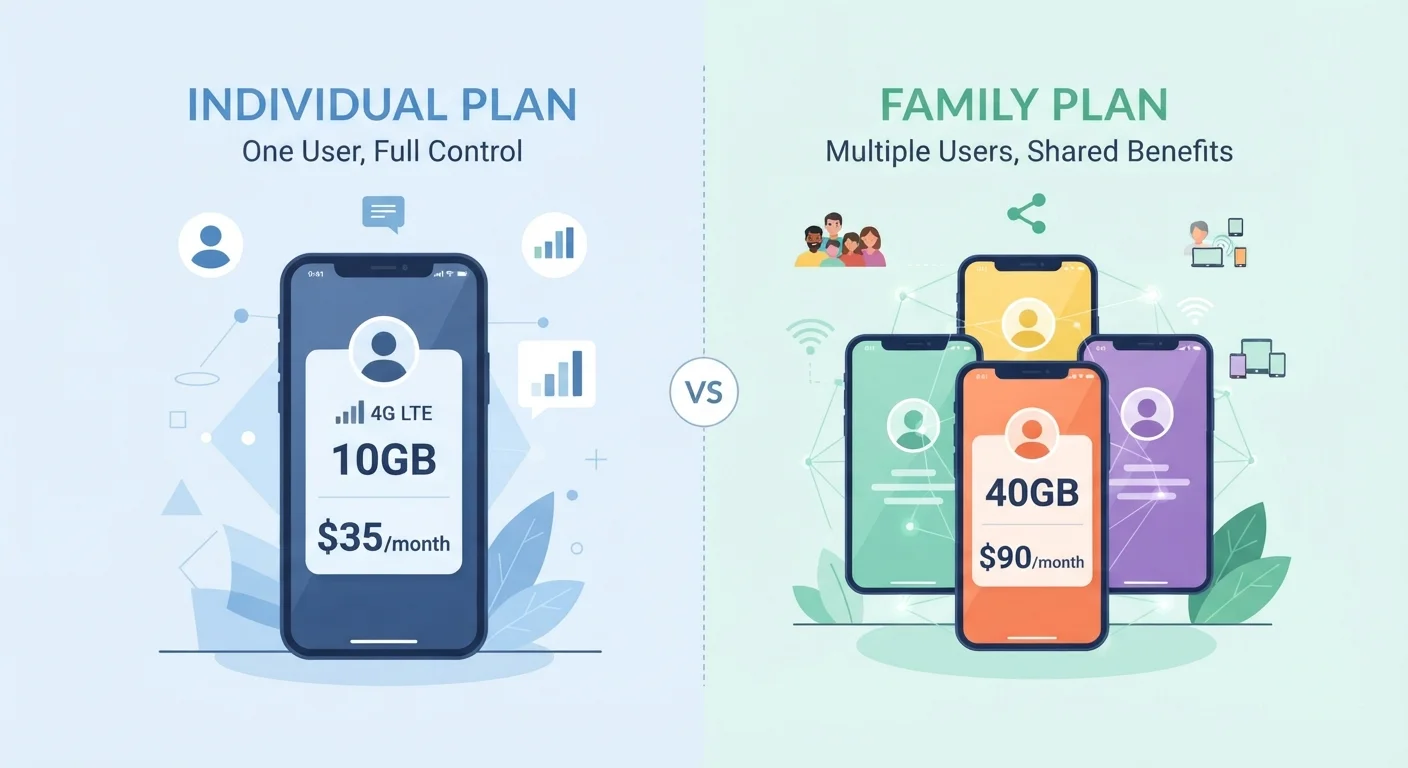
Photo credit: ArticlesHaven.net
In this article
Is a family plan always cheaper? Compare individual and multi-line plan structures to see which makes sense for your situation.
Key Takeaways
- Family plans almost always reduce the per-line monthly cost, but only if you have enough lines to justify them.
- Individual plans offer billing independence - one person's missed payment doesn't affect anyone else.
- Family plans typically require a primary account holder who is legally responsible for the full bill.
- The break-even point between an individual plan and a family plan is usually two to three lines.
- Data allocation, hotspot limits, and premium features may differ between tiers even within family plan structures.
How Each Plan Structure Is Built
An individual plan covers one line. You pay a flat monthly rate for a set amount of data, talk, and text - and that account belongs entirely to you. There's no coordination with other users, no shared pool to monitor, and no secondary account holders.
A family plan (sometimes called a multi-line plan) bundles two or more lines under a single account. The primary account holder is billed for all lines combined. Each line may have its own data allocation, or all lines may draw from a shared pool depending on the carrier's structure. For more on how shared data and group billing actually work in practice, see how family phone plans structure shared lines and multi-line discounts.
The key mechanical difference is who controls the account and who is financially responsible. On a family plan, the primary account holder owns the contract - which creates both convenience and liability.
| Criterion | Individual Plan | Family Plan |
|---|---|---|
| Number of lines | One line only | Two or more lines |
| Per-line monthly cost | Higher (no group discount) | Lower as lines increase |
| Billing responsibility | Account holder only | Primary account holder for all |
| Account independence | Fully independent | Shared account, linked lines |
| Usage visibility | Your data only | Primary can view all lines |
| Plan tier flexibility | Choose your own tier | Often same tier required across lines |
| Setup complexity | Simple, self-managed | Requires coordination among members |
The Per-Line Cost Math
The main appeal of a family plan is cost reduction per line. Carriers structure pricing so that each additional line costs less than the first. In general terms, a single line might cost significantly more per month than that same line would cost as part of a three- or four-line account.
~40%
Typical per-line savings on a 4-line family plan vs. individual
Industry analysts and carrier pricing structures generally show per-line costs dropping by roughly 35-45% when moving from one line to four lines on comparable tiers.
2-3 lines
Break-even point where family plans typically beat individual plans
Most carrier pricing models make the family plan cost-effective at two lines, with savings becoming more pronounced at three or more.
The savings aren't automatic, though. You need to compare the total family plan bill against what multiple individual plans would actually cost. Sometimes the gap is smaller than advertised, particularly when individual plan promotions are active or when not all lines need the same feature set.
Also factor in: family plans often require all lines to sit on the same tier. If one person needs unlimited premium data and another is fine with a basic data cap, a family plan may force you to pay for the higher tier across all lines. That's worth modeling before committing. Our guide on what changes between plan tiers within a single carrier can help you understand what you'd actually be upgrading to.
Independence vs. Shared Responsibility
Individual plans are financially self-contained. If you're managing your own budget and don't want your service affected by someone else's payment behavior - or vice versa - that independence has real value.
Family plans create interdependence. A late payment by any member on the account can affect service for everyone. Disputes over data overages or feature upgrades have to be resolved among account members. The primary account holder also typically has full visibility into usage data for every line, which raises privacy considerations worth discussing before adding someone to your account.
Account Ownership and Privacy
On a family plan, the primary account holder generally has access to call logs, data usage summaries, and billing details for every line. If any member of the group values billing privacy - particularly adult children or housemates who aren't relatives - this visibility should be discussed before setting up a shared account. Some carriers offer limited privacy settings, but full account separation typically requires individual plans.
That said, for households with a high degree of trust and coordination - couples, parents managing children's lines, or small groups with shared finances - the administrative simplicity of one consolidated bill is a genuine convenience. See how this plays into broader telecom bundling decisions in our overview of when bundled services cost less than standalone plans.
When to Reconsider and How to Decide
If your household situation changes - someone moves out, a relationship ends, or a family member wants to take over their own billing - untangling a family plan can be complicated. Lines may need to be ported to new accounts, and any promotional credits tied to the group account may be forfeited.
Before choosing, answer three questions: How many lines do you actually need? Are the people sharing the account comfortable with shared billing and account visibility? And does the total cost of the family plan beat the total cost of separate individual plans when you account for the specific tiers each person actually needs?
Your household's internet setup is a related variable - if multiple people are relying heavily on mobile data rather than home Wi-Fi, the calculus shifts. The internet plan comparison by household type resource walks through how different living situations should frame their connectivity decisions overall.
This article provides general information about wireless plan structures for educational purposes. Plan pricing, terms, and availability vary by carrier and region. Verify current details directly with your carrier before making a decision.

Author
Articles Haven Editorial Contributor
Articles Haven Editorial Team is the collective byline for our editorial team and contributor network. Articles published under this byline or an editorial pen name are researched, written, and reviewed according to our editorial standards for clarity, consistency, and independence before publication.
View all articles →