
Deductible vs. Out-of-Pocket Maximum: Two Numbers That Determine Your Real Costs
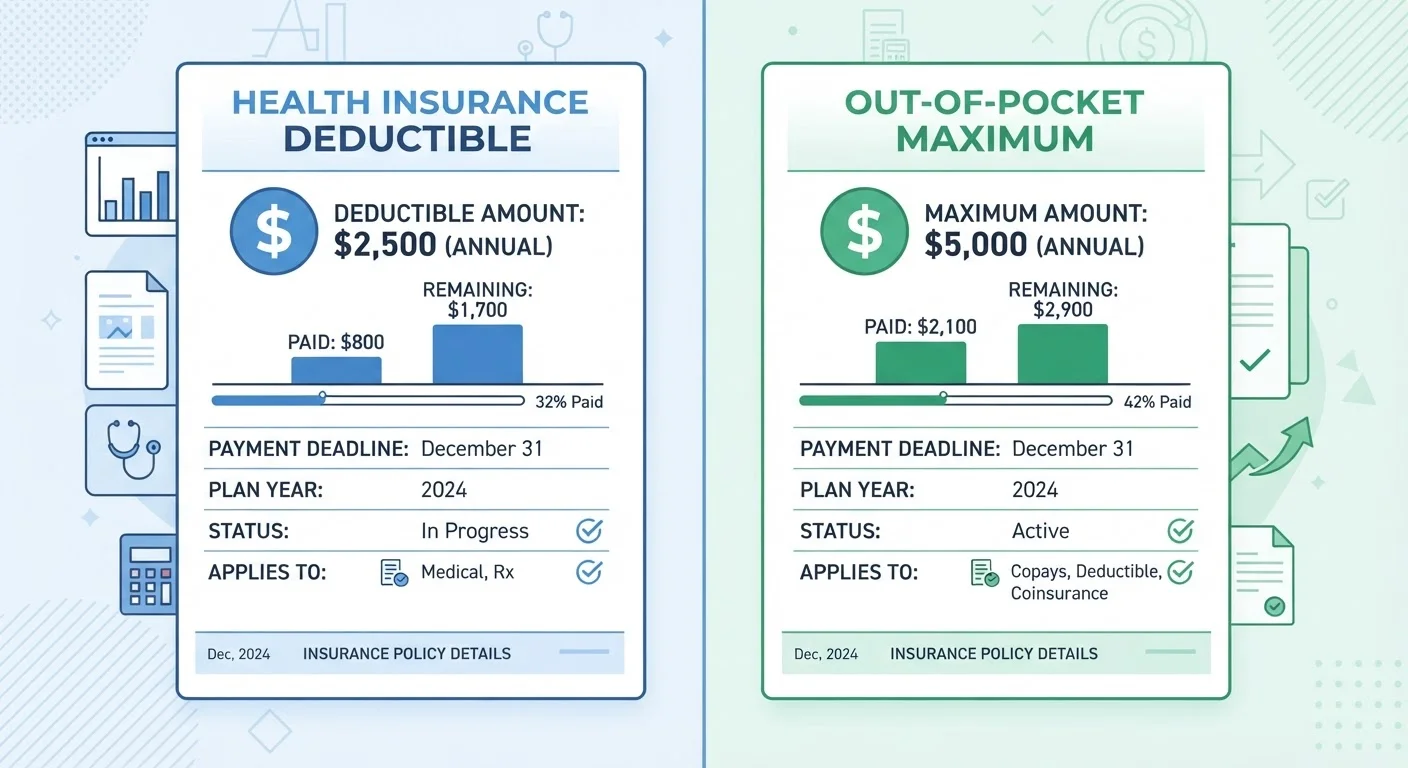
Photo credit: ArticlesHaven.net
In this article
These two figures look similar but work very differently. Here's how to read them together when evaluating any insurance policy.
Key Takeaways
- Your deductible is what you pay first before insurance kicks in - the out-of-pocket maximum is the most you'll ever pay in a year.
- Hitting your deductible doesn't end your cost-sharing; coinsurance or copays usually continue until you reach your out-of-pocket maximum.
- Premiums do not count toward either your deductible or your out-of-pocket maximum.
- Out-of-pocket maximums are federally capped for ACA-compliant health plans; deductibles are not.
- Reading both numbers together - not separately - gives you a realistic picture of your potential annual costs.
What Each Term Actually Means
These two figures appear on every health insurance plan summary, yet they're routinely confused - even by people who've had insurance for years. The confusion is understandable: both involve dollar amounts, both reset annually, and both affect what you pay out of your own pocket. But they do fundamentally different jobs.
A deductible is the amount you must pay for covered services before your insurer starts contributing. If your deductible is $1,500, you pay the first $1,500 of covered medical costs each plan year on your own. Only after clearing that threshold does the plan begin sharing expenses with you - typically through coinsurance (a percentage split) or flat copays.
The out-of-pocket maximum (sometimes called the out-of-pocket limit) is a hard ceiling. Once your total qualifying costs - including your deductible, coinsurance, and copays - reach that figure, your insurer covers 100% of covered in-network costs for the remainder of the plan year. It's the financial backstop that prevents a serious medical event from becoming an open-ended expense.
For a fuller picture of how both terms interact with premiums and copays, see how deductibles, premiums, and copays fit together.
| Criterion | Deductible | Out-of-Pocket Maximum |
|---|---|---|
| What it represents | Amount you pay before insurance shares costs | Maximum you pay before insurance covers 100% |
| Position in cost-sharing sequence | Starting threshold - first costs you absorb | Ending ceiling - where your exposure stops |
| Federal cap (ACA plans) | No federal cap | Annual federal cap applies |
| Premiums count toward it? | No | No |
| Coinsurance counts toward it? | Varies by plan | Generally yes, for in-network costs |
| Key question it answers | When does my insurer start helping? | What's the worst I can pay this year? |
| Relevance for catastrophic events | Lower relevance - only covers initial costs | High relevance - limits total financial exposure |
How They Work Together in Practice
Here's where many people get tripped up: reaching your deductible does not stop your cost-sharing. It just changes the form it takes. After your deductible is met, you typically still owe a percentage of each bill (coinsurance) or a flat fee per visit (copay) until you hit your out-of-pocket maximum. Think of it as a relay: the deductible is the starting line, the out-of-pocket maximum is the finish line, and coinsurance or copays are the middle miles.
Consider a simplified example. Suppose your plan has a $1,500 deductible, 20% coinsurance after the deductible, and a $5,000 out-of-pocket maximum. If you undergo a procedure billed at $10,000, you'd pay the first $1,500 (deductible), then 20% of the remaining $8,500 ($1,700 in coinsurance), totaling $3,200 - well under the $5,000 cap. In a catastrophic scenario where costs escalate, your out-of-pocket maximum would kick in and shield you from anything beyond $5,000 for that year.
$9,450
ACA individual out-of-pocket maximum (2024)
The federal government sets an annual ceiling on out-of-pocket costs for ACA-compliant individual health plans, updated each year by the Department of Health and Human Services.
$1,500-$8,000+
Typical individual deductible range
Deductibles for individual health plans vary widely based on plan tier (Bronze, Silver, Gold, Platinum) and employer contribution levels, according to KFF Health Insurance data.
43%
Adults underestimating out-of-pocket exposure
A Kaiser Family Foundation survey found a significant share of insured adults are uncertain or incorrect about how their plan's cost-sharing limits work in practice.
One important distinction: premiums - your monthly plan payment - do not count toward either your deductible or your out-of-pocket maximum. Paying $400 a month in premiums gets you no closer to satisfying either threshold. This is a common misconception worth double-checking on any plan you're evaluating. For more on that relationship, see why your deductible and premium move in opposite directions.
Key Differences and What to Watch For
Several structural differences between these two numbers affect how you should weigh them when comparing plans.
- Federal caps apply to out-of-pocket maximums, not deductibles. For ACA-compliant individual and employer-sponsored health plans, the federal government sets annual maximums on out-of-pocket limits (figures are updated each year). Deductibles have no such federal cap for most plan types, meaning they can vary widely.
- What counts toward each can differ. Some plans apply copays and coinsurance to the out-of-pocket maximum but not to the deductible. Others have separate deductibles for different service categories (e.g., prescription drugs vs. medical services). Always read the plan's Summary of Benefits and Coverage document - not just the headline numbers.
- Network boundaries matter. Most plans track in-network and out-of-network spending separately. Out-of-network costs often accumulate toward a separate, higher out-of-pocket maximum - or may not accumulate at all. Understanding how your plan handles this is essential. How in-network vs. out-of-network cost differences work is worth reviewing before any significant care decision.
- Family plans have two layers. Group or family plans commonly carry both individual and family-level deductibles and out-of-pocket maximums, which adds another layer of calculation when multiple people are on the same policy.
Family Plans: Two Sets of Numbers
Most family health plans carry both an individual deductible and a family deductible, plus individual and family out-of-pocket maximums. Under ACA rules, no single family member can be required to pay more than the individual out-of-pocket maximum before the plan covers their costs in full - even if the family limit hasn't been reached. Check both figures carefully when enrolling dependents.
For a broader comparison of cost-sharing terms, the difference between copays, coinsurance, and out-of-pocket maximums breaks down how each piece fits into your total annual spending.
This article provides general insurance information for educational purposes only and does not constitute personalized insurance, financial, or legal advice. Coverage terms, limits, and rules vary by plan and provider. Always review your actual policy documents and consult a licensed insurance agent or adviser before making coverage decisions.

Author
Articles Haven Editorial Contributor
Articles Haven Editorial Team is the collective byline for our editorial team and contributor network. Articles published under this byline or an editorial pen name are researched, written, and reviewed according to our editorial standards for clarity, consistency, and independence before publication.
View all articles →