
Shared Household Chore Apps vs. Paper Chore Charts: What Works Better?
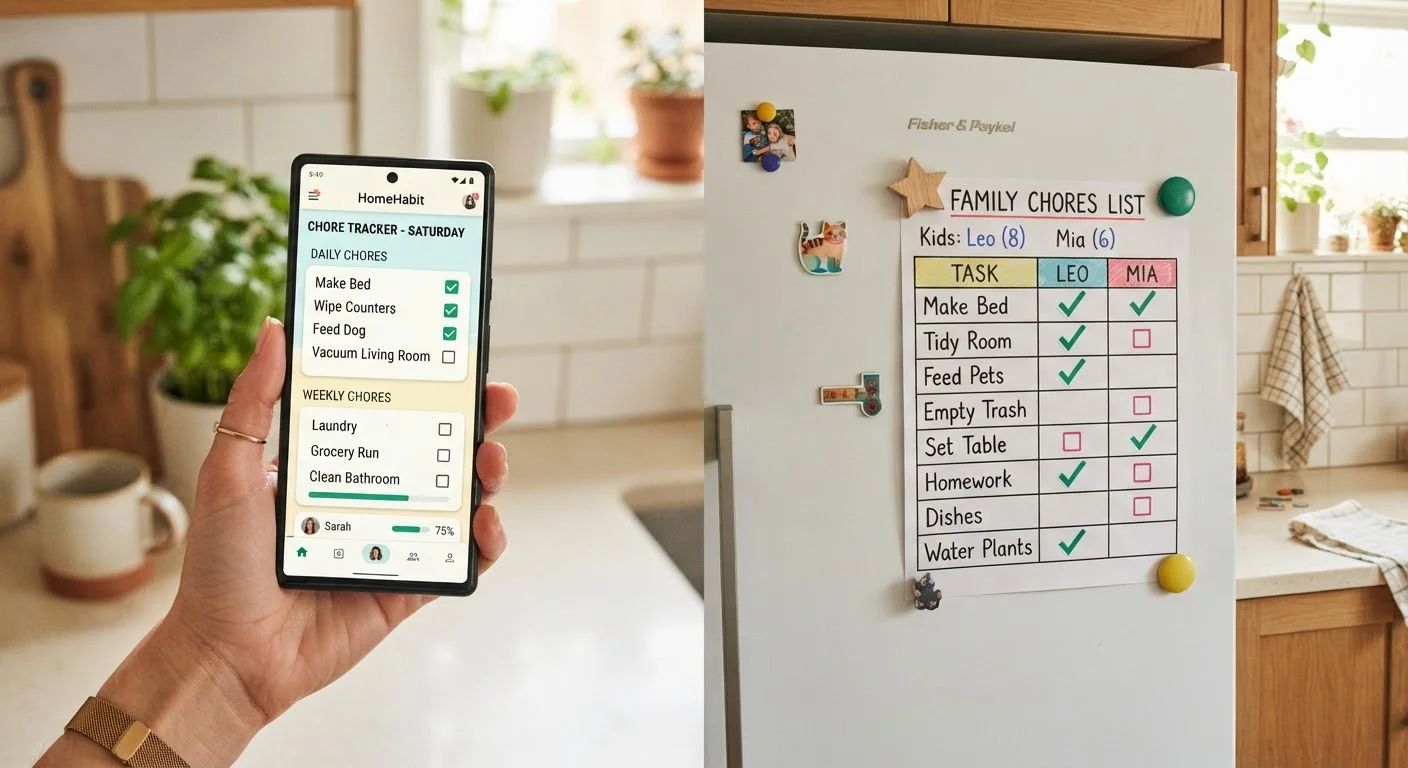
Photo credit: ArticlesHaven.net
In this article
Compare digital chore-tracking tools with traditional written charts to find which approach fits different household dynamics.
Key Takeaways
- Chore apps work best when every household member is willing to engage with the same platform consistently.
- Paper charts require no setup, cost almost nothing, and are always visible without unlocking a device.
- Apps offer notification reminders and task history; paper charts offer tactile satisfaction and zero screen time.
- Neither system reduces resentment on its own - clear agreements about fairness matter more than the tool.
- Households can layer both approaches: a paper chart for daily basics and an app for rotating or irregular tasks.
How Each System Actually Functions
Shared chore apps - such as category-leading tools in the household management space - let multiple users join a shared workspace where tasks can be assigned, scheduled, and marked complete. Members typically receive push notifications when a task is due or overdue. Many apps include recurring task automation, so dishes, laundry, and vacuuming reappear on schedule without anyone manually re-entering them. For a closer look at which in-app features translate to real daily value, see what features actually matter in household task apps.
Paper chore charts, by contrast, are exactly what they sound like: a written or printed list of tasks paired with names and checkboxes, usually posted somewhere central like a refrigerator or a bulletin board. There's no login, no notification, and no syncing. The chart is either updated by hand or replaced when it fills up. Simple as that.
| Criterion | Chore Apps | Paper Charts |
|---|---|---|
| Setup time | 15-30 minutes (accounts, onboarding) | Under 5 minutes |
| Cost | Free to ~$5/month depending on app | Essentially free |
| Reminders & notifications | Automatic push notifications | None - relies on visibility |
| Task rotation automation | Built-in for most apps | Manual tracking only |
| Works without a smartphone | No | Yes |
| Visibility in shared space | Requires opening app | Always visible if posted centrally |
| Suitable for young children | Limited - needs device access | Yes - no tech required |
| Task history / completion log | Yes, trackable over time | No - chart is typically reset |
Where Apps Have a Real Advantage
The strongest argument for chore apps is asynchronous coordination. When household members have different work shifts, school schedules, or simply aren't home at the same time, a shared digital task list keeps everyone aligned without requiring a household meeting. If someone finishes the grocery run, the app marks it done and others see it immediately.
Apps also handle task rotation far more gracefully. Manually cycling who cleans the bathroom each week on a paper chart is doable but error-prone. An app can automate this rotation without anyone tracking whose turn it is. This matters more as households grow in size. For practical coordination strategies beyond just chore tracking, running a multi-person household covers broader approaches that complement any task system.
~60%
US adults who use smartphones daily
Pew Research Center surveys consistently show smartphone ownership above 85% for US adults, with the majority reporting daily use across age groups.
2-3x
More household tasks done by women on average
Bureau of Labor Statistics American Time Use Survey data shows women continue to spend significantly more time on household activities than men across household types.
Where Paper Charts Hold Their Ground
Paper charts win on visibility and immediacy. A chart on the fridge is noticed every time someone opens it. No one needs to remember to open an app. For households with young children who aren't yet using smartphones, this passive visibility is especially valuable - a child can walk up and check off a task without any adult mediation.
There's also a genuine psychological case for physical checkboxes. The act of marking something done has a tangible quality that a tap on a screen doesn't always replicate, particularly for kids building habits. Cost is another practical factor: a paper chart is free and takes five minutes to make.
For those weighing the broader paper-vs-digital question in home management, managing home documents without the chaos explores similar trade-offs in document storage.
Apps Aren't One-Size-Fits-All
Household management apps vary widely in feature depth. Some are designed primarily for couples, others for families with children, and some skew toward roommate situations. Before committing to a platform, it's worth spending time in a free tier to see whether the interface fits how your household actually thinks about tasks - not just how the app's marketing describes it.
The Real Variable: Household Buy-In
Neither tool works if people don't use it consistently. A chore app where one member logs tasks and others ignore notifications is no better than a paper chart everyone walks past without looking. Research on household labor consistently points to agreement on fairness as the primary factor in whether any system holds. The tool is secondary.
Common assumptions about how labor should be split often create more friction than the system itself. chore division myths that create friction at home covers several of those assumptions with evidence-backed perspective. Choose your tool after the household has reached a genuine agreement about responsibilities - not instead of having that conversation.
One practical middle ground: use a paper chart for daily recurring tasks (dishes, counters, trash) and an app for weekly or irregular tasks that are easy to forget. This hybrid approach limits screen dependency while preserving the organizational power of digital tools where it actually helps.

Author
Articles Haven Editorial Contributor
Articles Haven Editorial Team is the collective byline for our editorial team and contributor network. Articles published under this byline or an editorial pen name are researched, written, and reviewed according to our editorial standards for clarity, consistency, and independence before publication.
View all articles →