
The Habit Loop: Cue, Routine, Reward — and How to Reshape It
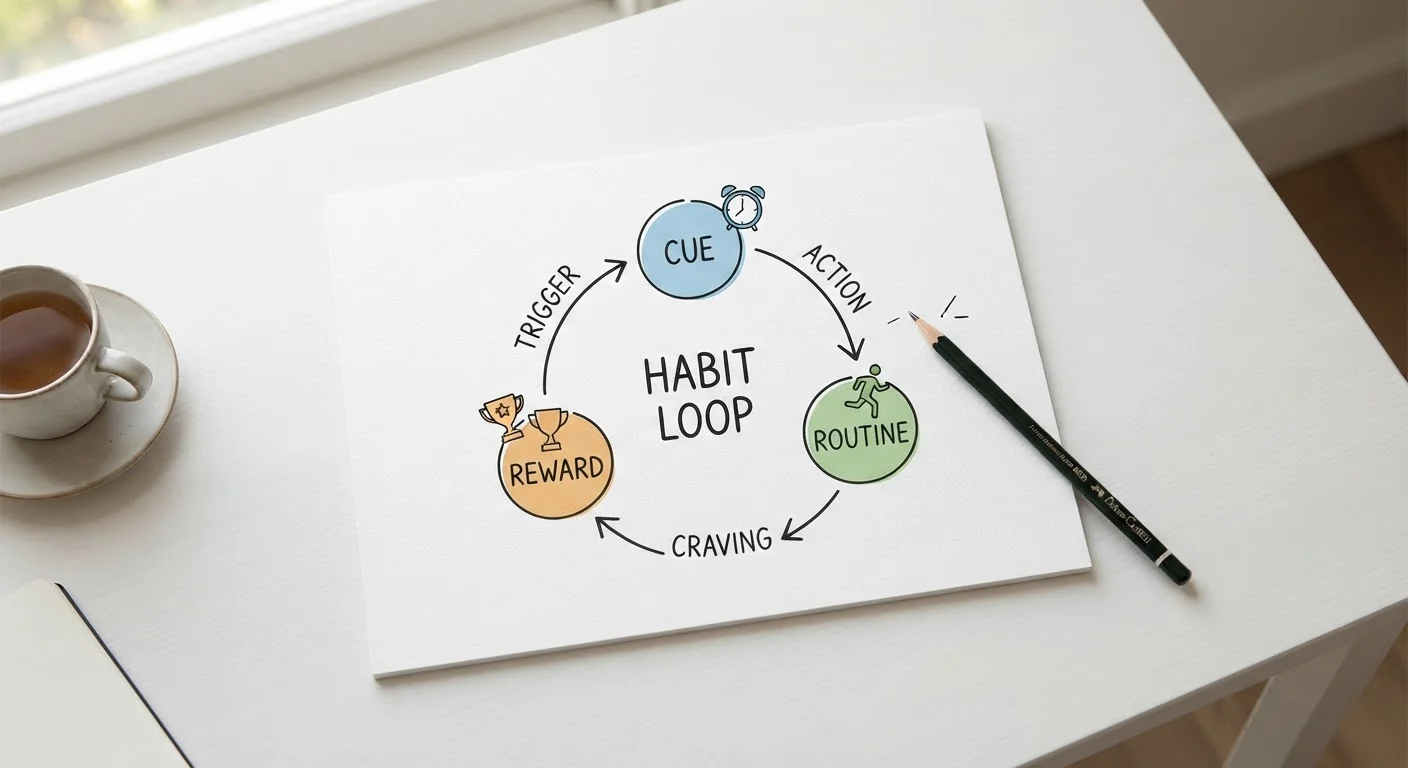
Photo credit: ArticlesHaven.net
In this article
Explore the three-part cycle that drives all habitual behavior and how to intervene at each stage.
Key Takeaways
- Every habit follows a three-stage loop: cue, routine, and reward.
- The cue is the most reliable intervention point for changing an unwanted habit.
- Rewards don't need to be external - emotional relief or a sense of completion also reinforce loops.
- Substituting a new routine while keeping the same cue and reward is a research-supported change strategy.
- Habit loops become more automatic with repetition, which is both why they're hard to break and why they're valuable once formed.
Where Habits Live in the Brain
Habits don't require conscious thought - that's the whole point. Once a behavior becomes habitual, your brain delegates it to lower-level processing systems, freeing up cognitive resources for other tasks. This is efficient but creates a real challenge when you want to change what you're doing automatically.
As explored in what habits actually are and why your brain makes them so hard to break, the neurological basis of habit formation is why willpower alone rarely works as a long-term strategy. Understanding the loop gives you a more reliable set of tools.
40-45%
Share of daily behaviors that are habitual
Research published in the journal Personality and Social Psychology Bulletin estimates that roughly 40-45% of everyday behaviors are performed habitually rather than through active decision-making.
18-254 days
Range for habit automaticity to develop
A study in the European Journal of Social Psychology found wide variation in how long it takes a new behavior to become automatic, depending on the person and the complexity of the habit.
66 days
Median time for a behavior to become automatic
The same European Journal of Social Psychology study reported a median of approximately 66 days for a new habit to reach automaticity - far longer than the widely cited but unsupported "21-day" figure.
Breaking Down the Three Stages
The Cue
A cue is any stimulus that triggers the habit sequence. It might be an alarm, a specific location, an emotional state, another person, or even a time of day. The cue doesn't cause the behavior directly - it activates the learned expectation of a reward, which then pulls you into the routine.
The Routine
The routine is the actual behavior - physical, mental, or emotional. It's what most people focus on when they try to change a habit, but the routine is only one third of the equation. Targeting it without addressing the cue or reward is why so many attempts at change fail.
The Reward
The reward is what your brain uses to decide whether this loop is worth running again. Rewards can be external (a snack, a social interaction) or internal (stress relief, a sense of control, dopamine release tied to completion). Over repetition, your brain begins to anticipate the reward the moment it detects the cue - a phenomenon sometimes called craving, which helps explain why habits feel urgent.
How to Intervene at Each Stage
The most reliable intervention point is the cue. Redesigning your environment to remove or change triggers is more effective than relying on willpower to resist the routine. If the cue never fires, the loop never starts.
When the cue can't be avoided, the next strategy is routine substitution - keeping the cue and reward constant but inserting a different behavior in the middle. This is the core logic behind many behavior change programs and is supported by research in habit science.
Adjusting the reward is harder but possible. Making an unwanted behavior less satisfying - or making a desired alternative more immediately rewarding - can gradually shift which loop your brain prefers.
Track Before You Try to Change
Before attempting to alter a habit, spend one to two weeks simply observing it. Note the time, location, emotional state, and what preceded the behavior. This detective work often reveals a cue that wasn't obvious - and knowing the actual cue makes substitution strategies far more effective.
For practical strategies that build on this foundation, habit stacking is one technique that uses existing loops as anchors for new ones - and it leverages the cue-routine-reward structure directly.
Keeping Habit Loops Healthy
While habit loops are genuinely useful, they can also become rigid. A routine that once served you well can become an obstacle - or in some cases, a harmful pattern - if the underlying need changes but the loop doesn't. It's worth periodically auditing your routines to check whether the reward they deliver still aligns with your actual goals.
When healthy habits become rigid rules is a useful read if you're wondering whether a routine has shifted from helpful to restrictive. The loop framework applies there too: if a cue triggers anxiety rather than motivation, that's a signal worth paying attention to.
For a broader view of how to build and sustain habits grounded in behavioral science, the complete overview of healthy habit building covers the full picture. And if you're curious about compounding small changes over time, the case for incremental change offers useful perspective on why modest, consistent adjustments often outperform dramatic overhauls.
Habits and Mental Health Overlap
Some behaviors that resemble habits - compulsive checking, repetitive actions tied to anxiety, or cycles tied to mood - may have a mental health component that goes beyond routine habit formation. If a behavior feels truly out of your control or is causing distress, it's worth discussing with a qualified mental health professional rather than treating it purely as a habit loop problem.
This article is for general informational and educational purposes only. It does not constitute medical or psychological advice. If you are struggling with compulsive behavior, addiction, or mental health concerns, please consult a qualified healthcare or mental health professional.
Frequently Asked Questions

Author
Articles Haven Editorial Contributor
Articles Haven Editorial Team is the collective byline for our editorial team and contributor network. Articles published under this byline or an editorial pen name are researched, written, and reviewed according to our editorial standards for clarity, consistency, and independence before publication.
View all articles →