
What Your Credit Score Actually Does to Your Car Loan
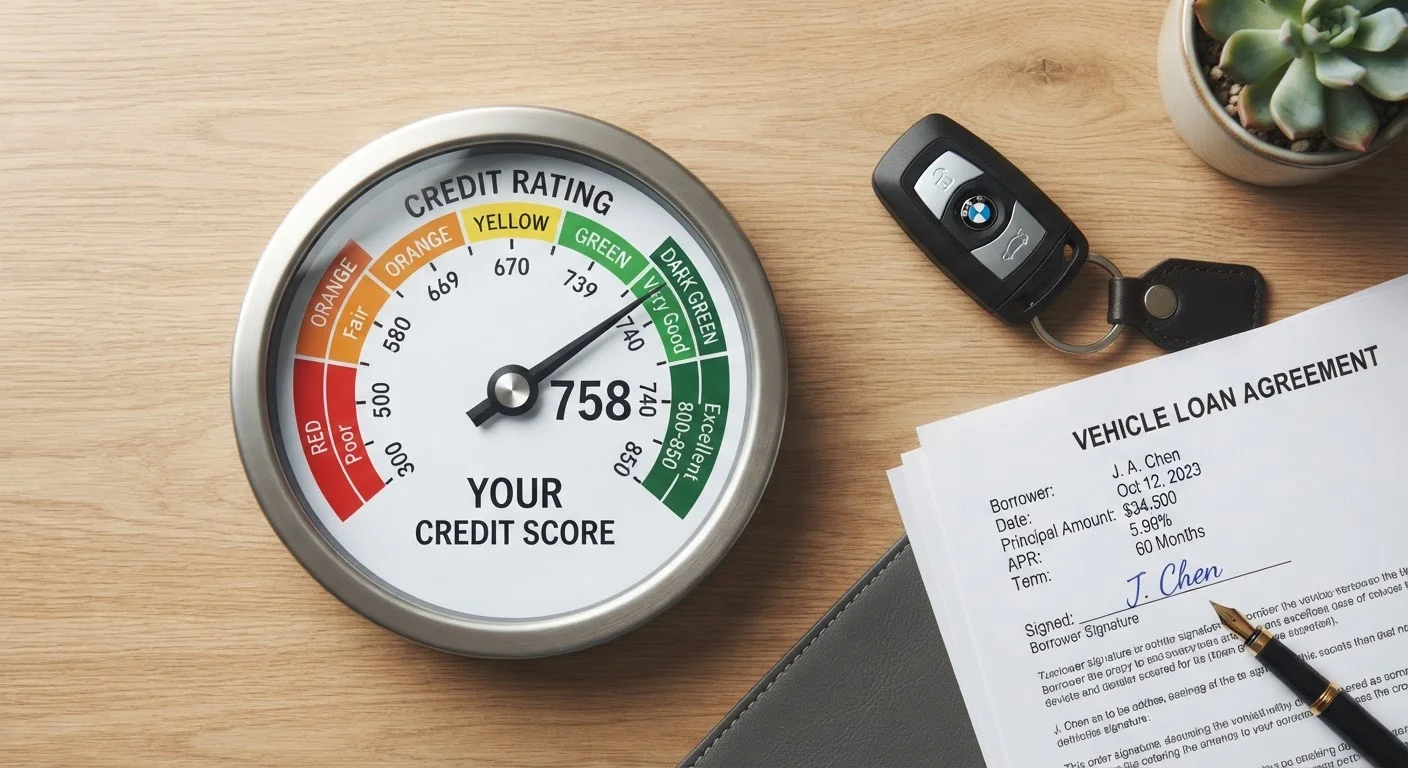
Photo credit: ArticlesHaven.net
In this article
See how credit score ranges affect the interest rates lenders offer, and what a few points difference can mean over a loan's lifetime.
Key Takeaways
- Your credit score directly sets the APR a lender will offer you on a car loan.
- Even a 50-100 point difference in score can shift your rate by several percentage points.
- A higher rate on a 60-month loan can cost hundreds or even thousands more in total interest.
- Lenders group borrowers into tiers; moving up a tier has the biggest rate impact.
- Checking your credit before shopping gives you time to correct errors and improve your position.
How Lenders Use Your Score to Set Your Rate
When you apply for an auto loan, a lender doesn't look at your credit score in isolation - they use it to slot you into a pricing tier. Each tier carries a defined APR range. The better your score, the lower the tier's rate floor. The worse your score, the higher the ceiling you're priced against.
Most lenders organize borrowers roughly as follows, though the exact cutoffs vary by institution:
- Excellent (720+): Access to the lender's lowest advertised rates.
- Good (660-719): Slightly elevated rates, but still competitive financing.
- Fair (600-659): Noticeably higher APRs; some lenders may require a larger down payment.
- Poor (below 600): Subprime territory - rates can run significantly higher, and terms may be more restrictive.
For a first-time borrower trying to get their bearings, the auto loan basics guide breaks down APR, loan terms, and how monthly payments are structured before you sit down with a lender.
~5-15%
Typical APR range across credit tiers for auto loans
General industry data shows subprime borrowers often face rates two to three times higher than prime borrowers for the same loan amount and term.
$5,000+
Extra interest paid by fair vs. excellent credit borrowers
On a $28,000 loan over 60 months, moving from a ~5% to a ~13% APR adds roughly $6,500 in total interest based on standard amortization calculations.
14-45 days
Rate-shopping window for minimal credit score impact
FICO scoring models consolidate multiple auto loan hard inquiries made within this window into a single inquiry, encouraging consumers to compare lenders.
What a Rate Difference Actually Costs You
The real-world impact of credit score tiers shows up in total interest paid - a figure that's easy to underestimate when you're focused on the monthly payment. Consider a $28,000 vehicle financed over 60 months:
| Credit Tier | Approximate APR | Monthly Payment | Total Interest Paid |
|---|---|---|---|
| Excellent | 5% | ~$529 | ~$3,740 |
| Good | 8% | ~$568 | ~$6,080 |
| Fair | 13% | ~$637 | ~$10,220 |
| Poor | 19% | ~$726 | ~$15,560 |
These figures are illustrative estimates based on general rate ranges and are not a guarantee of any lender's offer.
The gap between the excellent and poor tiers in this example exceeds $11,000 in interest alone - on the same vehicle, same loan term, same purchase price. That's the financial weight your credit score carries.
Steps That Can Move Your Score Before You Apply
If your score sits near a tier boundary, even modest improvement can shift you into a better rate category. A few moves worth considering well before applying:
- Pull your credit reports: Review all three bureau reports (Equifax, Experian, TransUnion) for errors. Disputing inaccurate negative items is one of the few cost-free ways to raise a score.
- Reduce utilization: Paying down revolving credit card balances - especially below 30% of the credit limit - can raise your score relatively quickly.
- Avoid opening new credit lines: New accounts lower average account age and add hard inquiries. Hold off on other credit applications in the months before car shopping.
- Make all payments on time: Payment history is the single largest factor in most scoring models. Even one missed payment can have an outsized negative effect.
Time Your Application After Improvements
Credit score changes from paying down balances or resolving disputes can take 30-60 days to appear on your report. If you're close to a tier boundary, waiting a billing cycle or two after making improvements - and then verifying the update - may be worth it before submitting a loan application.
If your score is already on the lower end, it helps to go in with realistic expectations. The guide to car buying with bad credit covers what lenders are likely to require and how to navigate the process without overextending financially.
Reading the Loan Offer With Your Score in Mind
Once you have an offer in hand, it's worth looking beyond the monthly payment to understand what you're actually agreeing to. Your auto loan statement will show the principal balance, interest charges, and payoff amount - figures that reflect exactly where your credit score placed you in the lender's pricing model.
If you've improved your score significantly after taking out a loan, refinancing is worth exploring. Lenders reassess your creditworthiness at the time of the new application, so a better score may translate to a lower rate on the remaining balance. See how the underlying loan mechanics work with this overview of auto loan financing to understand how refinancing fits into the picture.
Score Variations Between Lenders Are Normal
The credit score a lender pulls may differ from the score you see in a free monitoring app. Lenders often use industry-specific scoring models (like FICO Auto Score) that weight certain factors differently than general consumer scores. A small gap between what you see and what a lender sees is common and not a sign of error.
This article is for general informational purposes only and does not constitute financial or lending advice. Loan terms, rates, and eligibility vary by lender and individual circumstances. Consult a licensed financial professional or lender directly for guidance specific to your situation.
Frequently Asked Questions

Author
Articles Haven Editorial Contributor
Articles Haven Editorial Team is the collective byline for our editorial team and contributor network. Articles published under this byline or an editorial pen name are researched, written, and reviewed according to our editorial standards for clarity, consistency, and independence before publication.
View all articles →