
Dealer Financing vs. Bank or Credit Union Loans: Weighing Your Options
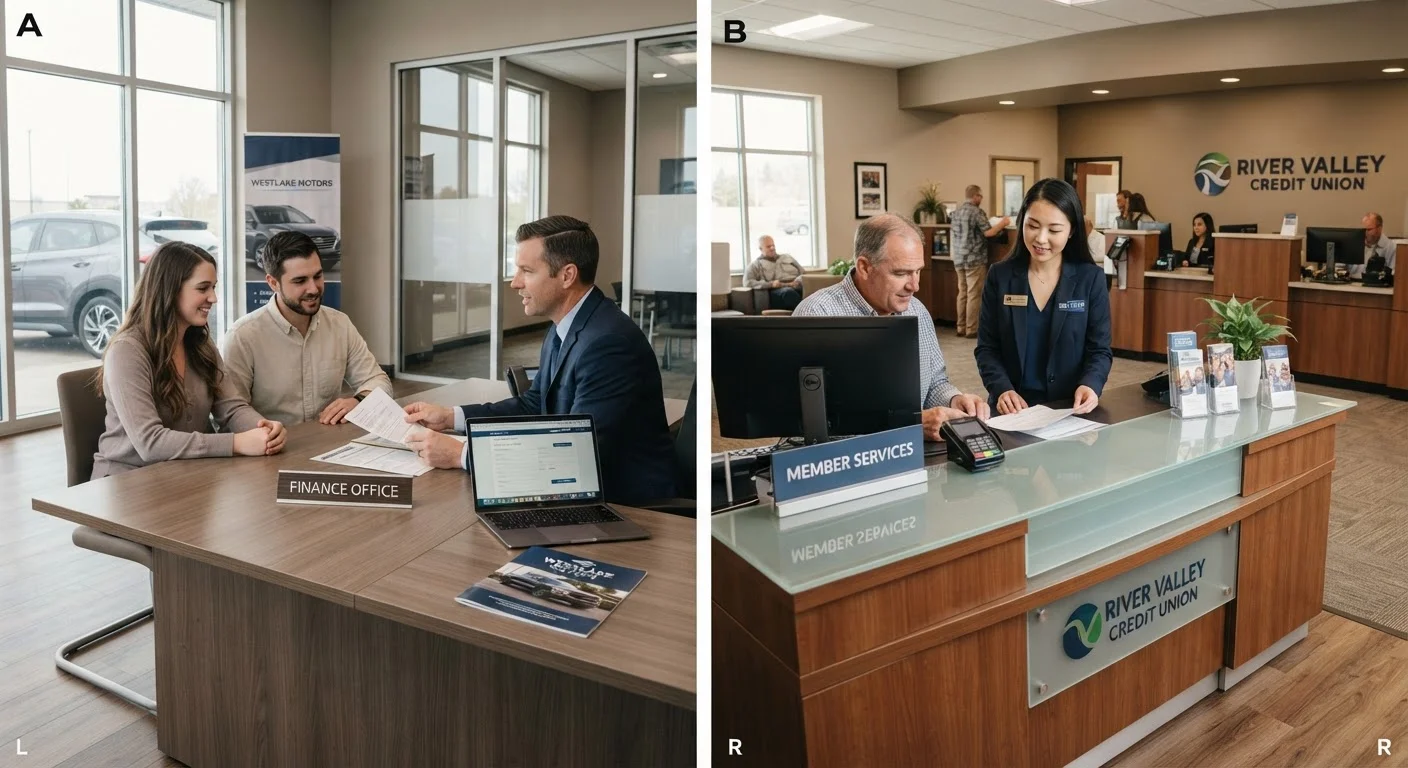
Photo credit: ArticlesHaven.net
In this article
Where you finance your car matters as much as the rate. Compare dealership financing with outside lenders across key factors.
Key Takeaways
- Dealer financing is convenient but the dealership typically marks up the rate above what the lender actually requires.
- Pre-approved bank or credit union loans give you a firm rate ceiling before you start negotiating on price.
- Credit unions often offer lower rates than banks, particularly for members with good credit histories.
- Manufacturer-sponsored promotional rates from dealers can genuinely beat outside lenders for qualified buyers.
- Comparing both options before signing is always worth the effort - it takes one or two extra business days at most.
- Your credit score shapes the rates both channels offer, so understanding it first gives you a stronger negotiating position.
How Each Financing Path Actually Works
When you finance through a dealership, the dealer acts as a middleman. They submit your credit application to one or more lenders - often the automaker's own financial arm, called a captive lender - and then present you with a loan offer. That offer usually carries a slightly higher rate than what the lender quoted the dealer, because the dealer earns what is called a finance reserve, or rate markup, as compensation for arranging the deal.
Bank and credit union loans work differently. You apply directly with the lender before or after visiting the dealer, get approved for a specific amount at a specific rate, and bring that commitment to the table when you negotiate. With a credit union loan in particular, you deal entirely with a member-owned institution whose income model is not built around rate markups. For a broader grounding in how loan mechanics work, see auto loan basics for first-time borrowers.
| Criterion | Dealer Financing | Bank or Credit Union Loan |
|---|---|---|
| Where you apply | At the dealership, day of purchase | Direct with lender before or after shopping |
| Rate transparency | Markup above lender's base rate possible | Rate quoted directly; no middleman markup |
| Promotional rates | Available on select new vehicles from captive lenders | Not eligible for manufacturer promotions |
| Convenience | One-stop process, same-day funding | Requires separate application, extra planning |
| Negotiating position | Rate unknown until finance office | Pre-approval sets firm rate ceiling |
| Used / private-party vehicles | Dealer inventory only | Works for dealer, private-party, and auction buys |
| Credit union option | Not applicable | Member-owned; often lower rates for eligible members |
The Rate Markup Problem - and When It Doesn't Apply
The finance reserve practice is legal and widespread, but it costs borrowers real money. On a $30,000 loan at 72 months, a two-percentage-point markup adds roughly $2,000 in extra interest over the loan's life, depending on the rate environment. Dealers are not obligated to disclose the markup, so the only reliable defense is knowing what competing lenders would charge before you sit in the finance office.
The important exception is manufacturer-sponsored promotional financing. When an automaker wants to move inventory, its captive lender may offer rates substantially below market - sometimes 0% or near-zero APR for well-qualified buyers. In those cases, dealer financing can genuinely win on rate. The catch: you typically have to choose between the promotional rate and a cash-back incentive, not both. Run the numbers on both scenarios before deciding. For guidance on how your credit profile affects the rates you'll actually be offered in either channel, see what your credit score does to your car loan rate.
~1-2%
Typical dealer rate markup over lender's base
Consumer finance research consistently finds that dealer finance reserve markups average one to two percentage points above the lender's actual buy rate, though amounts vary by lender agreement and negotiation.
14-45 days
Rate-shopping window treated as single inquiry
Most major credit scoring models consolidate multiple auto loan hard inquiries made within a 14-to-45-day window into one, reducing the credit impact of comparing lenders.
~30%
Share of new-vehicle buyers using captive lender financing
Industry data from the Federal Reserve and automotive finance reports suggest roughly a third of new-car buyers finance through automaker-affiliated captive lenders, the primary channel for promotional rates.
Pre-Approval as a Negotiating Tool
One of the clearest practical advantages of arranging outside financing is that a pre-approval letter converts your monthly-payment conversation into a vehicle-price conversation. Dealers often prefer to negotiate around monthly payments because small adjustments - stretched terms, bundled add-ons - can obscure the true cost of the loan. When you already have a rate locked in and a maximum loan amount defined, you negotiate on the out-the-door price of the car instead.
Getting pre-approved typically involves a hard credit inquiry, but most scoring models treat multiple auto loan inquiries made within a short window (often 14 to 45 days, depending on the model) as a single inquiry. So shopping two or three lenders in quick succession does less credit damage than many buyers fear. Buyers with lower credit scores face a narrower field of willing lenders but the same core logic applies: knowing your rate ceiling before you enter negotiations protects you.
Rate Shopping Won't Hurt Your Credit Much
Many buyers avoid comparing lenders because they worry about multiple credit inquiries lowering their score. In practice, most scoring models are designed to encourage rate shopping: auto loan inquiries made within a concentrated window are typically grouped into one. Checking your own credit with a soft pull beforehand does not affect your score at all. The risk of skipping comparison - paying a higher rate for years - far outweighs the minor and temporary impact of a hard inquiry or two.
Practical Considerations by Buyer Situation
Your financing path should fit your broader buying situation. If you are purchasing a new vehicle with a strong promotional rate attached, dealer financing deserves serious evaluation. If you are buying a used car - especially from a private seller - a bank or credit union loan is usually your only channel, since dealer-arranged financing is tied to the dealer's own inventory. See how financing terms typically differ for used versus new cars for more on how lender treatment changes based on vehicle age.
Students and buyers with thin credit files often find credit unions more accommodating than either banks or dealer-arranged lenders, since membership-based institutions may apply more judgment and less algorithmic underwriting. Car buying as a college student covers how limited credit history shapes the realistic options. Regardless of which path you choose, understanding the full cost of the loan - not just the monthly payment - is the essential discipline. Car loan basics for owners walks through APR, term length, and total interest paid in straightforward terms.

Author
Articles Haven Editorial Contributor
Articles Haven Editorial Team is the collective byline for our editorial team and contributor network. Articles published under this byline or an editorial pen name are researched, written, and reviewed according to our editorial standards for clarity, consistency, and independence before publication.
View all articles →