
Memory Foam vs. Innerspring Mattresses: What Sleep Science Says About Each
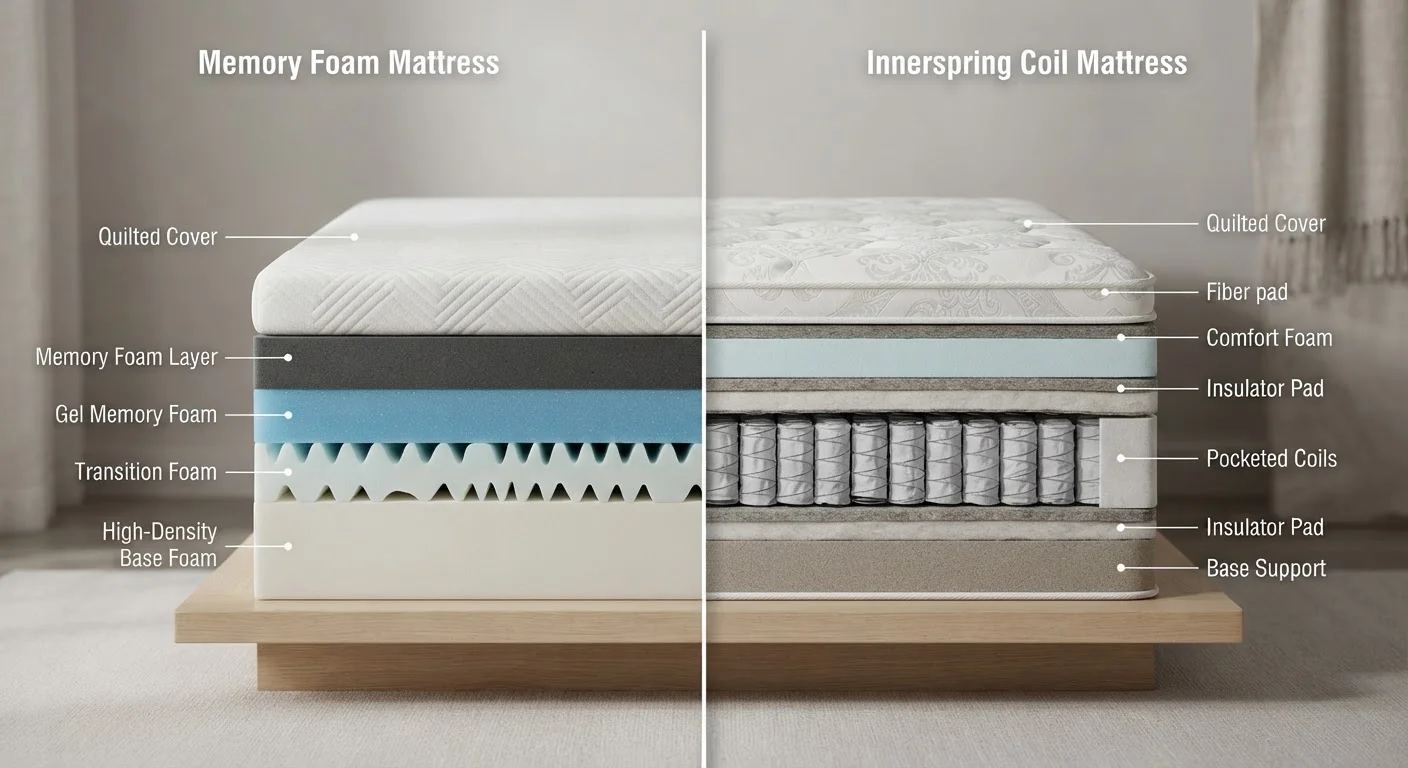
Photo credit: ArticlesHaven.net
In this article
Your sleep position and body type shape which mattress type works best. Compare memory foam and innerspring on support and feel.
Key Takeaways
- Memory foam contours closely to the body, which tends to suit side sleepers and those with joint pain.
- Innerspring mattresses offer more bounce and airflow, generally preferred by stomach and back sleepers.
- Heat retention is a documented drawback of traditional memory foam; newer gel-infused versions partially address this.
- Motion isolation is significantly stronger in memory foam, making it a common choice for couples with different sleep schedules.
- Neither type is universally superior - body weight, sleep position, and temperature sensitivity all factor into the decision.
How Each Mattress Type Works
Memory foam is a viscoelastic polyurethane material originally developed by NASA in the 1960s for aircraft cushioning. When used in mattresses, it responds to body heat and pressure by slowly conforming to your shape, then returning to its original form once pressure is removed. This creates a characteristic "sinking" feel that many sleepers find cradling.
Innerspring mattresses rely on a network of steel coils for their core support. The coil count, gauge (wire thickness), and arrangement - pocketed versus interconnected - determine how firm or responsive the surface feels. A thin comfort layer of foam or fiber typically sits on top of the coil system. The overall feel is bouncier and more "on top of" the surface rather than inside it.
Hybrid mattresses blend both: a foam or latex comfort layer over a pocketed coil base. They're worth knowing about, but this comparison focuses on the two traditional categories to keep the trade-offs clear.
Support, Pressure Relief, and Sleep Position
Research on mattress performance is limited by small sample sizes and industry funding, so most findings should be treated as directional rather than definitive. That said, the general patterns are consistent across studies.
Side sleepers tend to fare better on memory foam. When lying on your side, the hips and shoulders bear concentrated pressure. Memory foam distributes that pressure more evenly, which may reduce numbness and discomfort at those contact points.
Back and stomach sleepers typically need firmer, more uniform support to keep the spine aligned. An innerspring mattress - particularly one with a higher coil gauge and minimal pillow-top - provides that resistance without the deep conforming sink that can let the hips drop out of alignment.
Combination sleepers who shift positions throughout the night often find innerspring or hybrid options easier to move on. Memory foam's slow response time can feel restrictive when you try to reposition.
| Memory Foam | Innerspring | |
|---|---|---|
| Feel | Slow-conforming, cradling sink | Bouncy, responsive, on-surface feel |
| Best sleep position | Side sleepers | Back and stomach sleepers |
| Pressure relief | High - distributes weight evenly | Moderate - depends on coil type and topper |
| Temperature regulation | Tends to retain heat | Breathes well due to open coil structure |
| Motion isolation | Excellent - absorbs movement | Moderate to poor (better with pocketed coils) |
| Typical lifespan | 6-8 years (density-dependent) | 7-10 years for quality coil systems |
Body weight also matters. Heavier sleepers may sink through a lower-density memory foam layer and bottom out, negating the pressure-relief benefit. If you're over 230 lbs, look for higher-density foam (typically 5 lb/ft³ or above) or a hybrid with a robust coil base.
Temperature, Motion, and Durability
Heat retention is the most frequently cited complaint about memory foam. Traditional foam traps warmth because its dense, closed-cell structure limits airflow. Many manufacturers address this with gel-infused foam or open-cell constructions, though independent testing shows variable results - some products improve meaningfully, others show modest gains.
Innerspring mattresses breathe substantially better. Air moves freely through the coil layer, which keeps the sleep surface cooler for most people. If you consistently sleep hot, this is a real functional advantage, not just a marketing claim.
Test Before You Commit
Many mattress retailers offer extended in-home trial periods - commonly 90 to 120 nights. Your body needs at least a few weeks to adjust to a new sleep surface, so resist forming a final opinion in the first week. If temperature is your main concern, try sleeping on the mattress during warmer months before concluding whether heat retention is a real problem for you.
Motion isolation heavily favors memory foam. The material absorbs movement rather than transferring it, so a partner shifting or getting up is less likely to disturb you. Innerspring mattresses - especially those with interconnected coils - transfer motion more readily across the surface. Pocketed coil designs do better than traditional Bonnell coils, but still fall short of foam.
On longevity, a quality innerspring mattress typically maintains its support for 7-10 years; memory foam can degrade and develop body impressions sooner if the foam density is low. Foam density is one of the most reliable quality indicators you can check before purchasing.
Your broader sleep environment matters too. Pairing either mattress type with the right bedding can significantly affect comfort - see our comparison of wool vs. cotton bedding for temperature regulation guidance.
Making the Decision: Key Questions to Ask
Before choosing, work through these practical questions:
- What's your primary sleep position? Side sleepers generally benefit from conforming foam; back and stomach sleepers from firmer, more responsive support.
- Do you sleep hot? If yes, innerspring or a hybrid with a breathable comfort layer is worth prioritizing.
- Do you share a bed? If motion transfer bothers you or your partner, memory foam offers a measurable advantage.
- What's your body weight? Higher weight may require higher-density foam or a coil-supported hybrid to avoid premature sagging.
- Do you have joint or back pain? A healthcare provider is better positioned than any mattress review to advise on this - but generally, pressure relief (foam) or targeted lumbar support (firmer spring) are the two directions clinicians tend to distinguish.
Better sleep also depends on factors beyond the mattress. If you're working on sleep quality more broadly, the sleep routine guide covers evidence-informed steps that complement any mattress choice.
~$1,200
Median US mattress spend per purchase
Consumer spending surveys consistently place the average American mattress purchase in the $900-$1,500 range, with significant variation by type and retailer.
7-9 hrs
Recommended adult sleep duration
The American Academy of Sleep Medicine and Sleep Research Society jointly recommend 7-9 hours of sleep per night for adults to support overall health.

Author
Articles Haven Editorial Contributor
Articles Haven Editorial Team is the collective byline for our editorial team and contributor network. Articles published under this byline or an editorial pen name are researched, written, and reviewed according to our editorial standards for clarity, consistency, and independence before publication.
View all articles →