
Induction vs. Gas Cooktops: The Science of How Each Heats Your Food
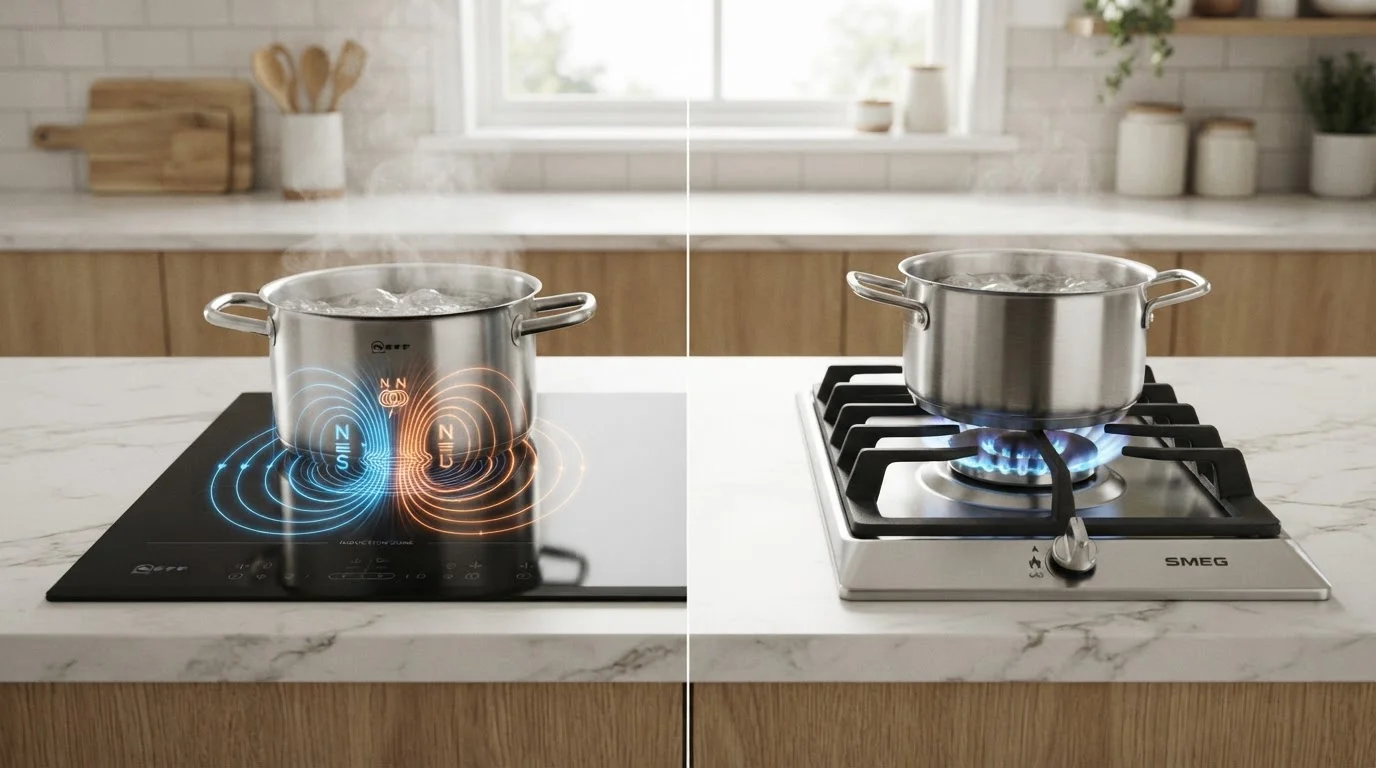
Photo credit: ArticlesHaven.net
In this article
Induction cooktops heat differently than gas—and the distinction matters for control, safety, and compatible cookware.
Key Takeaways
- Induction heats the pan directly via electromagnetic fields; gas heats through open combustion and radiated heat.
- Induction requires ferromagnetic cookware (cast iron, magnetic stainless steel); gas works with virtually any pan.
- Induction cooktops transfer roughly 85-90% of generated energy to food versus roughly 40-55% for gas.
- Gas produces combustion byproducts including nitrogen dioxide; kitchen ventilation matters with both types.
- Induction surfaces stay relatively cool to the touch, reducing burn risk compared to gas grates and surrounding surfaces.
- Installation requirements differ significantly: gas needs a gas line, induction needs a dedicated 240V electrical circuit.
How Each Technology Actually Heats Your Food
Understanding the core physics makes the trade-offs between these two cooktop types much easier to evaluate.
Gas cooktops burn a fuel - most commonly natural gas or liquid propane - to produce an open flame. That flame heats the air and the bottom of the pan through a mix of convection (hot air rising around the pan) and conduction (direct contact between flame and metal). A meaningful portion of that heat escapes sideways and upward, warming the kitchen rather than the food.
Induction cooktops use a different principle entirely. Beneath the smooth glass surface sits a coil of copper wire. When current flows through it, the coil generates an oscillating electromagnetic field. If the pan above contains ferromagnetic material - iron or certain grades of stainless steel - the field induces electrical currents (called eddy currents) within the pan's base. Those currents meet resistance in the metal and generate heat inside the pan itself. The glass surface only gets warm from residual contact with the hot pan, not from any independent heat source.
This distinction is why induction can hit a boil faster and then drop to a simmer almost immediately - you're switching the pan's own internal heating on and off, rather than waiting for a flame to fade or a coil to cool.
| Criterion | Induction | Gas |
|---|---|---|
| Heat mechanism | Electromagnetic field in pan | Open combustion flame |
| Energy efficiency | ~85-90% transferred to food | ~40-55% transferred to food |
| Temperature response | Near-instant adjustment | Fast, but flame fades gradually |
| Cookware requirement | Magnetic base required | Any material works |
| Surface burn risk | Low - surface stays cooler | Higher - grates and surround get hot |
| Indoor air quality impact | No combustion byproducts | Produces NO₂; ventilation needed |
| Power outage use | Non-functional | Usable with manual ignition |
| Installation need | Dedicated 240V circuit | Gas supply line |
Cookware Compatibility: The Induction Constraint
The biggest practical limitation of induction is cookware. Because the electromagnetic field must induce currents in the pan, the pan's base must be magnetic. A simple test: if a refrigerator magnet sticks firmly to the bottom of your pan, it will work on an induction cooktop.
Compatible with induction: cast iron, carbon steel, and many stainless steel pans (look for an induction symbol - a coil icon - on the base).
Not compatible: pure copper, pure aluminum, glass, and ceramic without an added magnetic base. If you cook with these materials regularly, switching to induction means buying new cookware or using an induction-compatible disc adapter, which partly negates the efficiency advantage.
Gas has no such restriction. Woks, copper sauciers, clay pots - all work the same way. For cooks who've spent years building a mixed-material kitchen, this flexibility has real value. Our cast iron vs. stainless steel cookware comparison explains how both of those induction-compatible materials behave differently under heat, which is worth understanding before making a switch.
~90%
Induction energy transfer efficiency
The U.S. Department of Energy has cited induction cooktops as transferring roughly 85-90% of generated energy to the cookware, compared to lower rates for gas and conventional electric.
2-4x
Faster boil time vs. gas (typical)
Independent kitchen tests commonly find induction brings water to a boil substantially faster than equivalent-wattage gas burners under controlled conditions.
NO₂
Primary combustion pollutant from gas cooking
Studies in environmental health literature have measured elevated nitrogen dioxide levels in kitchens using gas ranges without adequate external ventilation.
Safety and Air Quality Considerations
Both cooktop types carry legitimate safety considerations that are sometimes overstated in either direction.
Induction and surface burns: The glass surface of an induction cooktop doesn't heat up independently - it only warms from contact with a hot pan. This meaningfully lowers the risk of a child or adult burning a hand on the surface itself. That said, the pan and anything touching it are still very hot, so standard kitchen caution still applies.
Gas and indoor air quality: Burning natural gas produces combustion byproducts including nitrogen dioxide (NO₂) and trace amounts of carbon monoxide. Research published in environmental health journals has linked gas cooking without adequate ventilation to elevated indoor NO₂ levels. Running a range hood vented to the outside - not a recirculating filter - substantially reduces this exposure. Anyone with asthma or respiratory sensitivities in the household should factor ventilation quality into this decision. For broader context on how your cooking setup connects to daily habits, see our piece on cooking at home more often.
Gas and fire risk: An open flame near flammable materials - towels, paper, cooking oil - carries inherent risk. Induction eliminates ignition risk at the surface, though electrical faults are theoretically possible in any appliance.
Induction and Pacemakers: A Note
The electromagnetic field produced by induction cooktops is localized and generally considered low risk at normal cooking distances. However, individuals with implanted cardiac devices such as pacemakers should consult their cardiologist or device manufacturer before using induction appliances, as a precaution. This is a relatively uncommon concern, but worth knowing.
Installation, Costs, and Practical Fit
Neither cooktop type is universally easier to install. Gas requires an active gas supply line and proper venting. If you're in an all-electric building or a home without existing gas infrastructure, adding a gas line is a significant and costly project. Induction requires a dedicated 240V electrical circuit - standard in many newer homes but sometimes absent in older kitchens, where an electrician's upgrade may be needed.
From a running-cost standpoint, induction's higher energy efficiency often translates to lower cooking energy bills, though that advantage depends on local electricity versus gas rates, which vary considerably by region. Neither cooktop choice should be evaluated on energy cost alone without checking your local utility pricing.
If you're still deciding between a full gas range and electric alternatives, our gas vs. electric ranges comparison covers the broader range format in more detail. And if cookware is driving your decision, the ceramic vs. Teflon non-stick comparison is a useful companion for understanding surface coatings on induction-compatible pans.

Author
Articles Haven Editorial Contributor
Articles Haven Editorial Team is the collective byline for our editorial team and contributor network. Articles published under this byline or an editorial pen name are researched, written, and reviewed according to our editorial standards for clarity, consistency, and independence before publication.
View all articles →