
Free Shipping Thresholds: When Spending More to Qualify Actually Costs You
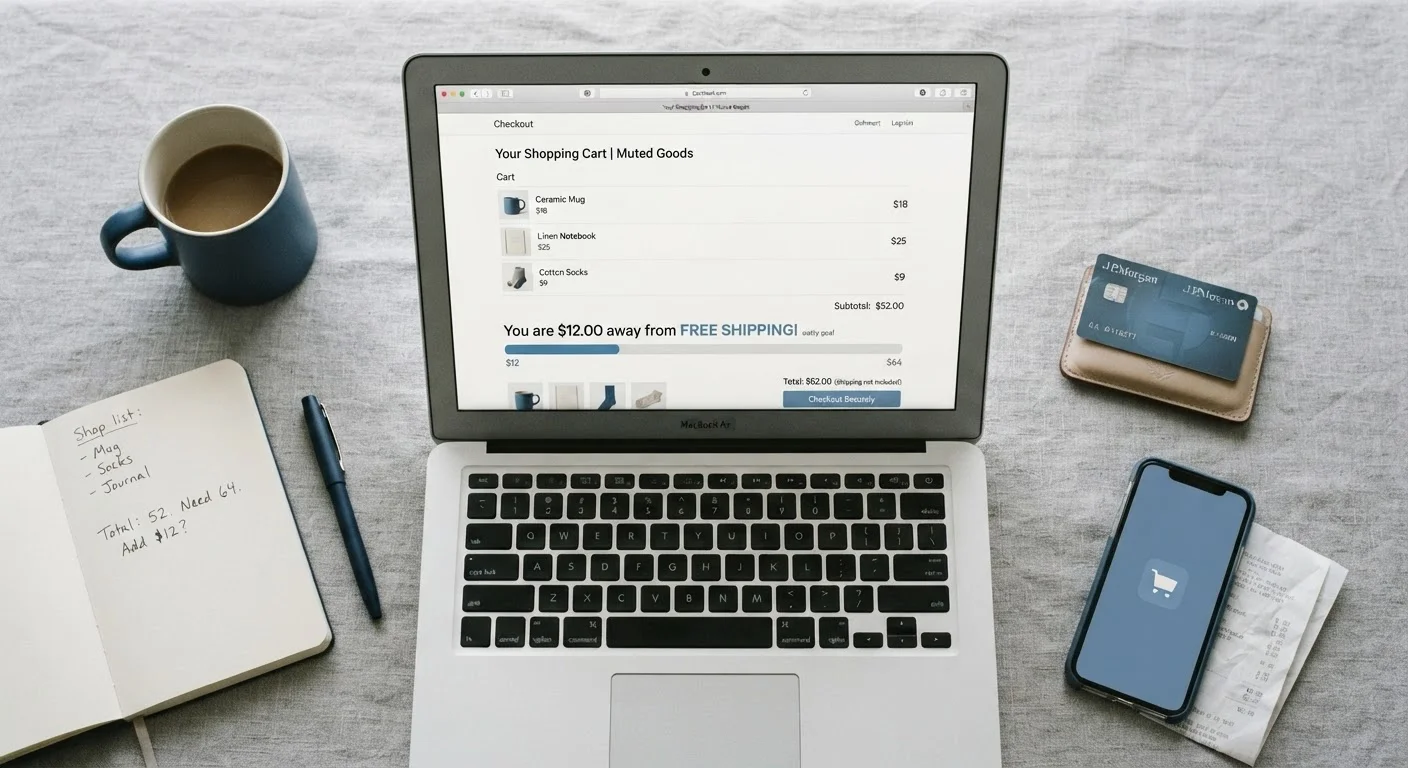
Photo credit: ArticlesHaven.net
In this article
Hitting a free shipping minimum can feel like a win, but adding items you didn't need often outweighs the shipping fee itself.
Key Takeaways
- Adding items to reach a free shipping threshold often costs more than just paying for shipping.
- Retailers deliberately set thresholds to increase average order value, not to save shoppers money.
- Calculating the actual math before adding items is the most reliable way to avoid overspending.
- Flat-rate or low-cost shipping options are frequently a better deal than threshold-chasing.
- Unnecessary purchases to qualify for free shipping can defeat the purpose of budget shopping entirely.
Why Free Shipping Thresholds Feel Like a Deal-But Often Aren't
Free shipping is one of the most effective psychological hooks in online retail. When a checkout page tells you you're only $12 away from qualifying, it frames spending more as saving - even when the math doesn't support it. The shipping fee you're avoiding might be $6.99. The item you add to clear the threshold might cost $14.99.
Retailers design these thresholds deliberately. The goal is to raise average order value, not to pass savings along to shoppers. That doesn't make the tactic deceptive - it's a standard pricing strategy - but it does mean consumers need to do the arithmetic themselves before clicking 'add to cart.' For a broader look at how checkout totals quietly inflate, see why your cart total rarely matches what you expect.
Adding an unneeded item that costs more than the shipping fee itself.
Why it happens: The checkout interface frames it as 'saving on shipping' rather than 'spending extra money,' which shifts the mental accounting.
Assuming any item added to hit the threshold is a good purchase because you 'needed it eventually.'
Why it happens: Shoppers rationalize threshold purchases by telling themselves the item has future value, even when it wasn't in their original plan.
Ignoring flat-rate or economy shipping options that may be cheaper than qualifying purchases.
Why it happens: The free shipping prompt is prominently featured; alternative shipping tiers are often buried in smaller text or dropdown menus.
Treating the free shipping threshold as proof that a retailer offers good value overall.
Why it happens: Shoppers associate 'free shipping' with consumer-friendly pricing, but thresholds are a revenue tool, not a loyalty benefit.
Splitting one order into multiple shipments to avoid the threshold, then paying multiple shipping fees.
Why it happens: Shoppers order in smaller batches thinking they're being disciplined, without realizing cumulative shipping fees can exceed a single threshold purchase.
How to Actually Run the Numbers Before You Buy
The core question is simple: does the cost of the qualifying item exceed the shipping fee? If you'd spend $15 on an item you don't need to avoid an $8 shipping charge, you've lost $7 - not saved anything. But most shoppers don't stop to frame it that way in the moment.
58%
Shoppers who add items just to qualify for free shipping
A survey by the National Retail Federation found that a majority of online shoppers have added items to their cart specifically to reach a free shipping minimum.
$8-$12
Typical free shipping threshold gap at checkout
Retail analytics research has consistently found that the average checkout nudge prompts shoppers to add between $8 and $12 in additional merchandise.
One practical approach: treat the shipping fee as part of the item's price. If a $30 item plus $7 shipping equals $37, and you genuinely want that item, pay the shipping. Adding a $12 filler product to avoid the fee brings your total to $42 - a worse outcome. The trap of 'just add one more for free shipping' is well-documented and easy to fall into under time pressure.
Urgency Cues Make This Worse
Countdown timers, 'limited stock' labels, and flash sale banners often appear alongside free shipping prompts - compounding the pressure to add items quickly. These tactics compress the time you have to evaluate whether the math actually works in your favor. Slowing down and doing the calculation, even briefly, usually reveals the better choice.
Also worth checking: flat-rate or expedited shipping costs on the same order. Some retailers offer a $4.99 standard shipping option that's far cheaper than adding $12 of unneeded merchandise. This calculation takes under a minute and can meaningfully protect your budget. These kinds of hidden costs quietly undoing a good deal are easy to overlook at checkout.
Smarter Alternatives to Threshold-Chasing
If free shipping genuinely matters to your budget, there are more reliable ways to access it than adding items you don't need. Some retailers offer free shipping on all orders above a threshold you'd realistically hit anyway. Others provide free shipping as part of a membership or loyalty program worth evaluating on its own merits.
Holding your order until you have a legitimate reason to spend more is another underrated option. Building a wishlist - items you actually want - and waiting until your natural cart hits the threshold means you're not manufacturing a purchase to chase a perk. This ties into the broader framework of shopping smarter: deferring purchases until conditions genuinely favor you.
Membership Shipping Plans Deserve Separate Scrutiny
Annual shipping memberships can offer genuine value if your order frequency is high enough to offset the fee - but they can also lock you into a retailer ecosystem that isn't always competitively priced. Calculate your expected annual shipping costs before committing to any paid membership. If you'd spend less just paying per-order shipping, the membership isn't saving you money.
It's also worth questioning whether a free shipping threshold is a sign of good retailer value in the first place. Several common shopping myths cost consumers real money, and 'free shipping equals a better deal' is one of them. A retailer with no threshold and a modest flat shipping rate may offer a lower total cost than one whose free shipping perks require buying more than you intended. Evaluate the full checkout total - not just the shipping line - before deciding where to shop. For more on how 'free' features can obscure real costs, see what 'free shipping' actually costs you.

Author
Articles Haven Editorial Contributor
Articles Haven Editorial Team is the collective byline for our editorial team and contributor network. Articles published under this byline or an editorial pen name are researched, written, and reviewed according to our editorial standards for clarity, consistency, and independence before publication.
View all articles →