
Nationwide 5G vs. mmWave 5G: Understanding the Two Very Different Signals
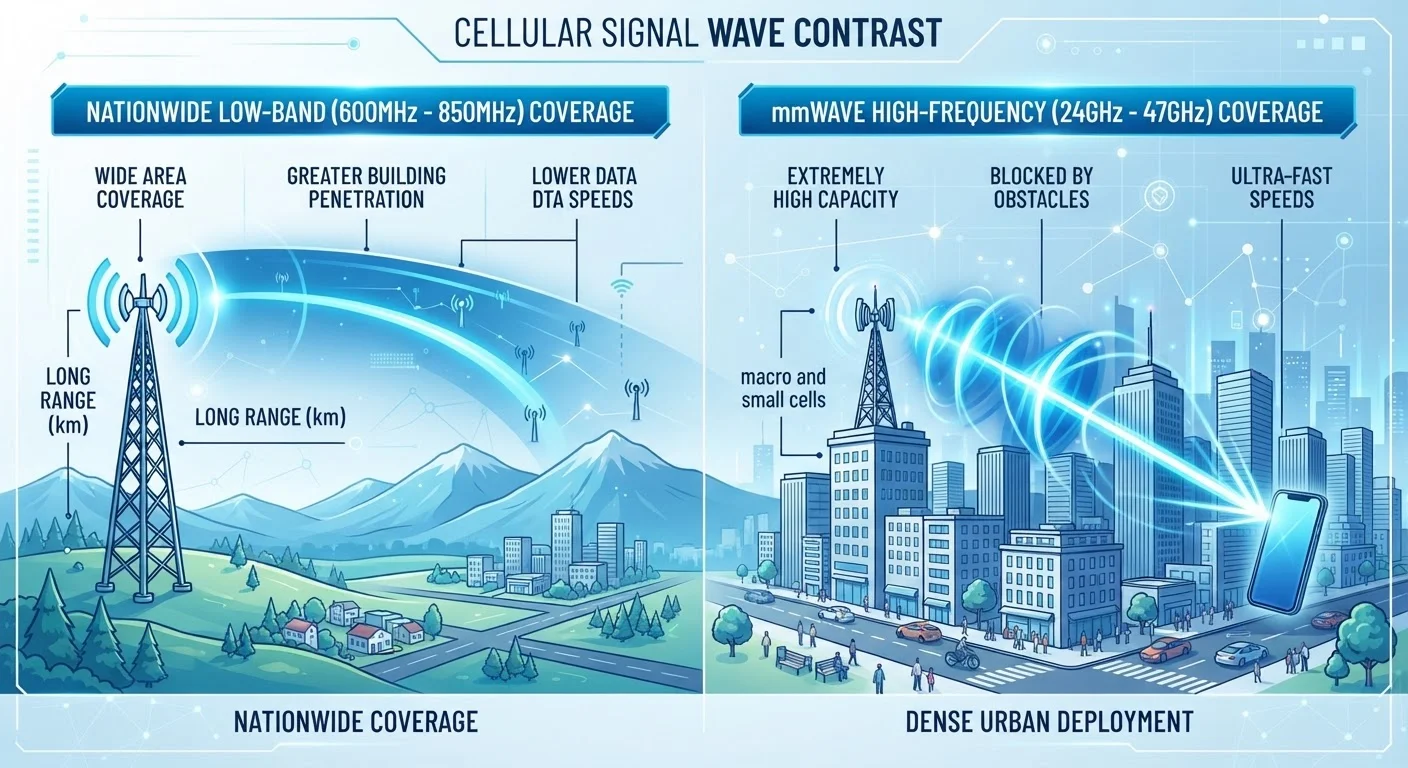
Photo credit: ArticlesHaven.net
In this article
Not all 5G is the same. Sub-6GHz nationwide 5G and mmWave 5G differ dramatically in range, speed, and availability.
Key Takeaways
- Nationwide 5G uses sub-6 GHz frequencies that travel farther but deliver more modest speed improvements over 4G LTE.
- mmWave 5G uses extremely high frequencies that offer blazing speeds but struggle to penetrate walls or travel more than a few hundred feet.
- Most 5G phones connect to sub-6 GHz the vast majority of the time, not mmWave.
- mmWave availability is largely limited to dense urban downtowns, major airports, and select venues.
- Your phone must explicitly support mmWave hardware - not all 5G-capable phones do.
What Makes These Two Signals So Different
The term "5G" appears on phone screens, carrier advertisements, and coverage maps - but it can describe two fundamentally different technologies operating at opposite ends of the radio spectrum. Understanding why they behave differently starts with the physics of radio waves.
Nationwide 5G operates on sub-6 GHz frequencies, meaning radio waves below 6 gigahertz. These lower frequencies travel long distances and pass through buildings reasonably well - characteristics that made 4G LTE workable across the country. Carriers have refarmed or expanded these bands to carry 5G signals, which is why nationwide 5G coverage maps can look impressive relatively quickly after a network upgrade. The trade-off is that the available spectrum in these bands is limited, which puts a ceiling on peak speeds.
mmWave 5G (millimeter wave) operates at frequencies ranging roughly from 24 GHz to 100 GHz. These extremely short wavelengths carry enormous amounts of data, enabling theoretical peak speeds often exceeding 1-4 Gbps in controlled conditions. The catch: mmWave signals fade rapidly with distance, struggle to pass through windows or walls, and can even be disrupted by foliage or rain. A signal that works perfectly on one side of a building may be completely absent ten feet away.
For background on how the broader generation labels map to real-world performance, see what network generation labels actually mean.
| Criterion | Nationwide 5G (Sub-6 GHz) | mmWave 5G |
|---|---|---|
| Frequency range | Below 6 GHz | ~24-100 GHz |
| Typical real-world speeds | 100-300 Mbps | Up to 1-4 Gbps (ideal conditions) |
| Signal range | Miles from a tower | Hundreds of feet |
| Building penetration | Moderate | Very poor |
| Coverage geography | Urban, suburban, rural | Dense urban nodes and select venues |
| Device support required | Most 5G phones | Specific mmWave-capable hardware only |
| Latency | Low (improvement over LTE) | Ultra-low in supported zones |
| Practical daily relevance | High for most users | Low for most users |
Real-World Coverage and Speed: What to Actually Expect
Marketing claims about 5G speeds often reflect mmWave conditions that most users will rarely - if ever - encounter. In practice, the experience depends heavily on which flavor of 5G your phone is connected to at any given moment.
With sub-6 GHz 5G, real-world download speeds commonly land between 100-300 Mbps, a noticeable but not dramatic step up from a strong 4G LTE connection. The value proposition here is consistency and reach, not raw throughput.
With mmWave, speeds in genuinely supported locations can reach 1 Gbps or more - fast enough to download a high-definition film in seconds. But that experience is tethered to a very small geographic bubble, often just the immediate outdoor area surrounding a mmWave antenna node. Step inside a coffee shop or walk around a corner and the signal may vanish entirely.
~300 ft
Typical outdoor mmWave effective range
Industry technical analyses consistently show mmWave signals degrading sharply beyond a few hundred feet under real-world conditions.
Sub-6 GHz
Spectrum most US 5G connections use
Network analytics firms have found that the large majority of 5G connections in the US occur on sub-6 GHz bands, not mmWave.
24-100 GHz
mmWave frequency band range
The FCC defines millimeter wave spectrum broadly across this range; carriers have primarily deployed commercial 5G mmWave in the 24-39 GHz portion.
Carriers deploy mmWave strategically in high-foot-traffic locations: dense downtown blocks, major transit hubs, sports stadiums, and convention centers. Outside those pockets, your phone reverts to sub-6 GHz 5G or even 4G LTE. Coverage maps can obscure this distinction - something worth understanding before switching plans. Our explainer on how wireless coverage maps work and where they fall short goes deeper on reading these tools critically.
Device Compatibility and What Your Phone Actually Supports
Not every 5G phone supports mmWave. This is a hardware distinction baked into the phone's modem and antenna design - software updates cannot add mmWave capability to a device that wasn't built with it. Budget and mid-range 5G phones frequently support only sub-6 GHz bands. Some flagship models include mmWave hardware but only when sold through specific carriers in specific markets.
Before assuming your device can access mmWave, check the phone's published specifications for explicit mmWave band support (look for bands like n258, n260, or n261 in the spec sheet). Carrier websites sometimes indicate which devices are mmWave-capable in their device compatibility listings.
Check the Spec Sheet, Not Just the Box
A phone marketed as "5G-capable" may only support sub-6 GHz bands. mmWave support requires specific antenna arrays and modem configurations listed in the device's full technical specifications. If mmWave connectivity matters to you, look for explicit band listings (n258, n260, n261) in the manufacturer's published specs before purchasing. Even among mmWave-capable devices, availability may depend on the carrier version of the phone.
This hardware gap is why the flashiest 5G speed claims in carrier advertising may not apply to your current device, your location, or your plan tier. Common wireless plan myths often center on exactly this kind of ambiguity - speeds advertised in ideal conditions rarely reflect everyday use.
Which Type of 5G Actually Matters for Most Consumers
For the overwhelming majority of US consumers, sub-6 GHz nationwide 5G is the 5G signal they live with day to day. It's what keeps a phone connected during a commute, in a suburban neighborhood, or in a mid-size city. Carrier competition on nationwide 5G footprint and mid-band spectrum (a sub-category of sub-6 GHz around 2.5-3.7 GHz offering a better speed-coverage balance) is arguably the more meaningful differentiator when choosing a plan.
mmWave matters in specific professional or event-based contexts: a journalist filing large video files from a convention center, a developer stress-testing a dense-network use case, or an event-goer streaming from a packed stadium. For everyday consumers, the near-absence of mmWave outside a handful of urban blocks makes it a marginal factor in plan selection.
If you're comparing carrier plans with home internet in mind, it's also worth understanding where fixed wireless and other broadband types fit - see our comparison of satellite internet vs. fixed wireless for a parallel set of trade-offs, and browse the Internet Plans hub for broader context.

Author
Articles Haven Editorial Contributor
Articles Haven Editorial Team is the collective byline for our editorial team and contributor network. Articles published under this byline or an editorial pen name are researched, written, and reviewed according to our editorial standards for clarity, consistency, and independence before publication.
View all articles →