
Urgent Care, Emergency Room, or Primary Care: Choosing the Right Setting
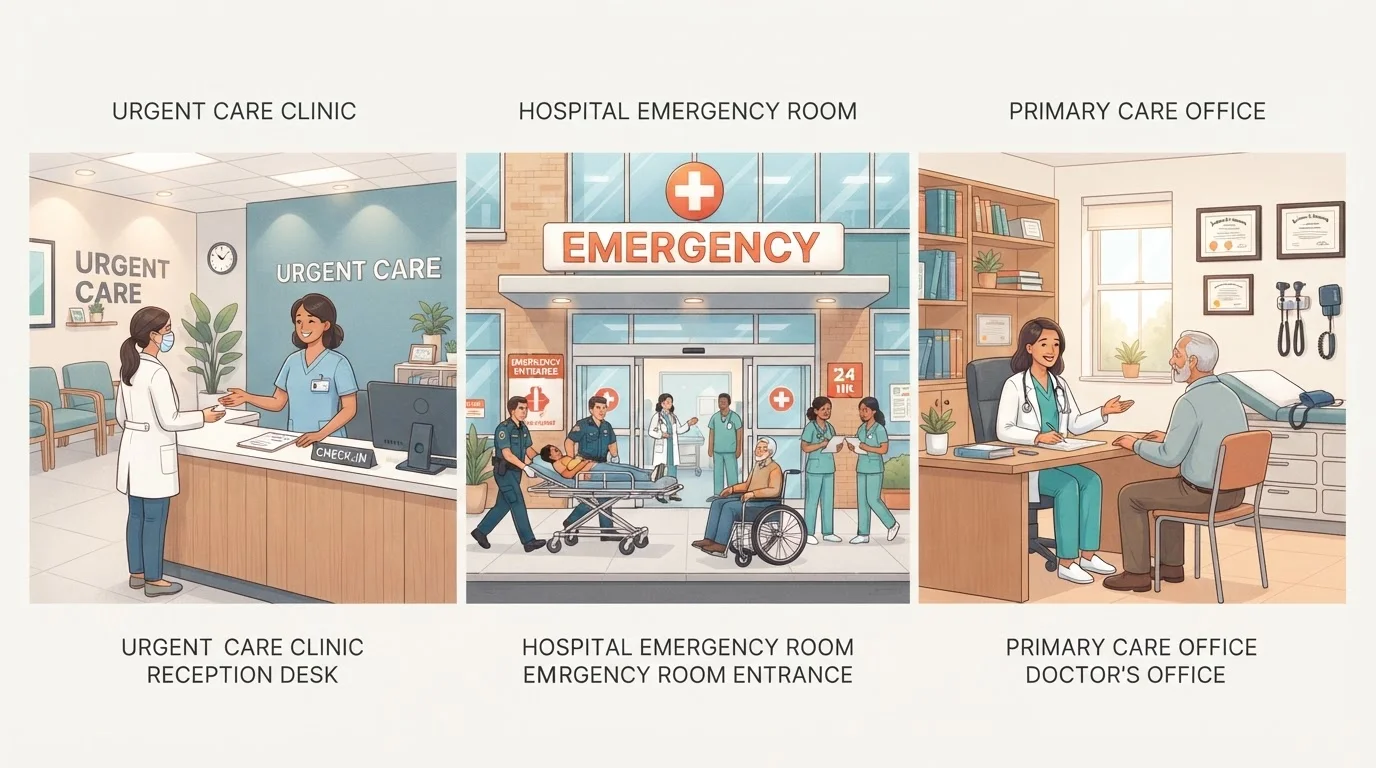
Photo credit: ArticlesHaven.net
In this article
Where you seek care affects both your health outcome and your bill. Learn which setting fits which type of medical situation.
Key Takeaways
- Emergency rooms are for life-threatening or severe conditions - not for convenience or speed.
- Urgent care handles non-emergency issues that can't wait for a scheduled appointment.
- Primary care is best for ongoing health management, chronic conditions, and preventive visits.
- The care setting you choose directly affects your out-of-pocket costs and insurance coverage.
- When in doubt about severity, call your doctor or a nurse line before deciding where to go.
Why the Setting Matters as Much as the Care
When something goes wrong with your health, the instinct is often just to get to a doctor - fast. But where you go matters a great deal, both clinically and financially. Emergency rooms, urgent care centers, and primary care offices are designed for very different situations, and using the wrong one can mean longer waits, higher bills, or delayed care for a condition that needed faster attention.
Your insurance plan may also apply different cost-sharing rules depending on the setting. Copays and coinsurance at an ER are typically much higher than at an urgent care clinic or primary care office. Understanding the differences helps you make a faster, smarter decision in the moment - and can prevent an unpleasant surprise when the bill arrives. For a broader picture of how costs work across insurance settings, see the Coverage & Costs overview.
Emergency Room: When to Go
Emergency departments exist to handle conditions that are potentially life-threatening, rapidly worsening, or require diagnostic equipment and specialists not available elsewhere. They operate 24/7 and are legally required to evaluate and stabilize patients regardless of ability to pay.
Go to the ER for symptoms such as: chest pain or pressure, difficulty breathing, signs of stroke (facial drooping, arm weakness, speech difficulty), severe allergic reaction, heavy uncontrolled bleeding, loss of consciousness, major trauma, or anything that feels like it could be life-threatening.
The trade-off: ERs are expensive, and they prioritize by severity, not arrival time. A non-emergency visit to an ER can mean a multi-hour wait and a bill that's significantly higher than other settings - even with insurance.
Don't Downplay Serious Symptoms
It's common to hesitate before going to the ER due to cost concerns or uncertainty. However, certain symptoms - chest pain, stroke signs, difficulty breathing, or severe allergic reactions - warrant immediate emergency care without delay. Cost is a real consideration, but it should never be the reason to avoid emergency care when it's genuinely needed. Your insurance plan's cost-sharing rules for emergency visits are worth reviewing in advance so you're not caught off guard.
Urgent Care: The Middle Ground
Urgent care centers fill the gap between your primary care office and the ER. They typically handle conditions that need same-day attention but aren't emergencies. Most are walk-in, with extended hours including evenings and weekends - a practical option when your primary care provider isn't available.
Conditions well-suited to urgent care include: minor cuts that may need stitches, sprains and minor fractures, fevers without serious symptoms, urinary tract infections, ear and sinus infections, mild asthma flare-ups, and diagnostic needs like strep tests or X-rays for a suspected minor break.
Urgent care is generally less expensive than an ER, and most major insurance plans cover it, though cost-sharing varies. It's also worth knowing that urgent care cannot handle everything - if you arrive with a serious condition, staff will direct you to an ER.
~40%
ER visits considered non-urgent
Studies published in health policy journals have consistently found that a substantial share of emergency department visits involve conditions treatable in lower-acuity settings.
3-5x
ER cost vs. urgent care for similar visits
Health cost research generally finds emergency department facility fees are substantially higher than urgent care fees for comparable non-emergency conditions.
If you're ever unsure whether telehealth might work instead of an in-person urgent care visit, the telehealth vs. in-person care comparison breaks down which scenarios fit each option.
Primary Care: Your Long-Term Health Home
Primary care providers (PCPs) - including family medicine physicians, internists, and nurse practitioners - are the foundation of ongoing health management. They're best positioned to handle routine issues, manage chronic conditions, coordinate referrals, and track your health over time.
Primary care is the right call for annual wellness visits, managing conditions like diabetes or high blood pressure, prescription refills, mental health referrals, and most non-urgent symptoms that can wait a few days for an appointment. Many practices now offer same-day or next-day slots for acute needs, which can be faster and cheaper than urgent care for established patients.
If you don't yet have a primary care provider, it's worth establishing one before you need urgent attention. See questions to ask before joining a new practice for a useful starting framework. For those curious about alternative models, concierge medicine and direct primary care offer different access structures worth understanding.
Not Sure Where to Go? Call First
Many insurance plans include a 24/7 nurse advice line - check the back of your insurance card. A brief call can help you determine whether your situation warrants the ER, can wait for urgent care, or is safe to address with your primary care provider the next day. This step alone can save you time, money, and unnecessary stress.
| Urgent Care | Emergency Room | Primary Care | |
|---|---|---|---|
| Best for | Acute, non-life-threatening issues | Life-threatening or severe conditions | Ongoing and preventive health needs |
| Availability | Walk-in, extended hours | 24/7, always open | By appointment, some same-day |
| Typical wait time | 15 min - 1 hour | 1 - 6+ hours (by severity) | Varies; often shorter for established patients |
| Relative cost | Moderate | High | Lower for insured patients |
| Diagnostic capability | Basic X-ray, labs, rapid tests | Full imaging, labs, specialists | Basic labs; referrals for advanced tests |
| Continuity of care | Low - one-time visit | Low - hand-off to other providers | High - ongoing relationship |
This article is for general informational purposes only and is not a substitute for professional medical advice. If you are experiencing a medical emergency, call 911 immediately. Consult a qualified healthcare professional for guidance specific to your situation.

Author
Articles Haven Editorial Contributor
Articles Haven Editorial Team is the collective byline for our editorial team and contributor network. Articles published under this byline or an editorial pen name are researched, written, and reviewed according to our editorial standards for clarity, consistency, and independence before publication.
View all articles →