
Medicaid vs. Medicare: Who Each Program Serves and How They Work
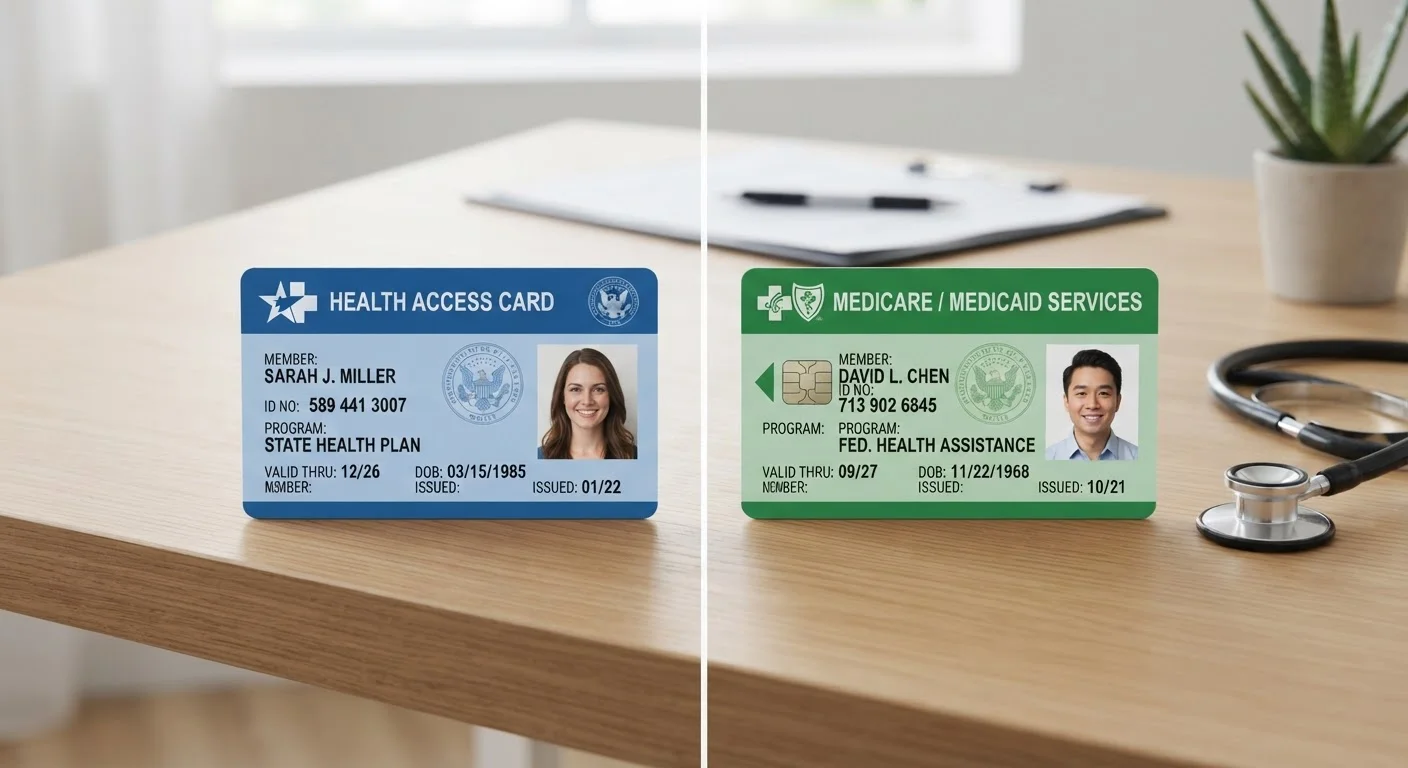
Photo credit: ArticlesHaven.net
In this article
Medicaid and Medicare are often confused but serve very different populations. This side-by-side breakdown clarifies eligibility and coverage.
Key Takeaways
- Medicare is primarily age-based; Medicaid is primarily income-based.
- Medicare is federally administered; Medicaid is a federal-state partnership with rules that vary by state.
- Both programs can cover the same person simultaneously - this is called dual eligibility.
- Medicare has premiums and cost-sharing; Medicaid typically has minimal or no cost-sharing for enrollees.
- Neither program covers everything - gaps exist in both, particularly for long-term and dental care.
The Core Distinction: Age and Disability vs. Income
Medicare and Medicaid share a name prefix and are both government health programs, but their eligibility logic is fundamentally different. Understanding that difference is the fastest way to figure out which one - if either - applies to your situation.
Medicare is a federal program primarily for people aged 65 and older, regardless of income. It also covers certain younger individuals who have received Social Security Disability Insurance (SSDI) for at least 24 months, or who have been diagnosed with End-Stage Renal Disease (ESRD) or ALS. Income does not determine basic Medicare eligibility.
Medicaid, by contrast, is an income-based program jointly funded by the federal government and individual states. Eligibility depends largely on household income relative to the federal poverty level (FPL), though other factors like family status, age, pregnancy, and disability can also matter. Because states administer Medicaid under broad federal guidelines, the rules - including income thresholds and covered services - vary meaningfully from state to state. See how Medicaid eligibility works and why it varies by state for a deeper breakdown of those differences.
| Criterion | Medicare | Medicaid |
|---|---|---|
| Primary eligibility basis | Age (65+) or qualifying disability | Income and household status |
| Who administers it | Federal government only | Federal-state partnership |
| Income requirement | None for basic eligibility | Must fall within state income limits |
| Premiums | Part B and D carry monthly premiums | Generally none or very low |
| Cost-sharing | Deductibles and coinsurance apply | Minimal or none for most enrollees |
| Dental and vision coverage | Generally not covered | Often included as optional benefit |
| Long-term care coverage | Very limited | Can cover nursing home and home care |
| Rules vary by state | No - nationally uniform | Yes - significantly |
How Each Program Is Structured
Medicare is divided into lettered parts, each covering different services. Part A covers inpatient hospital stays and some skilled nursing facility care. Part B covers outpatient services, physician visits, and preventive care. Part C (Medicare Advantage) bundles Parts A and B through private insurers. Part D covers prescription drugs. Most people pay no premium for Part A if they have sufficient work history, but Parts B and D involve monthly premiums. For a plain-English walkthrough of these parts, see Understanding Medicare Parts A, B, C, and D.
Medicaid does not use a lettered structure. Instead, it functions as a single program within each state, though states may offer optional benefits beyond the federally required minimums. Required benefits include physician services, hospital care, lab tests, and nursing facility services. Optional benefits - which most states include - can cover dental, vision, and prescription drugs. Cost-sharing in Medicaid is typically minimal or absent for most enrollees.
~65M
People enrolled in Medicare
According to CMS data, Medicare covered approximately 65 million beneficiaries in recent reporting years.
~90M
People enrolled in Medicaid and CHIP
CMS enrollment data shows combined Medicaid and CHIP enrollment has exceeded 90 million in recent years, reflecting expansion and pandemic-era continuous enrollment policies.
~12M
Dual-eligible beneficiaries
The Medicare-Medicaid Coordination Office estimates roughly 12 million individuals qualify for both programs simultaneously.
Both programs have notable coverage gaps. Medicare does not generally cover long-term custodial care, routine dental, or vision. Medicaid can fill some of those gaps for dual-eligible individuals - those who qualify for both programs simultaneously.
Dual Eligibility and How the Programs Interact
Roughly 12 million Americans qualify for both Medicare and Medicaid - a status called dual eligibility. This typically applies to low-income seniors or individuals with disabilities who meet Medicare's age or disability criteria and also fall within their state's Medicaid income limits.
When someone is dual eligible, Medicare generally pays first (as the primary payer), and Medicaid may cover remaining costs - such as deductibles, copayments, and services Medicare doesn't include. This coordination can substantially reduce out-of-pocket exposure for people who would otherwise struggle with Medicare's cost-sharing requirements.
Dual Eligibility Enrollment Is Not Automatic
Qualifying for both programs does not mean you are automatically enrolled in both. You typically need to apply for Medicaid through your state agency separately from Medicare enrollment. Low-Income Subsidy (LIS/Extra Help) programs for Part D drug costs may also require a separate application. Check with your State Health Insurance Assistance Program (SHIP) counselor for guidance at no cost.
If you are trying to understand your broader coverage options, the Health Insurance Explained article provides useful context on how insurance structures generally work before diving into program-specific details.
Common Misconceptions Worth Clearing Up
One of the most frequent misunderstandings is that Medicare is free. Basic Part A may carry no premium for those with a qualifying work history, but Part B premiums, deductibles, and coinsurance all apply. High-income enrollees pay higher Part B and D premiums through a surcharge structure called IRMAA (Income-Related Monthly Adjustment Amount).
Another common confusion: assuming Medicaid is only for children or the unemployed. While children and families have historically been the program's largest group, the Affordable Care Act's Medicaid expansion extended eligibility to most adults under 65 earning up to 138% of the FPL - in states that chose to expand. As of the time of writing, a majority of states have adopted expansion, but not all. Eligibility rules in non-expansion states remain considerably more restrictive for adults without children.
It's also worth noting that neither program replaces the other in function. They address overlapping but distinct needs. For those navigating limited income alongside age or disability, understanding both is essential. You may also want to explore what community health centers offer as a supplemental resource, particularly if coverage gaps leave certain services unaffordable.
This article is for general informational purposes only and does not constitute medical, legal, or financial advice. Eligibility rules and program details can change. Consult a licensed benefits counselor, your state Medicaid agency, or the official Medicare program resources for guidance specific to your circumstances.

Author
Articles Haven Editorial Contributor
Articles Haven Editorial Team is the collective byline for our editorial team and contributor network. Articles published under this byline or an editorial pen name are researched, written, and reviewed according to our editorial standards for clarity, consistency, and independence before publication.
View all articles →